How accurate is It's AI compared to other detectors?
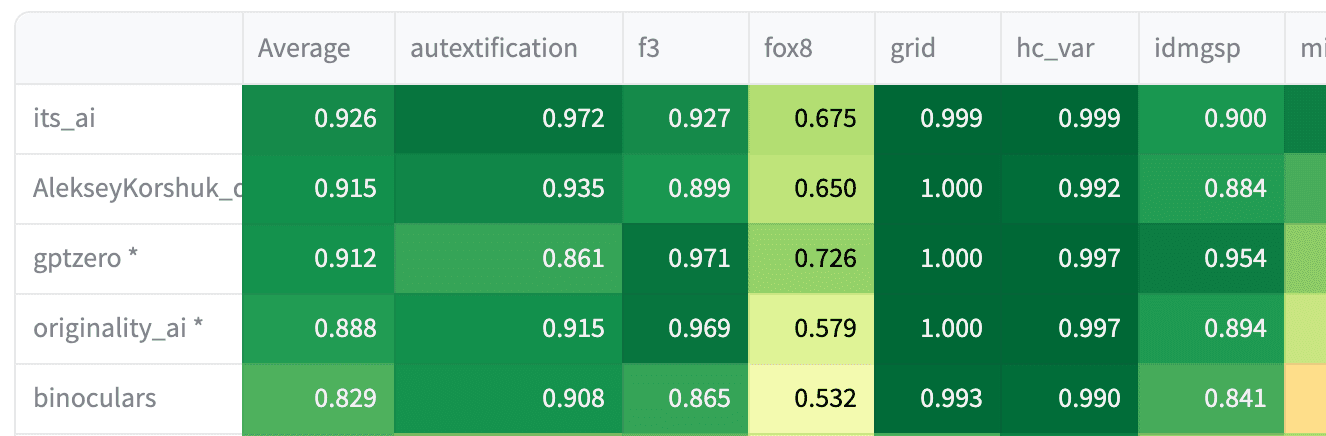
We don't rely only on internal tests. The main reference points are public benchmarks. On the RAID benchmark our model reaches 94.2% accuracy at a 5% false-positive rate on non-attacked texts and ranks first on the leaderboard. On MGTD — a combined benchmark built from 15 datasets and almost two million samples — It's AI took first place with more than 95.8% accuracy at 5% FPR. The ROC-AUC chart published on our site shows a score of 0.92 for It's AI, higher than GPTZero, Originality and ZeroGPT. These results are the basis for calling It's AI one of the most accurate AI text detectors available today.
Are AI detectors accurate in general?
There is no single number that describes every detector. Accuracy depends on the model, the type of text and how the benchmark is built. Many tools handle simple, "clean" AI outputs well but lose performance on paraphrased, edited or very domain-specific writing. Benchmarks such as RAID are designed to measure this robustness: they mix multiple language models, topics and attack strategies to see how detectors behave outside of ideal conditions. It's AI performs strongly under those constraints, but like any statistical model it can still make mistakes, especially on very short or heavily edited texts.
Is It's AI reliable enough for education and business use?
Reliability is mostly about how often human writing is wrongly flagged as AI. In our public materials we highlight two numbers: • on the ASAP 2.0 dataset of student essays the false-positive rate is 0.8%; • on the GRiD, HC3 and GhostBuster benchmarks the average false-positive rate stays below 1%. In these tests fewer than one out of a hundred human texts is misclassified as AI-generated. This is why we consider the detector suitable for sensitive contexts such as grading, hiring, academic integrity checks or content quality review — as long as it is used as a decision-support tool, not as the only judge.
How do GPTZero and ZeroGPT compare to It's AI?
A fair comparison is to look at the same benchmark under the same conditions. In our RAID evaluation, all detectors are compared at a fixed 5% false-positive rate. At that setting It's AI achieves the highest accuracy on non-attacked texts and the best average score across all scenarios. Competing tools such as GPTZero and ZeroGPT reach noticeably lower accuracy at the same error level on human texts. The exact numbers and tables are available in our public benchmarks report so that anyone can verify the comparison.
Which benchmarks do you use to evaluate the detector?
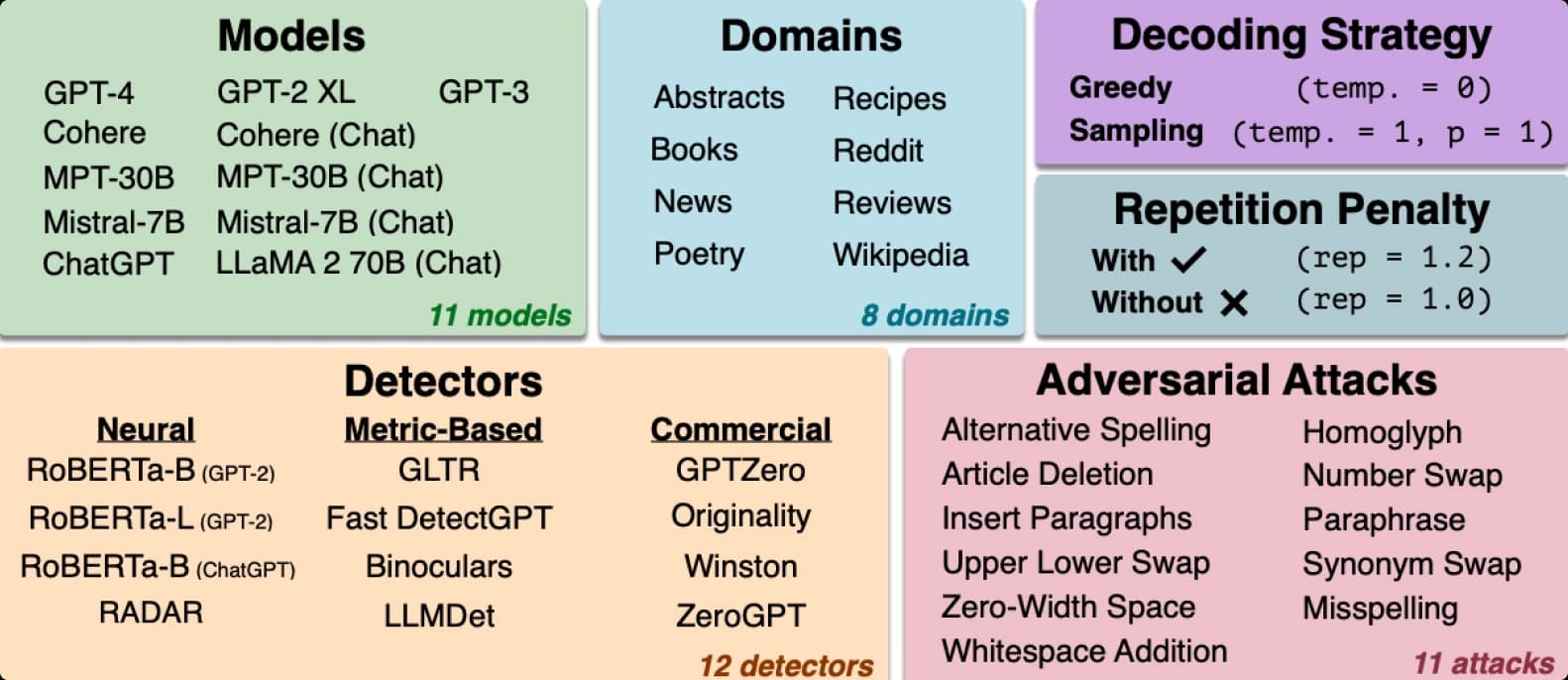
We report results on several independent benchmarks: • RAID – a large benchmark with millions of generations from 11 language models, 8 domains and multiple adversarial attacks. • MGTD – an aggregated evaluation built from 15 datasets and almost two million samples, where we lead the ROC-AUC scoreboard. • GRiD – a Reddit-based dataset with pairs of human and ChatGPT answers to the same prompts. • HC3 – a corpus of almost 40,000 question–answer pairs from domains like medicine, law and finance, again with human and ChatGPT responses. • GhostBuster – several datasets of creative writing, news and student essays generated by GPT-3.5-turbo and paired with human originals. • CUDRT – a bilingual benchmark that tests detectors on operations such as creating, expanding, rewriting, polishing, summarising and translating text. Taken together, these benchmarks cover both straightforward AI generations and more subtle editing scenarios.
What do accuracy, F1-score and ROC-AUC actually measure?
We use standard classification metrics so that our results are comparable with other work: • Accuracy tells you what share of all texts the detector classifies correctly. • F1-score balances precision (how many flagged texts are truly AI-generated) and recall (how many AI-generated texts are found). It is useful when the number of AI and human texts is unbalanced. • ROC-AUC measures how well the model separates human and AI texts across all possible decision thresholds; values closer to 1 indicate better separation. For example, on the GRiD benchmark our detector reaches an F1-score of about 0.975 and a ROC-AUC close to 0.998, and on MGTD the ROC-AUC is 0.92. These are the numbers you see referenced on the Accuracy page.
What are false positives and false negatives in AI detection?
• A false positive happens when human text is incorrectly marked as AI-generated. • A false negative happens when AI-generated text is classified as human. On RAID we compare detectors at a fixed 5% false-positive rate, so each model is allowed the same maximum share of human texts that can be mislabelled as AI. For education-focused scenarios we tune the model more conservatively and report 0.8% FPR on ASAP 2.0 and an average FPR below 1% on GRiD, HC3 and GhostBuster. In the product you can also adjust the decision threshold yourself: lowering it catches more AI texts but increases false positives, raising it does the opposite. This lets you balance sensitivity and strictness for your own use case.
Do benchmark scores translate to real-world texts?
Benchmarks are simplified snapshots of reality. They are extremely useful for comparing detectors on the same datasets, under clearly defined attacks and across different domains. They show how models behave when conditions are controlled and make it possible to track progress over time. Real-world texts, however, can be messier: mixed human-plus-AI content, non-English languages, formatting artefacts, very short snippets, niche jargon. In practice we see a strong correlation between benchmark performance and real-world robustness, but we still recommend treating the detector's output as one important signal rather than a final verdict, especially in high-stakes situations.
How often do you update and re-evaluate the model?
We release new versions only after running the same set of benchmarks again. In our report you can see several iterations of the model (for example, versions from September and December 2024) with separate rows in the RAID, GRiD and CUDRT tables. If a new version does not at least match the previous one on these benchmarks at comparable false-positive rates, we do not ship it. This way, the web app and API always use a model whose performance is documented and easy to audit.
Why do you describe It's AI as state-of-the-art?
We use the term "state-of-the-art" only in connection with benchmark results. It's AI reaches or exceeds the best published scores on the benchmarks where we participate: • it leads the RAID leaderboard with 94.2% accuracy at 5% FPR on non-attacked texts; • it tops the MGTD ROC-AUC scoreboard with a score of 0.92; • on GRiD and CUDRT it outperforms the detector baselines originally proposed for those datasets. That is what we mean when we say that It's AI is a state-of-the-art AI text detector — the claim is tied directly to transparent, third-party benchmarks rather than to opaque internal tests.