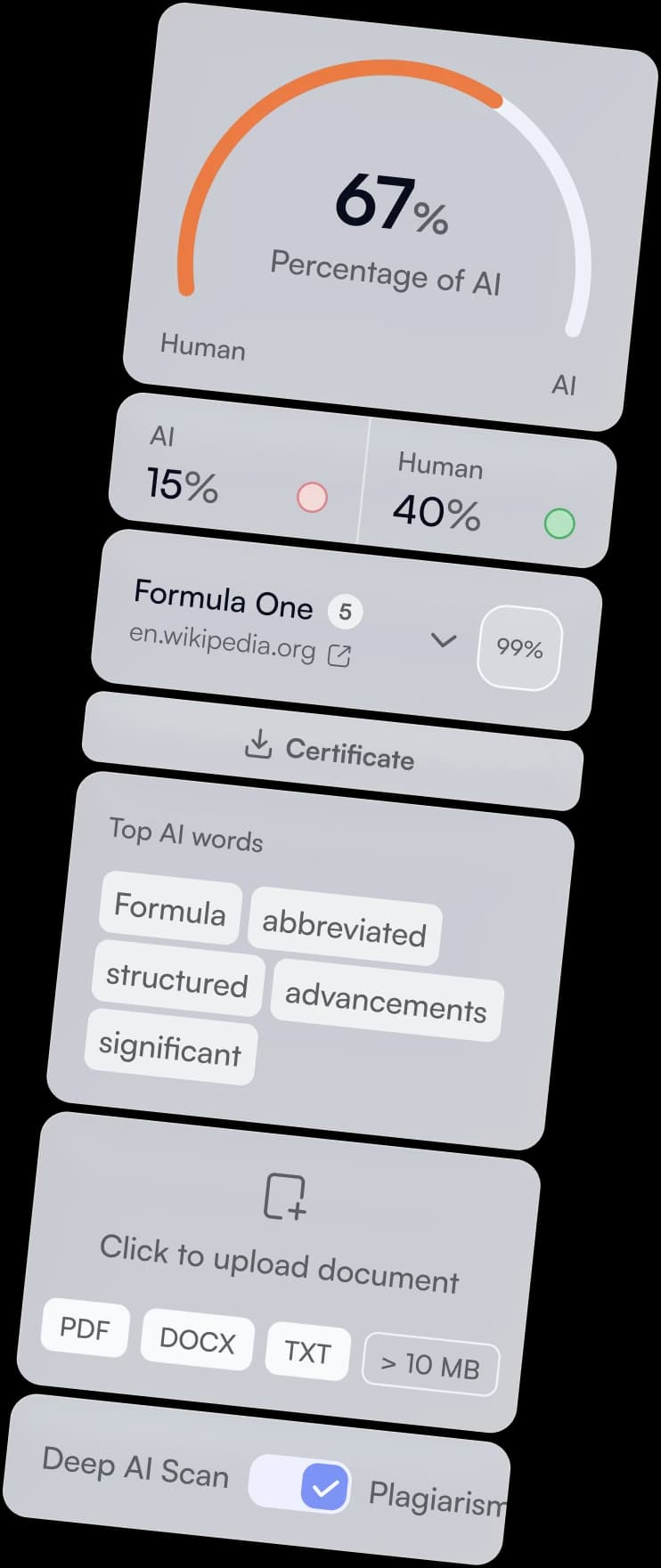
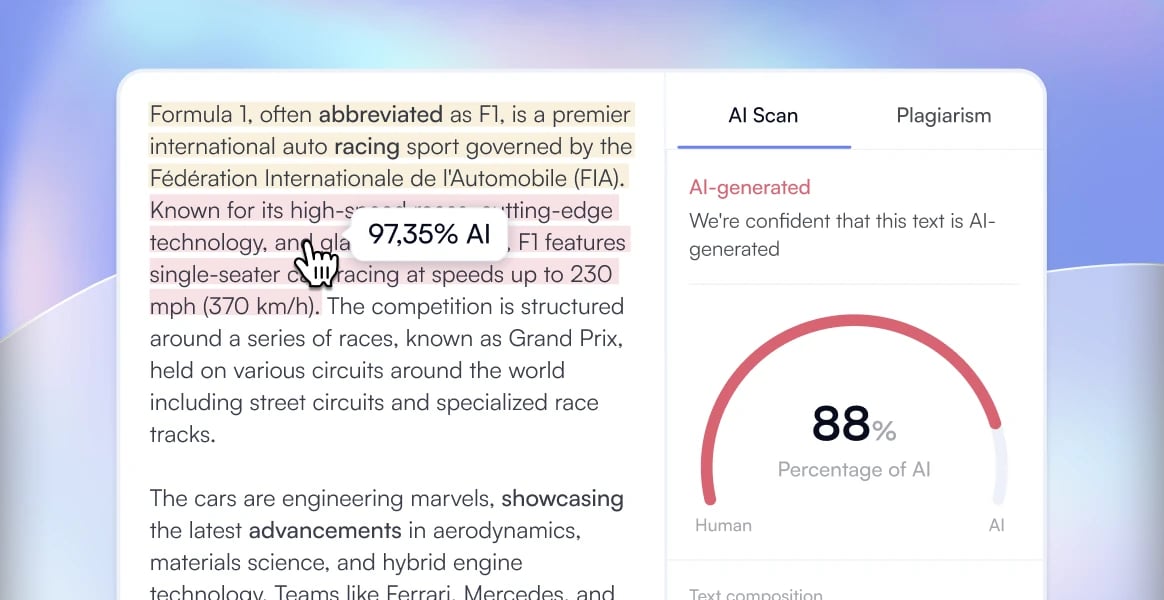
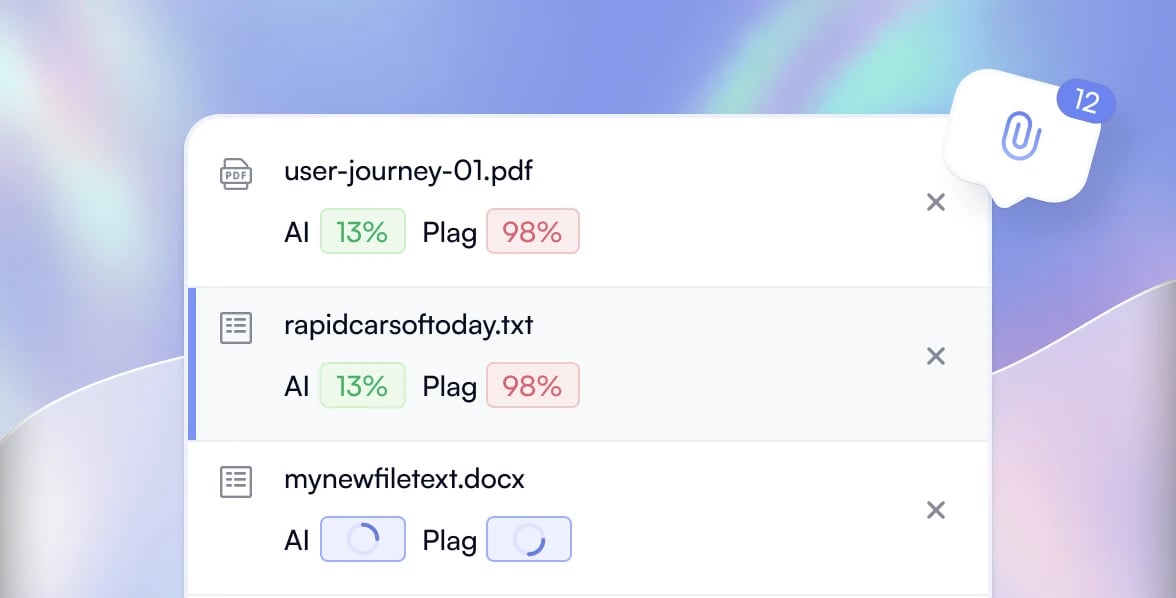

The most accurate AI detector in the world
![[object Object]](/_next/image?url=%2Fimg--target-tools-2.jpg&w=3840&q=85)
![[object Object]](/_next/image?url=%2Fimg--target-tools-1.jpg&w=3840&q=85)
![[object Object]](/_next/image?url=%2Fimg--target-tools-10.jpg&w=3840&q=85)
The most accurate AI detector in the world
An AI detector / AI detection API is a service you call from your code to estimate whether a piece of text is human-written or generated by a language model.
Instead of pasting samples into a web form, you send them programmatically (usually as JSON over HTTP) and receive probabilities, labels and sometimes token-level scores. This lets you:
The It's AI AI detector API and AI detection API expose the same models that power the web app, including deep scan mode and batch endpoints, so you can embed the detector into pipelines, labeling tools or dashboards.
Integration is similar to any other REST service:
With It's AI, you can score up to 500k characters per request and up to 2,000 texts per minute in batch mode, which is usually enough for most data pipelines. If you need higher throughput, you'd shard workloads across workers or coordinate with the team for enterprise limits.
"Best" depends on your constraints, but from a modelling perspective you want three things:
It's AI exposes the same engine that leads the MGTD ROC-AUC scoreboard (0.92 vs lower scores for GPTZero, Originality and ZeroGPT) and ranks first on the RAID benchmark at 94.2% accuracy with 5% FPR on non-attacked texts. The API is essentially a production wrapper around that model, which is why we position it as a strong candidate for an AI detector / LLM detector API in ML workflows.
Even the best AI detector APIs are not oracles. Accuracy depends on:
The engine behind the It's AI API is evaluated on RAID, MGTD, GRiD, HC3, GhostBuster and CUDRT. That mix covers simple generations, long-form writing and "edited AI" scenarios. In practice this means:
Treat the AI detector API as a high-quality filter for triage and cleaning, not as a single point of truth.
Some vendors offer on-premise or private-cloud deployments of their AI detection API, usually as a managed container / VM image that you run inside your own VPC. The trade-offs are:
If you need an on-prem or private-cloud version of the It's AI detector for regulated environments, the realistic next step is to talk directly with the team: they can confirm current options, SLAs and whether a dedicated deployment is possible for your use case.
Throughput depends on three factors:
The It's AI AI detector API is optimised for batch mode: you can send texts up to 500k characters each and process roughly 2,000 texts per minute per pipeline according to the marketing copy. For most teams that's enough to:
For very large corpora (hundreds of millions of documents) you'd typically combine batching, multiple workers and possibly dedicated capacity negotiated with the provider.
Security comes down to a few questions:
It's AI states that data sent through the API remains within the system and is not transferred to third parties. From a practical standpoint you should still:
For highly sensitive corpora you might run an internal red-team test: send synthetic confidential samples, verify logging and retention behaviour, and check that the AI detection API fits your compliance needs.
A pragmatic workflow for detecting AI in training data:
The goal isn't to reach "zero synthetic tokens" — that's unrealistic — but to prevent your core LLM from being dominated by recycled AI output.
Over-filtering can distort distributions or wipe out minority domains. A few patterns that work in practice:
An AI detector for datasets like It's AI gives you the per-document signal; how aggressively you act on it depends on your tolerance for synthetic content and on the task you're training for.
The trick is to treat filtering as a controlled experiment, not a one-shot clean-up:
Over time you'll converge on a pipeline where the AI detector for LLM datasets is just another step: raw data → basic cleaning → AI detection + scoring → sampling / weighting → final training mix.