The pressure is the same — and so is the response
The report's central frame is a two-sided squeeze the entire media industry is now caught in. On one side, AI answer engines are closing in: Google AI Overviews and ChatGPT serve the answer directly to the reader, who never has to click through. Publishers themselves project a 40% drop in search referrals over the next three years.
On the other side, the creator economy is pulling the audience away. Individual experts build followings faster than institutional brands, and almost 4 in 10 newsroom leaders (39%) worry they could lose their top editorial talent — star journalists, columnists, podcast hosts — to that ecosystem, where there's more control and potentially higher income.
If you run a corporate blog, write product articles, or work in content marketing, this frame applies to you directly. AI Overviews can surface a long-form news piece and an SEO guide with equal ease. Readers subscribe just as readily to a beat journalist as to a LinkedIn expert. Once you see the squeeze clearly, you can also see where value is leaking away and where it still holds. Reuters Institute shows that newsrooms have already found an answer, and it runs through AI content detection. That answer works well beyond news.
Where the money is going — and where you can grow
The big practical shift of 2026 is that publishers are rewriting their editorial priorities around what AI can't reproduce, and around what survives an AI fact check.
The Reuters Institute survey captures the move in net scores: original investigations gain +91 percentage points and contextual analysis +82, while general news drops −38.
Taneth Evans, Head of Digital at The Wall Street Journal, puts the logic of the pivot plainly: "The best response from journalism is to double down on what makes us valuable and unique."
By that logic, any expert-led blog has a clear opening. Client cases with real numbers, original research in your niche, expert commentary from your team on current events, first-hand product breakdowns. ChatGPT can't reproduce any of this, because it doesn't have the underlying data. Reuters Institute's numbers show which kinds of content are becoming premium. The same logic applies to your content plan: instead of broad overview topics where you compete with the AI answer head-on, the bet shifts to material with only one possible source, and that source is you.
AI verification: why it's moving from ethics to product
In Reuters Institute's companion piece "How will AI reshape the news in 2026? Forecasts by 17 experts," one of the five cross-cutting trends is the rising demand for verification. Joshua Ogawa of Nikkei describes the specific tooling shift: in the era of deepfakes, newsrooms need to build standards like C2PA, the protocol for digital provenance of visual content, directly into their workflow. Reuters Institute also lists digital provenance among the terms expected to go mainstream in 2026.
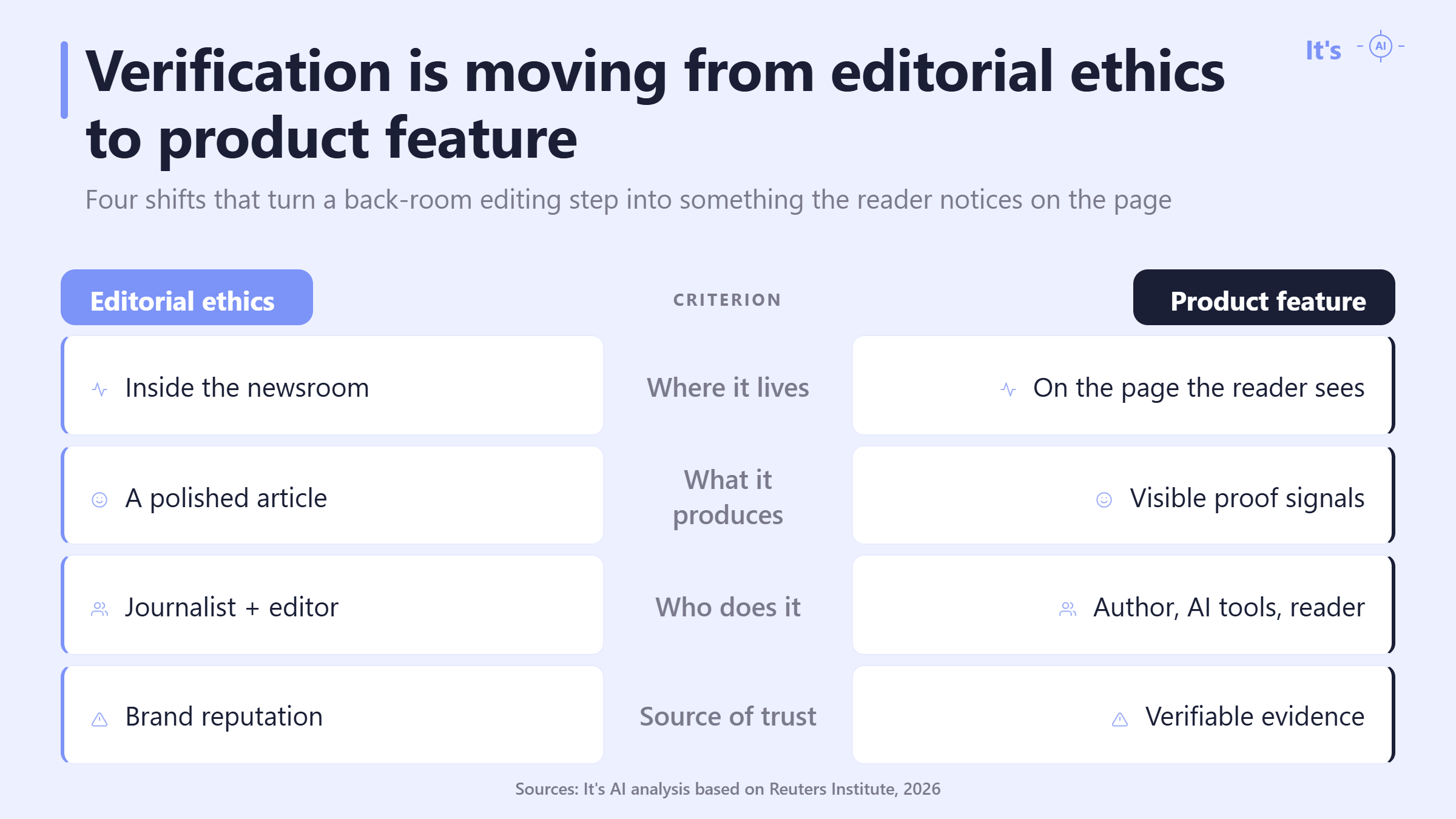
Verification used to live inside editorial workflows as part of professional ethics. The journalist verified the source, the editor verified the journalist. It wasn't a service, and it certainly wasn't a product. The AI fact checker of 2026 is both. Shuwei Fang, a Shorenstein Fellow at Harvard, calls this moment a chance for the industry to build a new product that helps audiences tell the real from the generated. That product is an AI content checker in everything but the name.
When you build content for a blog, product pages, educational materials, or email newsletters, you get the same opening. The pre-publish review stops being an invisible internal step and turns into a visible part of the value proposition the reader notices. Clear sources, verifiable numbers, a visible difference between expert text and generated text. All of it builds trust, which can translate into subscriptions and return visits.
The verification stack: AI content detector and C2PA
In practice, the stack covers three layers that map to three different tools.
| Layer |
What it verifies |
Standard / Tool |
| Images |
Origin and edit history of visual content |
C2PA |
| Sources |
Where claims and numbers come from |
Inline citations, working links |
| Text |
Whether the copy was written by AI |
AI content detector (It's AI) |
One question for the reader: is this real? Was this written by AI?
Publishers and content teams putting this in place now get exactly what Sarawagi called the deciding factor. Reader trust. And that trust can show up in the numbers: referrals, subscriptions, return visits, time on page.
For images, that layer is C2PA. For text, the It's AI detector plays a similar role. Or just: a ChatGPT detector. Not an ethics rule. A working tool.
FAQ — AI content detection
Does Google penalize AI-generated content?
Google doesn't penalize AI-generated content by default. The March 2024 spam policy targets "scaled content abuse" — mass-produced pages with no added value, regardless of whether AI or humans wrote them. The rollout reportedly cut low-quality content in search results by 45%. What Google's ranking systems actually evaluate is E-E-A-T (Experience, Expertise, Authoritativeness, Trustworthiness) — signals that come from original research and first-hand testing, not from the production method. Running an AI detector on your own content before publishing is a quality check for editorial workflow, not a Google-compliance check. The detector won't tell you if a page will rank; that depends on whether the content adds something readers can't get from a chatbot.
What AI detection score is considered safe for publishing?
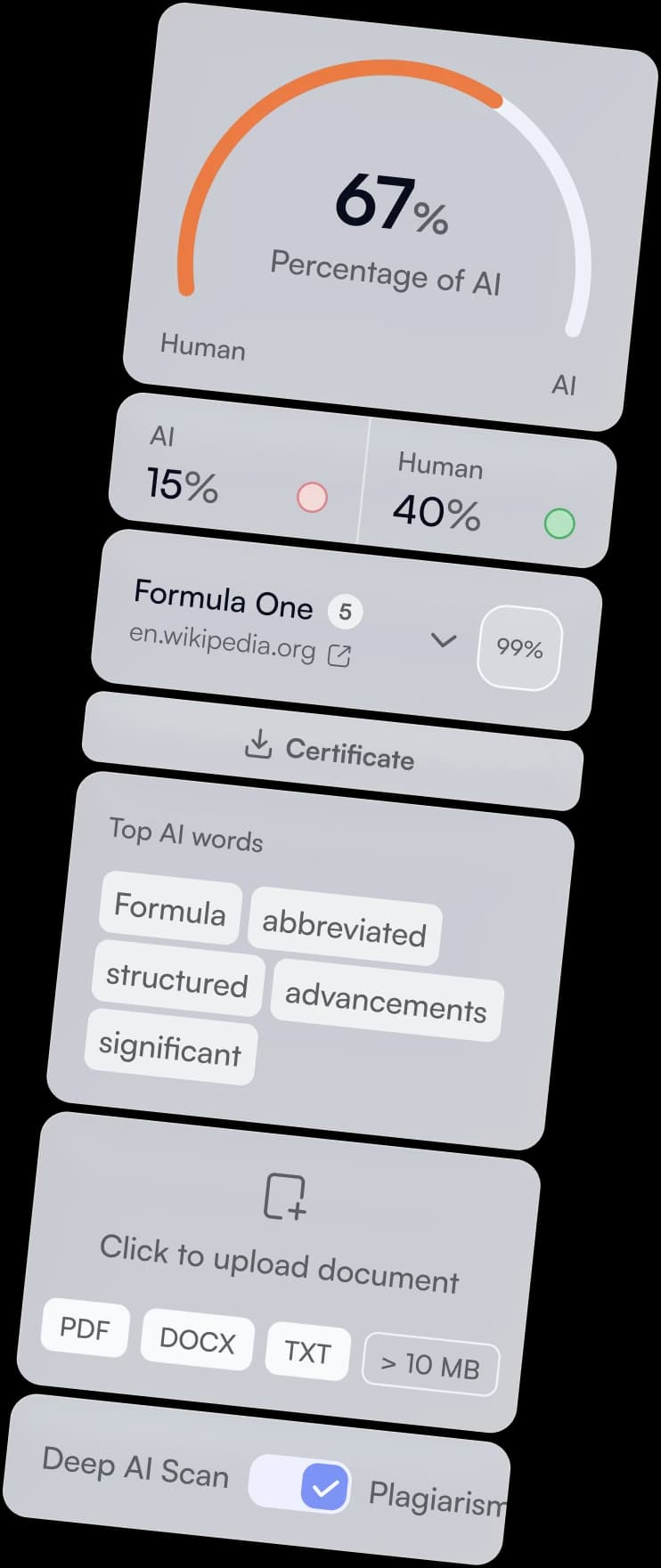
There's no universal safe threshold, but most editorial teams treat anything above 30% AI probability as a flag for review and above 70% as a likely rewrite. AI detection scores work as confidence intervals, not absolute verdicts. A score in the 0–30% range usually means the detector found mostly human-pattern signals. Above 70%, the detector is confident the text is AI-generated. The middle band (30–70%) usually indicates mixed signals or heavy editing — the most ambiguous range and the one that requires editor review. Thresholds also depend on text length: short pieces under 150 words produce less reliable scores, so editors often skip detection on social posts and run it on long-form content.
Can an AI detector identify which AI model wrote the text?
Modern AI detectors increasingly identify not just whether text is AI-generated but also which model produced it. Top detectors are trained on labeled samples from current language models (GPT-4, Claude, Gemini, Llama) and learn the statistical fingerprints each one leaves. The 2024 RAID benchmark — a peer-reviewed leaderboard tracking AI detector performance across multiple models and adversarial attacks — confirms that accuracy is highest on outputs from widely sampled models. Smaller or newer models can fool a detector into a generic AI label without specifying the source. For editorial workflows, model attribution matters less than the overall AI probability, but it's useful when investigating whether a writer used a particular tool.
Does using Grammarly or autocorrect trigger an AI detector?
Basic Grammarly edits don't trigger most AI detectors, but heavy use of AI-powered rewriting features can — and it can flag genuinely human-written text as AI-generated. AI detectors look for statistical patterns characteristic of large language models, not for editing assistance. Spell-check and grammar fixes leave the original author's rhythm intact and don't trigger detection. Heavy use of AI-powered rewriting — like paraphrasers and "make it more professional" buttons — introduces LLM-style smoothing into otherwise human prose. AI-detection vendors call this "cyborg writing": human text misclassified as AI because it's been over-processed through AI assistants. The practical implication: keep AI-assisted editing light, or expect false-positive AI detection scores on text you actually wrote yourself.
Should you disclose AI detection results to your readers?
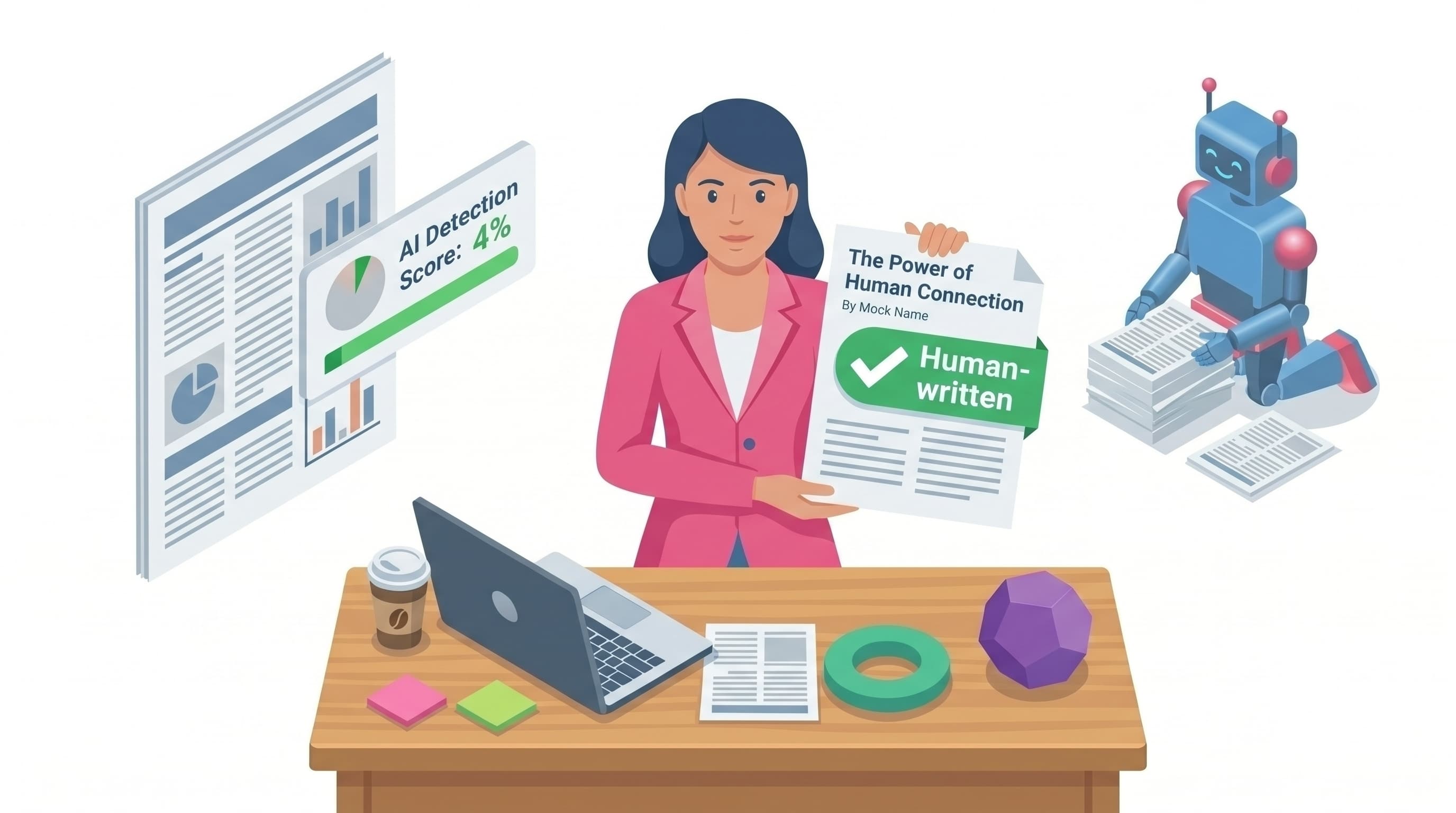
There's no consensus standard yet, but the 2026 trend is toward visible attribution — publishing the AI detection score alongside the article rather than hiding it in editorial workflow. Publishers experimenting with visible AI detection signals report mixed reader reactions, but the broader pattern is moving toward transparency. The Reuters Institute's 2026 trends report frames verification as a "product feature" — something the reader sees on the page, not just an internal step. In practice, this looks like a "human-written" badge near the byline, with the detector report linked from the article footer. The risk of hiding detection is the same as hiding sources: when readers question authenticity, the publisher has nothing to point to.