The bottom of the market collapsed: writing fell by a third
According to Vollna's analysis of 2.2 million Upwork projects, writing volume on the platform fell 32% year over year in 2025. That's the steepest drop across 12 marketplace categories. Eleven of the twelve went negative. The share of entry-level projects fell below 9%, down from roughly 15% the year before.
This is the half of the market where new copywriters used to learn the trade. Entry-level tasks at $30–100, product descriptions where they learned the craft on real assignments. They're gone. AI handles all of it for free in under a minute, and clients have noticed.
Brookings describes the same drop more precisely. In the study by Hui and co-authors, freelancers in categories most exposed to generative AI lost on average 2% of contracts and 5% of monthly earnings after the ChatGPT release. Here's the counter-intuitive part: the effect hit experienced freelancers with high-priced premium services hardest. The "an expensive specialist is safe from automation" logic didn't hold. The top tier took a bigger hit than the bottom one.
Hold on to that finding. We'll come back to it once it becomes clear why exactly this group is most motivated to quietly use AI without telling clients.
Top of the market: 44% premium for AI-augmented work
The same Upwork that lost a third of its writing projects reports in its latest In-Demand Skills 2026 report that demand for AI skills on the platform grew 109% year over year, based on actual client spending rather than job posts. Across all major work categories, AI-related skills are growing by double- and triple-digit percentages per year.
The premium from the intro shows up again here. The pay gap for AI-related work wasn't a Q4'24 anomaly: it hasn't shrunk over the past year. That premium is what holds the top tier of the market in place.
The same Freelancer Kompass gives two data points on the trajectory: in 2023, 41% of freelancers used AI; by 2026 the figure has doubled. In three years, AI has gone from a competitive advantage to basic hygiene.
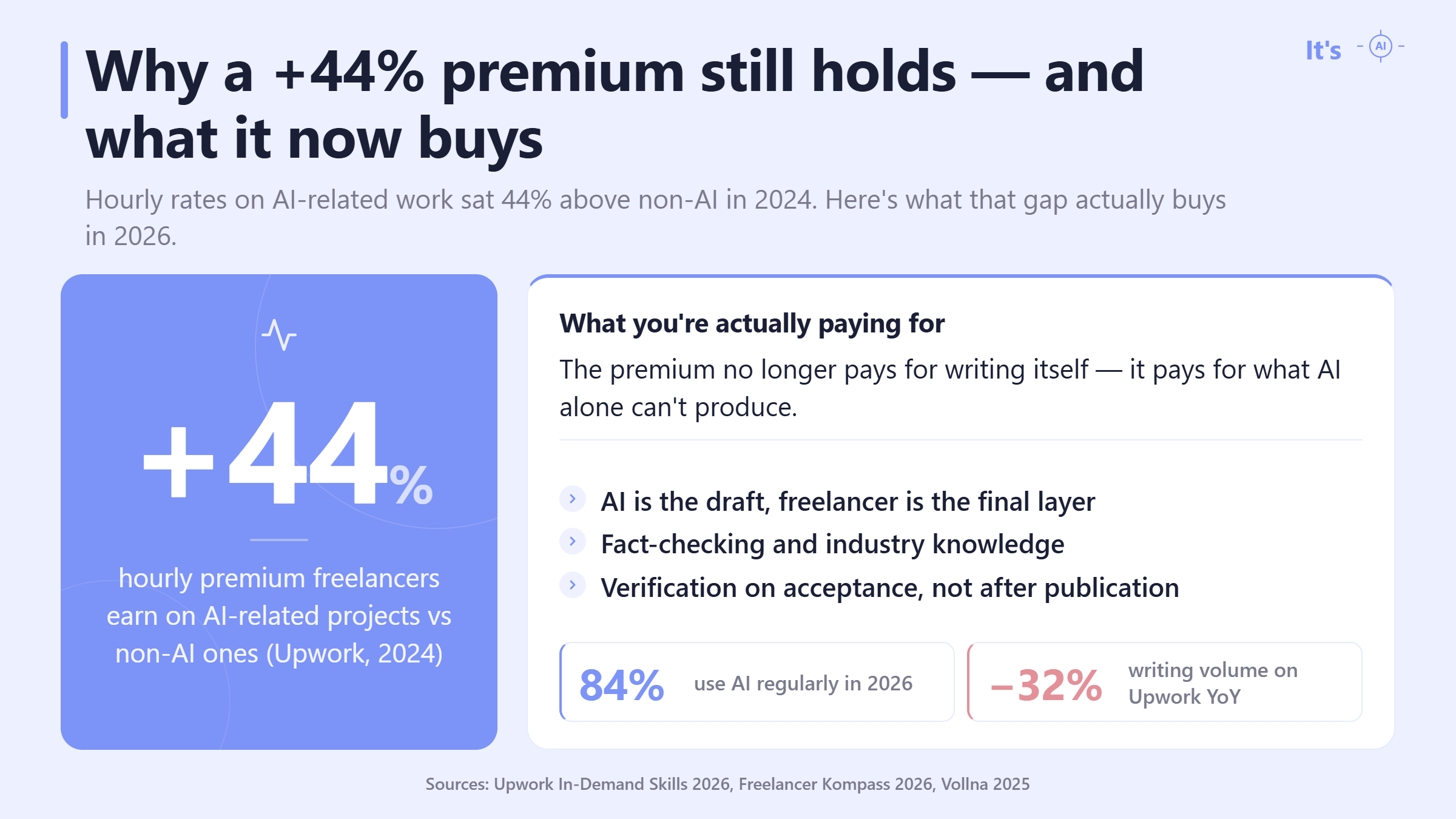
If almost everyone uses AI, but the premium is paid only for "AI-augmented expertise," AI alone in the stack doesn't earn the premium. A premium rate now assumes the specialist uses AI transparently, as a draft, and adds something AI doesn't have: expert editing with fact-checking, and inside knowledge of the industry. AI is trained on public text, not on the real practice of companies and people. Those who built a 2019 brand on "I just write well" lose in 2026. Those who learned to use AI as a tool and kept the final layer for themselves win.
This brings us back to Brookings. Experienced specialists with high rates were the group hit hardest. They're also the group most motivated to recover income. The most direct route: speed up with AI without telling the client. Their product still looks like expensive manual work on the surface, but inside it's no longer that.
Where the client money went: hard substitution in spending
Platform data shows one side of the market: tasks and rates. The most direct evidence of substitution comes from the other side: from the actual spending of the companies themselves. In "Payrolls to Prompts" (Ryan Stevens, Ramp, January 2026), Stevens tracks real spending by thousands of companies on freelance marketplaces and AI providers from Q3 2021 through Q3 2025. The method: difference-in-differences, with the ChatGPT release as a natural experiment.
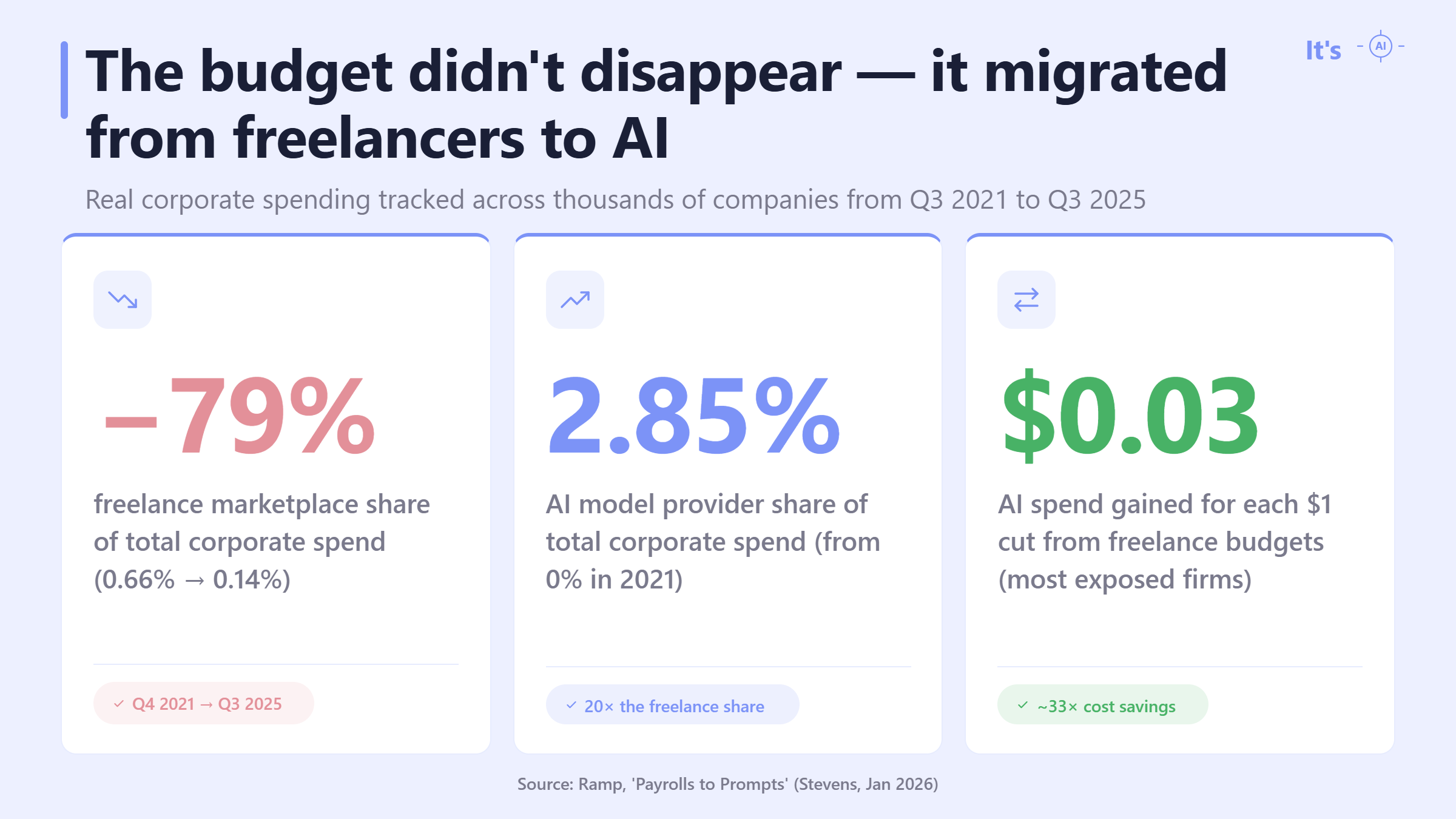
Stevens gives a direct estimate: for the most exposed firms, every $1 of departing freelance spend matches roughly $0.03 of new AI spend. For clients, that's savings by a factor of dozens. Budgets that used to go to contractors now go only to model vendors.
The takeaway for you as an editor isn't obvious, but it matters. The clients who stayed on freelance after this exodus stayed by choice, and they're the ones willing to pay the premium. They don't want cheap content: GPT already produces that for free. They want what AI doesn't produce. And it's their willingness to pay that holds the top tier of the market together.
If those clients start getting the same output for premium money that they could pull for free from their own API key, the premium disappears within a quarter. Then the top tier collapses behind the bottom one.
What you're buying with that premium in 2026
By the time a client pays a freelancer a premium rate, three conditions have lined up on the market.
- AI as a daily tool. The vast majority of freelancers now work with AI every day. Some are transparent about it with clients, some are not.
- The hit landed hardest on specialists with high rates. That group lost the most, and that's exactly the group most motivated to recover their income. Including by quietly speeding up the work with AI.
- An invisible gap at the moment of acceptance. In the delivered long-form piece, you can't always answer the basic AI-or-human question without checking. Human-written prose with AI as draft, and GPT output with light editing on top, look identical in an open file.
You pay this premium for a promise that real expertise went into the file. Without verification, it stays a promise.
How editors use AI detectors for long-form in 2026
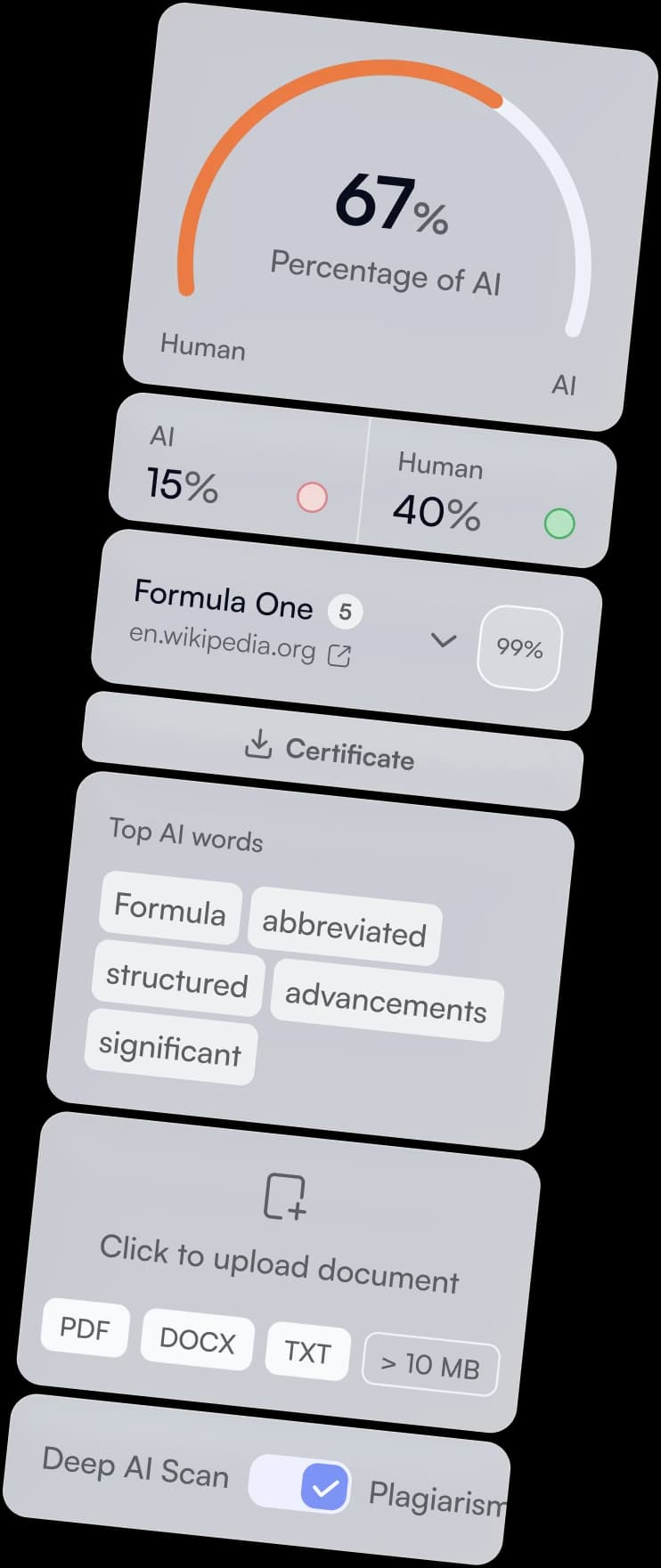
An AI detector (also called an AI detection tool or an AI content checker) analyzes the finished text and shows which fragments look AI-generated and which look human. To detect AI writing, it works on stylistic patterns and word distribution, not on a database of published text. That makes a detector different from plagiarism checks and from after-the-fact investigation: the check exists to give you a reading before payment, not to expose a contractor after.
Editors and content managers — anyone who pays freelancers a premium rate for long-form — rely on AI detection software in daily editorial work. The typical 2026 scenario: run the file through an AI detector before payment, not after publication. The goal is a clear picture before you make the financial decision.
What you do with the result depends on what the detector shows. A low percentage of AI-generated content is fine, and it's the usual picture for a premium freelancer with a transparent process. A high one is grounds for a conversation: ask the contractor to explain exactly how AI was involved in the work. A transparent freelancer in 2026 answers calmly. A conversation with a non-transparent one usually gives the answer well before any explanation does.
Was this written by AI? One experiment worth running today
If something in the data above made you pause, here's a simple way to verify AI use in the work you've already received. Take the last long-form piece you got from a freelancer. Not to catch the contractor out, just to have your own data. Run it through the It's AI detector and see what percentage the tool flags as AI-generated. If the result is fine, you pay with a new level of confidence. If the result surprises you, you have a topic for a calm conversation with the contractor before payment goes out.
One file, one minute of checking. There's no risk to the relationship with a transparent contractor — they'll be the first to back the idea of a check. The friction shows up only with those who have something to hide.
If you're the freelancer, you also have one action to take, but a different one: be open about using AI, and show exactly how you use it. Transparency now pays better than denial. The client willing to pay you a premium wants to know what they're buying. Set up your process so the answer is visible before acceptance.
The market split in 2026, and both halves now make new demands. Contractors now have to bring AI skills and a transparent process. Clients now have to make AI verification part of acceptance.
FAQ
Was this written by AI?
You can't tell from reading the file alone. The fastest reliable check is to run the text through an AI content detector, which scores how much of the writing matches AI-generation patterns. A detector compares the text against stylistic markers — flatter sentence rhythm and more predictable word choice than human writers produce — and returns a percentage plus a paragraph-by-paragraph breakdown. That's enough information for an editor to make a payment decision. Asking the writer directly works too, but only with contractors who have no reason to hide their process. The two methods together — detector reading plus a calm conversation — beat either one alone.
How does AI detection work?
AI detection works on stylistic and statistical patterns in the text, not on a database of known AI outputs. The detector looks for signals that human writers produce less often than language models do: flatter sentence rhythm and more predictable word choice. The model assigns each section a probability score, and the tool combines those scores into an overall reading. Detection works on any new text, including text from models the detector wasn't trained on — the underlying patterns are a property of how language models generate, not of a specific model's output.
Are AI detectors accurate, or do they give false positives?
Modern AI detectors are reliable on long-form text, with false-positive rates typically in the low single digits. Accuracy depends on text length: detectors work best on continuous prose of 300 words or more, where statistical patterns stabilize. Short snippets and heavily-edited AI output are the cases where false positives can still show up. For editorial use, the standard practice is to read a detector's verdict alongside the writer's process — a high AI score plus an unclear answer to "how did you write this" is a stronger signal than either factor alone.
What's the best AI detector for long-form content?
The choice depends on what you need detected and how the result will be used. For editorial workflows that pay freelancers a premium rate, the priorities are accuracy on long text and a paragraph-level breakdown — not a single overall score. The It's AI detector is built for exactly this use case: long-form content with paragraph-by-paragraph reading. For shorter content like social posts or ad copy, the calculus is different — short-text detection has higher noise, and no current tool matches long-form accuracy at the snippet scale.
How do you check if a freelance writer used AI?
Run the delivered text through an AI content detector before payment, not after publication. The detector returns a percentage and a section breakdown: a low score means clean human writing or a transparent AI-as-draft process, while a high score means most of the text matches AI-generation patterns. Combine the detector reading with the conversation — a transparent freelancer explains their process calmly when asked, while a non-transparent one hesitates or tells a story that doesn't match what the detector showed. Neither method alone is enough, but together they're a short, repeatable check that fits into an editorial workflow.