AI Text Detection: Protecting Corporate Reputation Amid Mass AI Adoption | It's AI
AI Text Detection: Protecting Corporate Reputation Amid Mass AI Adoption
Employee trust in AI dropped 18% while adoption grew 13%. Learn why businesses need AI content detection to protect reputation and quality control AI-generated output.
Svetlana ShakhovaApr 14, 202617 min read
AI Text Detection: Protecting Corporate Reputation Amid Mass Generative AI Adoption
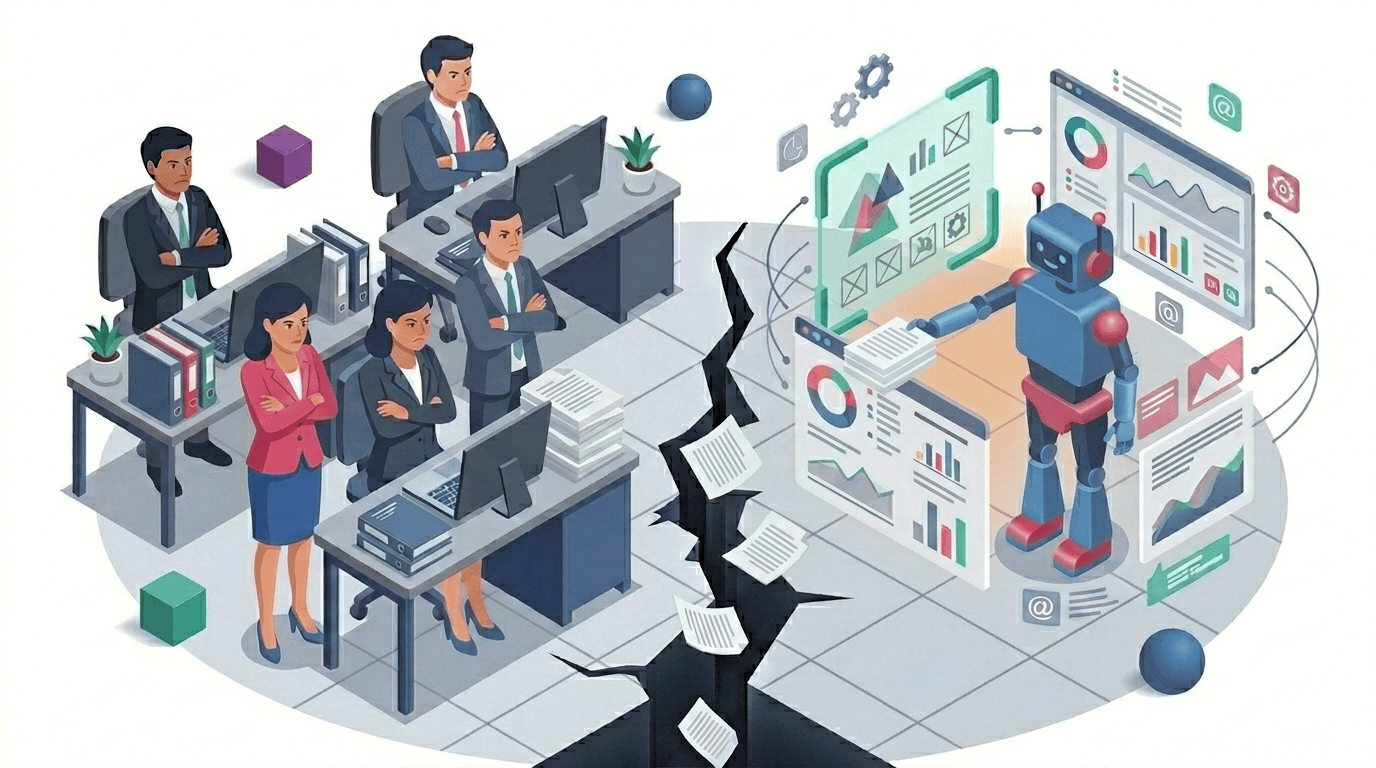
In January 2026, ManpowerGroup published the Global Talent Barometer — a survey of nearly 14,000 employees across 19 countries. The headline finding looks like a system error: over 2025, regular AI use in the workplace grew by 13%. Confidence in the technology dropped by 18%.
People tried it. And trusted it less.
This isn't about the early days of getting used to a new tool. It's not "resistance to change." Employees are using AI in their daily work and increasingly doubt it's worth anything. The gap between adoption and trust keeps getting wider. Let's break down how that happened.
Curious how your own text scores? Check it right here.
characters (min 200): 0/500000
PDF, DOCX, TXT
Deep AI Scan
find out which part of text seems AI-generated with our sentence-level segmentation.
Plagiarism check
detect plagiarized content by comparing your text against online sources.
Grammar check
find grammar and spelling mistakes in your text.
4000words left
AI Rollout Without Training Leads to Burnout, Not ROI
The drop in confidence isn't even. Boomers saw a 35% collapse. Gen X lost 25%. While the data says the most experienced workers are losing faith the fastest, age isn't actually the reason.
56% of employees reported receiving zero training on how to work with AI. Companies handed out the tools and never explained what they're for or how to use them. Mara Stefan, ManpowerGroup's VP of Global Insights, put it plainly: the gap wasn't created by the technology. It was created by the lack of support and training.
Meanwhile, 63% of respondents report burnout from stress and overwork. And 64% are staying in their current roles despite that burnout, driven by fear of automation. The report called it "job hugging." Employees aren't growing, aren't looking for anything new. Just holding on to what they've got.
On the other side of the table, employers aren't seeing results either. PwC's 29th Annual Global CEO Survey found that only 10–12% of companies see any real return from AI in revenue or cost savings. 56% said the technology delivered nothing.
A vicious cycle, basically. Companies push AI because the market pressures them to. Employees get no training. Results don't show up. Trust drops. But the rollout keeps going.
The Risks of Top-Down Implementation: How Forced AI Adoption Destroys Employee Loyalty
The previous section showed that companies aren't getting returns from AI and employees aren't getting training. But there's a third factor: the way AI gets rolled out is itself destroying trust.
The Edelman Trust Barometer ran a separate flash poll on AI across five countries (Brazil, China, Germany, the UK, and the US) and captured the mechanics of that process. In developed nations, the majority of AI skeptics feel the technology is being forced on them from above. No involvement in the process. No one asks what they think. Just a top-down mandate. And this isn't just hurt feelings. It's a direct cause of rejection.
The data shows that the opposite approach actually works. Employees are far more willing to pick up AI when they feel their position is getting stronger, not weaker. On AI questions, they trust their colleagues far more than executives or government officials. And most workers in developed economies are convinced that business leaders won't tell the full truth about what AI means for jobs.
The problem isn't that people are against technology. The problem is they don't trust the people pushing it. And the less secure someone feels, the stronger the pushback. Not because they don't understand AI. Because nobody gave them a reason to believe this technology is working in their favor.
The Dynamics of Corporate Risk: Why Trust in Autonomous AI Systems Is Freefalling
ManpowerGroup and Edelman show a trend over a year. Deloitte TrustID showed how fast trust can disappear in a matter of months.
Between spring and summer 2025, trust in enterprise generative AI tools took a noticeable hit. But the real crash happened with agentic AI — systems that act on their own rather than just making recommendations. The scale of the drop is in the infographic below.
Edelman picked up an interesting counter-signal, though. People who do trust the technology are willing to use even agentic AI for finances, healthcare, major purchases, and job hunting. And the ratio of those ready to use it versus those who aren't is overwhelming. The potential is there. But it's locked behind a wall of distrust.
Overcoming AI Skepticism: Transparent Adoption and Internal Training
A few companies are trying to close the gap. IBM and Accenture launched internal AI academies to retrain employees. Edelman found that peer-to-peer communication about AI is twice as effective as messaging from leadership. And voluntary adoption delivers better results than mandatory rollouts.
The strongest driver of trust, according to Edelman, is personal experience. When generative AI helps a specific employee work through a complex task, trust jumps by 40 to 50 points depending on the country.
Turns out trust comes back from the bottom up, not the top down. Not through strategy decks, but through real, hands-on value that the employee felt for themselves.
Controlling Generated Content: Why Businesses Need Regular AI Text Detection
All of these reports focus on what happens inside companies. But untrained employees using AI without trust or oversight don't just affect internal processes. They affect everything that goes out the door.
Articles, reports, newsletters, client responses. When employees don't trust AI and don't know how to use it properly, the content they produce with it reflects that. And when a company publishes material without knowing what was checked by a human versus what a model spat out unchecked, it's adding noise to an environment where trust is already at its lowest.
Most companies got nothing from AI. But they're still generating content with it. And that content reaches clients, partners, regulators.
AI content detection isn't a tool for the paranoid. It's baseline quality control in a world where trust in autonomous AI systems can collapse within a single quarter. A bridge between "we use AI" and "we stand behind what it produces."
Without that bridge, the numbers in these reports will keep heading one direction. Down.
FAQ — AI Text Detection for Business
The best AI detectors in 2026 hit 90–95% accuracy on standard English text. That's reliable enough to catch the bulk of unchecked AI content before it goes out the door. Where they struggle: short texts under 300 words, heavily human-edited drafts, and mixed-authorship documents where one person wrote the intro and a model wrote the rest. No AI checker is reliable at 100% — but the gap between "mostly catches it" and "nobody checks at all" is where corporate risk lives.
AI detectors analyze how predictable the text is. Language models like ChatGPT pick words based on statistical probability. Human writing doesn't work that way — we skip ahead, circle back, choose odd words for emphasis. An AI text detector measures these patterns and scores how likely the text is to be AI generated. The more predictable the writing, the higher the score.
The most trusted AI detector is the one that shows you why it flagged something, not just that it did. Binary yes/no verdicts don't help editorial teams. The It's AI detector gives probability scores, so you can decide how to handle a 60% flag versus a 95% flag. That's what separates a trusted AI detector from a novelty tool — it helps you make a call, not makes the call for you.
Yes. An AI detector tool catches AI-generated content that would otherwise go out to clients, regulators, and partners without review. When 56% of companies report zero ROI from AI tools and employee trust keeps falling, unchecked AI content is a liability — not a productivity win. Running an AI detection tool on outbound content is the cheapest quality control step a company can add. It won't fix a broken AI strategy, but it will keep bad output from reaching people who matter.
Most AI detection platforms offer a free tier or trial. The It's AI detector has a free version — no signup, paste the text and check. That's enough to test how the tool handles your team's actual content. A free AI detector won't always have the same depth as a paid plan (batch processing, API access, longer texts), but for checking individual articles and reports before publishing, free works fine as a starting point. The goal: check for AI generated content before it goes live, not after.
Make AI detection a step in your editorial workflow — between "draft done" and "published." One person runs the text through an AI content detector, flags anything above the threshold, and the author reviews those sections. Same logic as spell check or legal review. The worst approach is checking content that's already live. If you want to detect AI written content consistently, it has to be a process, not a one-off panic check after a client complains.
Yes, AI detection false positives happen. Formulaic writing — legal boilerplate, financial disclosures, product specs — can trigger flags because it's repetitive by design, not because a model wrote it. A reliable AI detector keeps this rate low, but no tool eliminates it completely. Here's the thing, though: a false positive means a human takes another look at a text that was fine. A false negative means AI-generated content goes out unchecked. Those two errors cost very different amounts.
Top AI content detectors report 90–95% accuracy on English text in controlled tests. Real-world accuracy depends on what you're checking. Lightly edited ChatGPT output — easy to catch. A draft where AI wrote the skeleton and a human rewrote every paragraph — much harder to detect. AI detector accuracy also drops on shorter texts and on content in languages with smaller training datasets. The honest answer: no AI generated content detector catches everything. But catching 9 out of 10 unchecked pieces is a massive upgrade over catching none.