Optimize LLM training and data selection with It's AI for data scientists

Hero image
clock
Control the quality of the data used for LLM training and optimize the work of your model with the most accurate AI checker (according to MGTD benchmark).
Try for free

Why ML engineers choose It's AI

Get word-level predictions with deep scan mode
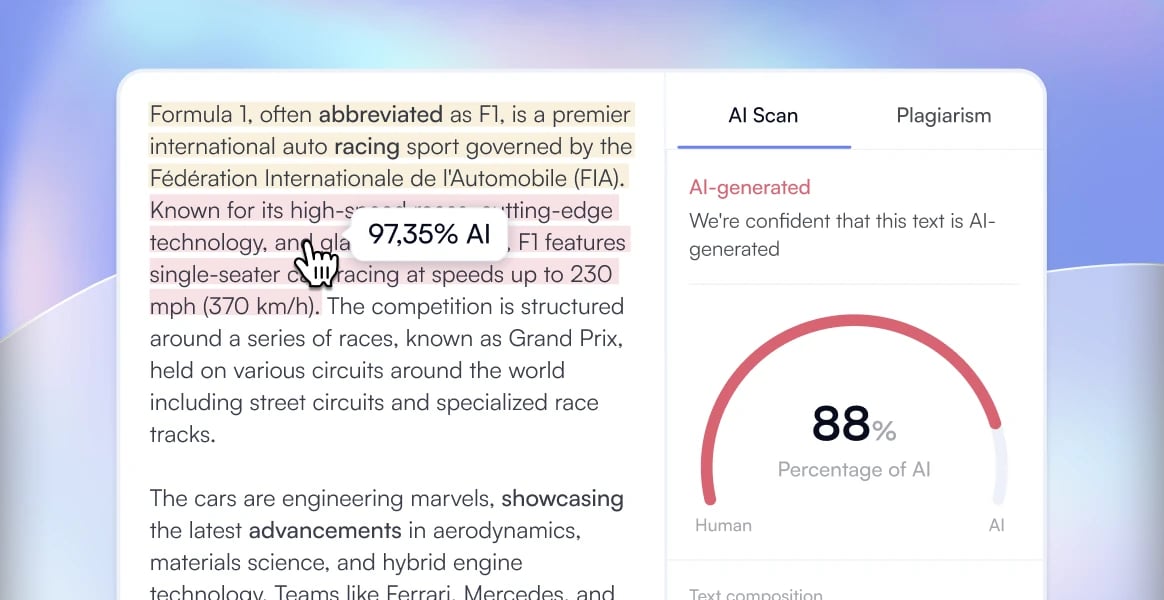
It's AI deep scan feature allows you to see data originality at the word level, giving you the probability of each word being AI-generated. You'll always know the origins of data used for AI model training.
[object Object]
Access to It's AI API
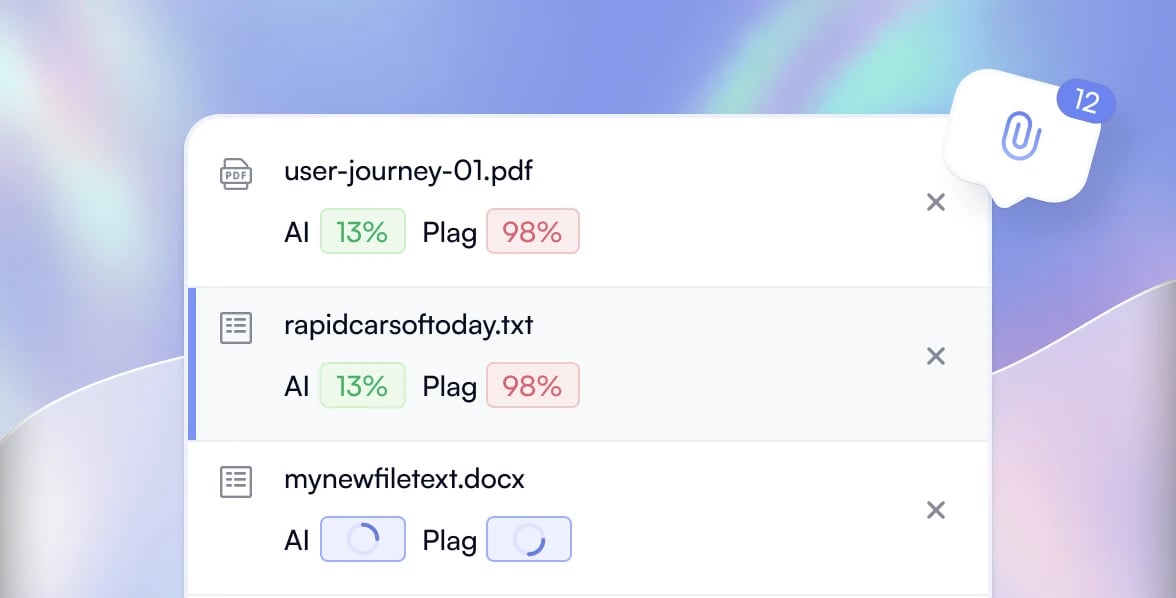
Our AI checker provides access to its API along with comprehensive technical documentation. You'll be able to filter out datasets or integrate it into AI products for the lowest price on the market starting from 7.5$ per 100k words. Score texts of up to 500k characters and process up to 2000 texts per minute with its batch processing mode.
[object Object]
Rest assured of your data safety
It's AI follows strict policies regarding data security. All the data you use remains in our system only and is never transferred to third parties.
[object Object]
Try for free

Additional features of It's AI for engineers

Go to App

It's AI Integration Capabilities

Chrome Extension

Chrome Extension

Check your text instantly without leaving a page—just highlight it and get an answer.
ChatGPT Plugin

ChatGPT Plugin

Analyze and verify AI-generated content directly within ChatGPT.
API

API

Integrate It’s AI into your own applications with our API.
Zapier Integration

Zapier Integration

Connect AI detection with thousands of apps for automated workflows.
Coming soon
Moodle Integration

Moodle Integration

Ensure academic integrity by verifying AI-generated content in Moodle.
Coming soon
Gmail spam filter

Gmail spam filter

Automatically detect AI-generated spam emails in your inbox.

Reviews

USER REVIEW
I've tried many detectors, but It's AI remains the most accurate and convenient - especially when working with massive datasets.
[object Object]'s avatar
Felix Enriquez
Fullstack/ML Engineer at Takumi Studio LLC
USER REVIEW
Flexible pricing, rich functionality, and a clear interface. It's a must-have tool for any ML engineering team.
[object Object]'s avatar
Dinara Darkulova
Big Data Engineer at Google Cloud Platform
USER REVIEW
I rely on It's AI in every ML project. It's the best tool for checking model responses and optimizing training workflows.
[object Object]'s avatar
Rahul Behal
Machine Learning Operations Engineer at Arctic Wolf
USER REVIEW
I integrate It's AI API into my custom LLMs. Fine-tuning goes faster, and I'm always aware of the quality of the data I use.
[object Object]'s avatar
Anna Berger
Machine Learning Engineer at Bloomfield Robotics

Why ML Engineers Choose It's AI?

Accurate. Simple. Affordable.
time.pngThe most accurate AI detector in the world
The most accurate AI detector according to MGTD benchmark (ICAIE, 2025) – the biggest and most robust benchmark for AI checkers, consisting of 15 other datasets and almost 2M samples.
MGTD Roc-Auc Score
It's AI
92.0
GPTZero
88.7
Originality
82.5
ZeroGPT
71.4
99.1%
accuracy
Our average score among GRiD, HC3 and GhostBuster benchmarks.

<1% FPR
It's AI models were trained to minimise False Positive Rate. Our FPR on student writings dataset (ASAP 2.0) is 0.8%.
Full Arabic Support
Over 98.7% accuracy with less than 0.5% FPR on Algerian Scientific papers dataset (ASJP).
Sign up

Preserve data quality for your models

Detect AI
Find plagiarism
Coming soon
Improve texts
All of that with industry-leading technologies! Make training efficient by filtering generated texts out of your datasets with It's AI.
Get started. It’s Free
originality

FAQ

What is an AI detector API and what is an AI detection API?

An AI detector / AI detection API is a service you call from your code to estimate whether a piece of text is human-written or generated by a language model.

Instead of pasting samples into a web form, you send them programmatically (usually as JSON over HTTP) and receive probabilities, labels and sometimes token-level scores. This lets you:

  • score training data before it enters your corpus;
  • monitor production traffic for AI-generated content;
  • build internal tools for data quality or abuse detection.

The It's AI AI detector API and AI detection API expose the same models that power the web app, including deep scan mode and batch endpoints, so you can embed the detector into pipelines, labeling tools or dashboards.

How do I integrate an AI detector API into my app or pipeline?

Integration is similar to any other REST service:

  1. Obtain credentials. Create an account, generate an API key and keep it in a secure secrets manager.
  2. Choose the endpoint. For example, a single-text endpoint for interactive use or a batch endpoint for nightly jobs.
  3. Send texts as payloads. Typically as UTF-8 strings with optional metadata (IDs, language, source).
  4. Parse scores. Use overall AI probability for simple decisions, and token-level scores when you need a more detailed view.
  5. Wire into your stack. Call the API from data ingestion, pre-processing, labeling, moderation or evaluation stages.

With It's AI, you can score up to 500k characters per request and up to 2,000 texts per minute in batch mode, which is usually enough for most data pipelines. If you need higher throughput, you'd shard workloads across workers or coordinate with the team for enterprise limits.

Which is the best AI detector API for ML engineers and data scientists?

"Best" depends on your constraints, but from a modelling perspective you want three things:

  • Strong benchmark results on datasets like RAID, MGTD, GRiD and CUDRT.
  • Low false-positive rates so you don't over-filter human data.
  • Stable, well-documented API with predictable throughput and pricing.

It's AI exposes the same engine that leads the MGTD ROC-AUC scoreboard (0.92 vs lower scores for GPTZero, Originality and ZeroGPT) and ranks first on the RAID benchmark at 94.2% accuracy with 5% FPR on non-attacked texts. The API is essentially a production wrapper around that model, which is why we position it as a strong candidate for an AI detector / LLM detector API in ML workflows.

How accurate are AI detector APIs in real-world training data?

Even the best AI detector APIs are not oracles. Accuracy depends on:

  • which generators they were trained/evaluated on;
  • how close your data is to benchmark domains;
  • how heavily the text has been edited by humans.

The engine behind the It's AI API is evaluated on RAID, MGTD, GRiD, HC3, GhostBuster and CUDRT. That mix covers simple generations, long-form writing and "edited AI" scenarios. In practice this means:

  • the API works very well at catching raw or lightly edited LLM outputs;
  • performance is still strong on mixed or paraphrased content, but you should monitor recall and FPR on your own domain;
  • for truly critical datasets, it's safer to combine the detector with manual review or heuristic filters.

Treat the AI detector API as a high-quality filter for triage and cleaning, not as a single point of truth.

Can an AI detector API run on-premise or in a private cloud?

Some vendors offer on-premise or private-cloud deployments of their AI detection API, usually as a managed container / VM image that you run inside your own VPC. The trade-offs are:

  • Pros: full control over data residency, network access and compliance;
  • Cons: more DevOps overhead, upgrades and scaling are on your side (or via a support contract).

If you need an on-prem or private-cloud version of the It's AI detector for regulated environments, the realistic next step is to talk directly with the team: they can confirm current options, SLAs and whether a dedicated deployment is possible for your use case.

How fast is an AI detector API for batch processing?

Throughput depends on three factors:

  • how many characters per request the API allows;
  • whether it provides true batch endpoints;
  • concurrency limits per account / key.

The It's AI AI detector API is optimised for batch mode: you can send texts up to 500k characters each and process roughly 2,000 texts per minute per pipeline according to the marketing copy. For most teams that's enough to:

  • pre-screen nightly or weekly data drops;
  • clean moderate-sized corpora before training;
  • run evaluation passes on candidate datasets.

For very large corpora (hundreds of millions of documents) you'd typically combine batching, multiple workers and possibly dedicated capacity negotiated with the provider.

How secure is an AI detection API for proprietary datasets?

Security comes down to a few questions:

  • Where is data processed and stored?
  • Is it logged or reused for training?
  • Who can access logs and outputs?

It's AI states that data sent through the API remains within the system and is not transferred to third parties. From a practical standpoint you should still:

  • route traffic over HTTPS only;
  • rotate keys regularly and store them in a proper secrets manager;
  • minimise sensitive metadata in payloads;
  • sign a DPA / enterprise contract if your organisation requires it.

For highly sensitive corpora you might run an internal red-team test: send synthetic confidential samples, verify logging and retention behaviour, and check that the AI detection API fits your compliance needs.

How can I detect AI in training data for LLMs?

A pragmatic workflow for detecting AI in training data:

  1. Segment your corpus. Split by source (web crawl, user logs, synthetic data, etc.).
  2. Run an LLM detector (like the It's AI deep scan) on suspicious segments first — e.g. sites known for AI content or time windows after LLMs became widely used.
  3. Use thresholds and heuristics. For each document, combine model probability, length, and metadata (source domain, time) to flag high-risk samples.
  4. Spot-check. Have humans review a subset of flagged and unflagged items to calibrate thresholds.
  5. Iterate. Tighten or relax filters depending on how much AI-generated text you're willing to keep.

The goal isn't to reach "zero synthetic tokens" — that's unrealistic — but to prevent your core LLM from being dominated by recycled AI output.

How do I filter AI-generated text from training datasets without losing too much data?

Over-filtering can distort distributions or wipe out minority domains. A few patterns that work in practice:

  • Use soft filters. Instead of deleting all samples above a threshold, consider down-weighting them or sampling fewer items from high-risk buckets.
  • Filter by source first. Remove obvious synthetic sources (spammy sites, auto-generated blogs) before you touch genuine domains.
  • Separate "clean" and "noisy" shards. Keep a high-confidence human shard for core training and a lower-confidence shard for auxiliary tasks or experimentation.
  • Log everything. Save detector scores and thresholds so you can later re-run training with different filtering strategies.

An AI detector for datasets like It's AI gives you the per-document signal; how aggressively you act on it depends on your tolerance for synthetic content and on the task you're training for.

How can I remove AI-generated records from a training corpus without breaking its distribution?

The trick is to treat filtering as a controlled experiment, not a one-shot clean-up:

  1. Start with a copy. Never filter the only copy of your corpus; always keep the raw version.
  2. Define target proportions. Decide what share of AI-generated or ambiguous content you can live with (e.g. <5–10%).
  3. Apply graded thresholds. Use the LLM detector for training data to mark samples as "keep", "down-weight" or "drop" rather than a binary keep/drop.
  4. Track per-domain impact. Check how filtering affects domains, languages and document types; avoid wiping out small but important slices.
  5. Re-evaluate. Train small models or run evals on downstream tasks to see whether the filtered corpus behaves better or worse.

Over time you'll converge on a pipeline where the AI detector for LLM datasets is just another step: raw data → basic cleaning → AI detection + scoring → sampling / weighting → final training mix.