The EDUCAUSE survey: an AI detector sees only one side of the exam
EDUCAUSE, the American nonprofit association that studies how universities use technology, published "The Impact of AI on Learning Assessment" on 1 June 2026. The report is based on a survey of 438 faculty and university staff. Zoom, a 2026 partner of the association, sponsored it.
Most of the faculty surveyed use AI when they build and run assessment. Most of them believe students use AI when they take that assessment.
This is the same exam. Someone who used a model sits on both sides of the table. The work that goes through an AI content detector is the student's.
Two more findings explain what holds the arrangement in place. Faculty want to keep the right to decide for themselves when AI use is appropriate. Students report that they lack clear policies explaining when AI is allowed. The side that isn't checked keeps its discretion. The side that is checked gets the absence of a clear rule.
Peer review: reviewers get caught with a trap, not an AI detector
In academic publishing the author is the one who gets checked. The manuscript is run through AI detection tools, screened for plagiarism, and submitted with a required AI disclosure. The reviewer who reads that manuscript is checked differently.
A manuscript under review is unpublished and treated as confidential, so NeurIPS bans reviewers from uploading the papers they referee into AI chatbots. To find out who ignores the ban, the organizers hid instructions inside the papers they sent out for review. A person reading the manuscript never sees them. A language model follows them, and the review comes back carrying the planted phrases.
ICML 2026 used the same tactic first, injecting hidden prompts into every submitted paper. Nihar Shah, the conference's scientific integrity chair, says the effort identified hundreds of referees who broke the policy, and their reviews were rejected. ICML desk-rejected just under 500 papers over violations of that policy, around 2 percent of everything submitted (The Transmitter, 1 July 2026).
The author is checked by a standing procedure he knows about in advance. Reviewers were caught by a trap nobody told them existed.
Sören Auer, a computer scientist at Leibniz University Hannover, found the hidden prompts himself while reviewing for NeurIPS, because he converts PDFs to Word and that makes some of them visible. He rejected the first paper he reviewed. He assumed its authors had planted the prompt, and he withdrew the flag only after finding the same text in a second manuscript.
An author nearly lost a paper to a trap built for reviewers. Auer's objection, posted on LinkedIn, is worth reading twice:
You do not build a healthy reviewing culture by treating your reviewers as suspects.
— Sören Auer, Leibniz University Hannover, 2026
He is right. Nobody says it when the author is the default suspect.
The Journal of Medical Ethics retraction: the paper was pulled, the review process was not
On 28 May 2026 the Journal of Medical Ethics, a BMJ title, retracted a paper it had published online in September 2025. The journal checked the references and found that several of them do not exist. The author had used a language model to find and read the sources he cited, and did not verify them before submitting. The retraction notice, the public document where a journal explains what went wrong, also cites evidence of peer review manipulation.
So the journal put two problems on the record: invented references, and a review process that was manipulated on the same paper. The paper was retracted. The journal says it will inform the author's institution. The review process still runs.
Court rulings: the judge is on the same list as the litigant
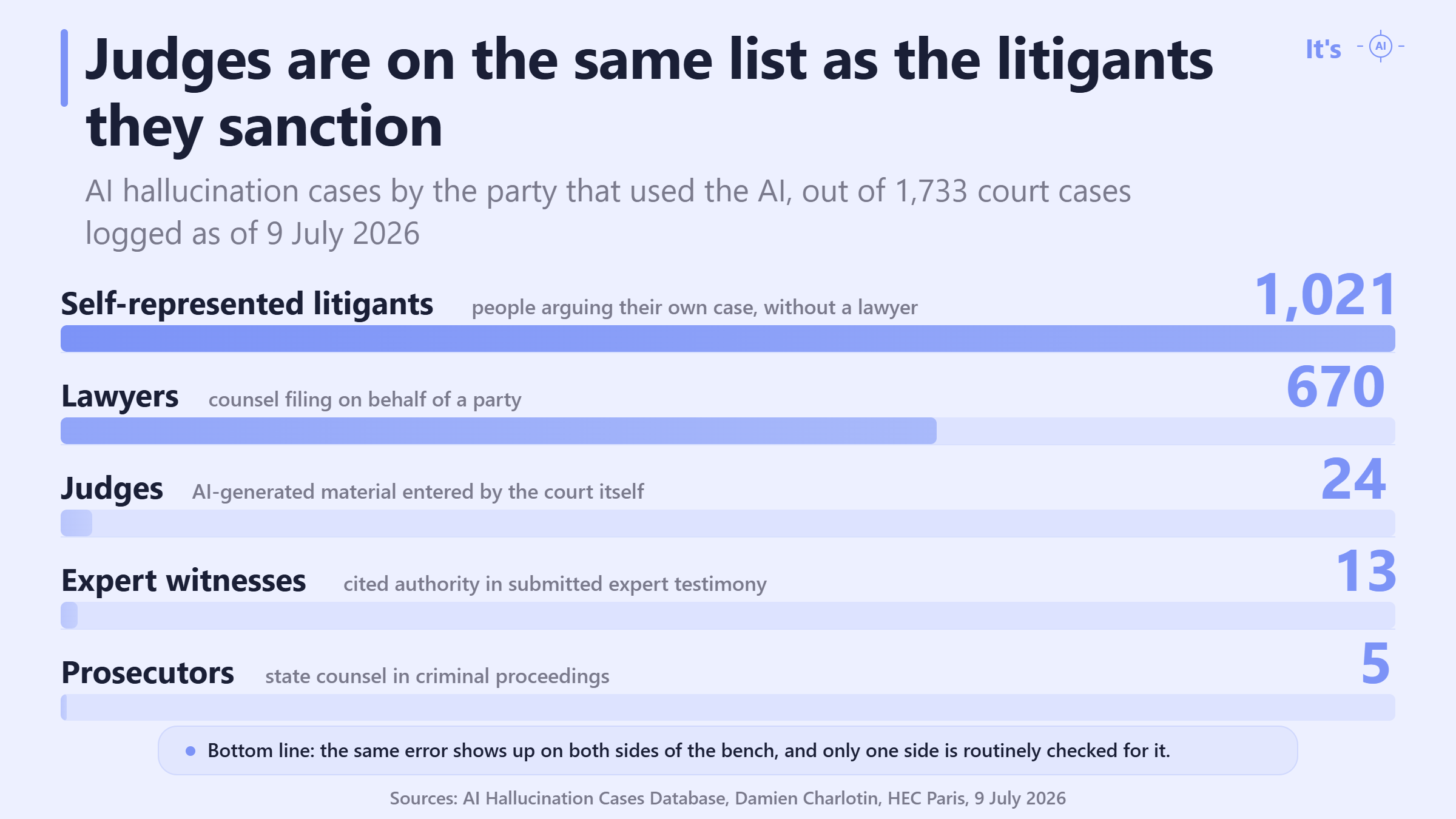
Damien Charlotin, a researcher at the Smart Law Hub at HEC Paris, maintains an open database of court cases where someone cited a precedent invented by a language model. The database tags each case by who used the AI. Self-represented litigants come first, by a wide margin. Lawyers come next. Judges are on the same list (AI Hallucination Cases Database).
The most recent of those cases reached the Supreme Court of India. Corporate disputes there are heard by the NCLT, a specialized tribunal for company matters; its rulings are appealed to the NCLAT, the appellate tribunal in the same system; above that there is only the Supreme Court. On 2 July 2026 the Supreme Court heard Pooja Ramesh Singh v. Jammu and Kashmir Bank Ltd. and set aside the rulings of both tribunals. Both had built their reasoning on precedents that do not exist and on paragraphs attributed to real judgments. A language model generated them, on the court's side. The Supreme Court called this a subversion of the rule of law and declared zero tolerance (Supreme Court of India).
It directed the Bar Council of India to frame the disciplinary measures. The Bar Council licenses and disciplines advocates. The error in this case was not made by advocates.
What the four documents say about AI detection
In none of the four cases does the checking side use AI less than the checked side. EDUCAUSE says so directly. The other three say it through the violation.
A check that runs one way doesn't measure honesty. It measures which of the two can't refuse it.
Which makes an AI detector an integrity instrument only when the institution runs its own paperwork through it. The exam prompt, not just the paper written against it. The review, not just the manuscript. Run student work through It's AI and never your own course materials, and you have learned something about students and nothing about yourself.
None of this is expensive. A reviewer's AI disclosure is one line on a form. The obstacle isn't technical.
What to do about one-sided AI detection today
If you are the one being checked, ask for the policy in writing, before you submit:
- which uses of AI are allowed
- which are not
- which AI detector you are checked with
- how a result can be disputed
A rule that doesn't exist on paper can't be followed in advance. It can still be used to explain a decision after the fact.
If you are the one checking, run your own document through the same procedure. The prompt, the rubric, the review. A check you won't apply to your own text says nothing about anyone else's.
FAQ: AI detection in practice
How can you detect AI-generated text?
AI writing detection works statistically, not forensically. A detector measures how predictable each word is given the words before it, because language models pick high-probability continuations more consistently than people do. The output is a probability, not a verdict. Sentence-level and paragraph-level scoring matters more than a single document score, since a mixed document averages out and hides the generated passages inside the human ones. Nothing in the method depends on who wrote the document or what role they hold. The same procedure that runs on a student essay runs on an exam prompt, a peer review, or a draft judgment.
How accurate is AI detection on text that a human has edited?
AI detection accuracy is highest on raw model output and drops as a person rewrites it. Editing changes exactly what the detector measures: word choice, sentence length, and how predictable each continuation is. Heavily revised AI drafts are the hardest case, and so are texts written by non-native speakers, whose vocabulary is often more predictable than a native speaker's. Any result stated as a clean yes or no is overstating what the method can do. Read the score as evidence that invites a conversation, not as proof, and ask what threshold the institution treats as a finding.
Is an AI detector the same thing as a plagiarism checker?
No. An AI plagiarism checker compares your text against a corpus of existing documents and reports overlap. An AI detector compares your text against how a language model writes, and reports likelihood. A passage can be fully original and still score as AI-generated, and a passage can be copied word for word from a human source and score as human. Institutions often run both and report a single combined verdict, which is where most disputes start. Ask which of the two produced the number you are being shown.
Can an AI detector be run on a teacher's assignment or a reviewer's report?
Yes. An AI detector for teachers, students, reviewers, and editors is the same tool; the text does not carry the author's job title. Nothing technical prevents an institution from running an exam prompt, a grading rubric, or a peer review report through the same procedure it applies to submitted work. Where this is not done, it is a policy choice rather than a limitation of the method. A written policy that names which documents get checked, and which do not, is the fastest way to find out which kind of choice your institution has made.
Can you dispute the result of an AI detection check?
That depends on what the policy says, which is the reason to ask for it in writing before you submit anything. Request the full report rather than the headline percentage, including per-paragraph scores and the threshold the institution treats as a finding. Ask which detector produced it and when it was last updated, since model output changes and detectors are retrained against it. Ask whether the same procedure was applied to the document you were given. A check that only one party is subject to is difficult to defend as evidence.