Newby v Adelphi University: Where the University Lost the Case
Adelphi lost on four procedural violations, and the court did not weigh the detector's accuracy in any of them:
- the student was denied an advisor of his choice, which the university's own student bill of rights guarantees;
- counter-evidence, reports from two other detectors that called the text human-written, was never reviewed;
- the appeal was handled by the same administrator who made the original decision;
- the system treated the student as responsible by default until he contested the charge a second time.
Judge Randy Sue Marber called the finding and the appeal denial "without valid basis and devoid of reason", annulled both, and ordered Adelphi to clear the student's academic record. One caveat for anyone citing the decision: New York's Supreme Court, despite the name, is a trial court, so the ruling does not bind other judges and says nothing against detectors as such.
Note
A note for your university's lawyers: the case ran under Article 78 of New York's civil procedure rules, the standard route for challenging what an institution decides, and is cited as 2026 NY Slip Op 26021, Nassau County.
The charge itself said Newby used a grammar-checking service as generative AI. He agreed he had run the checker, denied that any machine wrote the essay, and the committee closed the case without saying which of the two it had punished. Extra attention came from who the plaintiff was: a freshman on the autism spectrum, in the university's paid Bridges support program.
The court cited the instructor's own email when it called the charge baseless. On December 4, 2024, Micah Oelze wrote to the student that he had expected the committee to make its own decision, "instead, it seems like their system defaults you as responsible unless you contest the claim again", and advised him to contest the charge. Check whether your instructors know what happens to a report after they file it: an instructor who files one while unsure of the procedure is creating evidence against his own university.
Why Universities Disable AI Detection and What They Keep Instead
The universities that switched off AI detection over the past two years are not walking away from detection itself. What they drop is punishment handed out over a single number. Curtin University said so on September 4, 2025. The AI-detection feature there has been off since January 1, 2026, and text matching still runs.
| University |
What it did |
When |
What remains |
| Vanderbilt |
disabled the detector; Honor Council does not consider scores |
August 2023 |
a review procedure instead of a score |
| Curtin |
disabled the AI-detection feature |
since January 1, 2026 |
text-matching checks |
| WSU |
ended the contract for the AI-detection module |
February 2026 |
plagiarism checks for faculty and students |
| Pittsburgh |
Teaching Center disabled its detector, supports no detection tools |
February 2026 |
— |
The table could be longer. WSU's memo lists the R1 universities that dropped detection before it did: UC Berkeley, Colorado State, Indiana University, Michigan State, Oregon State, and the University of Washington. Pittsburgh's teaching center put the reason in one line: detectors are "not accurate enough to prove" a violation. Error rates are not the whole story, though. Even a perfect detector only says where a text came from. It cannot say what help the course allowed or what the student was told. That part of a case has to come from somewhere else.
An AI Detector as Sole Evidence: the WSU Numbers
A third of all AI cases at WSU ended with a not-responsible verdict, and the reason was the same each time: the detector report arrived without anything else to support it. The count comes from the university itself, covering two academic years, in the same memo.
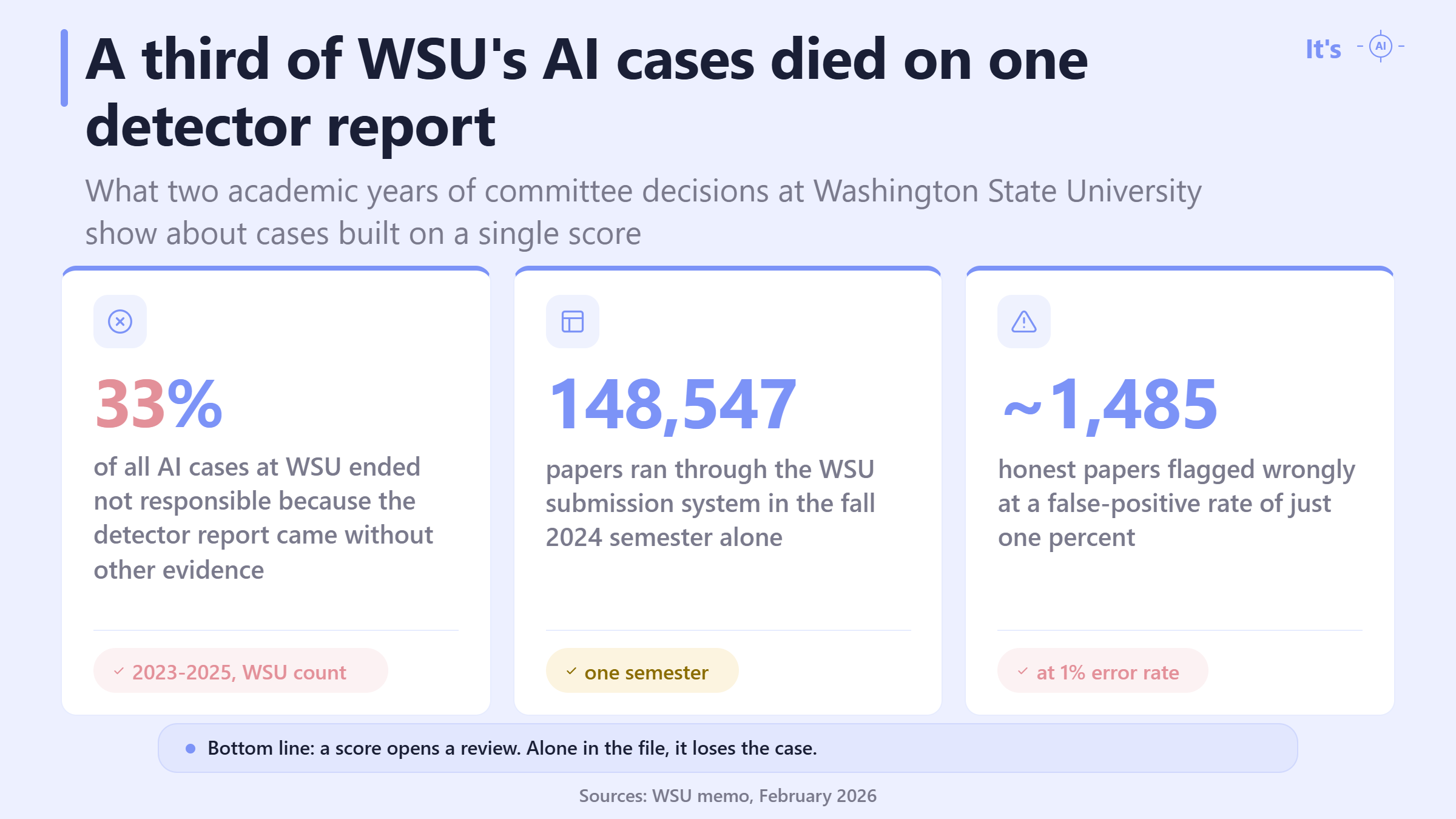
AI cases at WSU, 2023–2025: how often a case collapsed because the detector report came alone, and what that meant at the volumes the university handles.
In the volume of papers which passes through the WSU system in a single semester, even rare mistakes add up to thousands of honest works marked wrongly over a year. And behind each such mark there is a student who wrote the paper himself.
The court in New York, the committee in Pullman and the honor council in Nashville never spoke to one another. But all three of them now begin a review from the score instead of ending it there.
Who Still Needs a Detector Where It Has Been Turned Off
At WSU the objection came first of all from the instructors themselves. In its answer of February 13, 2026 the faculty senate listed everything the memo had passed over in silence: the switching off happened in the middle of the semester, nobody was consulted, nothing came instead of the module, and the internal rules already forbade building a charge on one report.
For the students this report was invisible from the very beginning. What the detector thought about his essay, Newby found out only after the zero was already in his record. The check before submission is the only version of this report which the student holds in his own hands, and it comes early enough to collect the drafts, the sources and the history of versions.
How to Build an Academic Integrity Case That Holds Up
At Vanderbilt the replacement has been written down. The Honor Council there reads the instructions to the assignment and the AI policy in the syllabus, compares the essay with the earlier works of this same student in the course, and listens to both sides, while the scores of detectors and the papers of other students remain outside. To this one has to add the history of versions with the drafts, and the written talk with the student held before any report. For Newby the check of the syllabus would have mattered most, because his course did not forbid grammar tools at all.
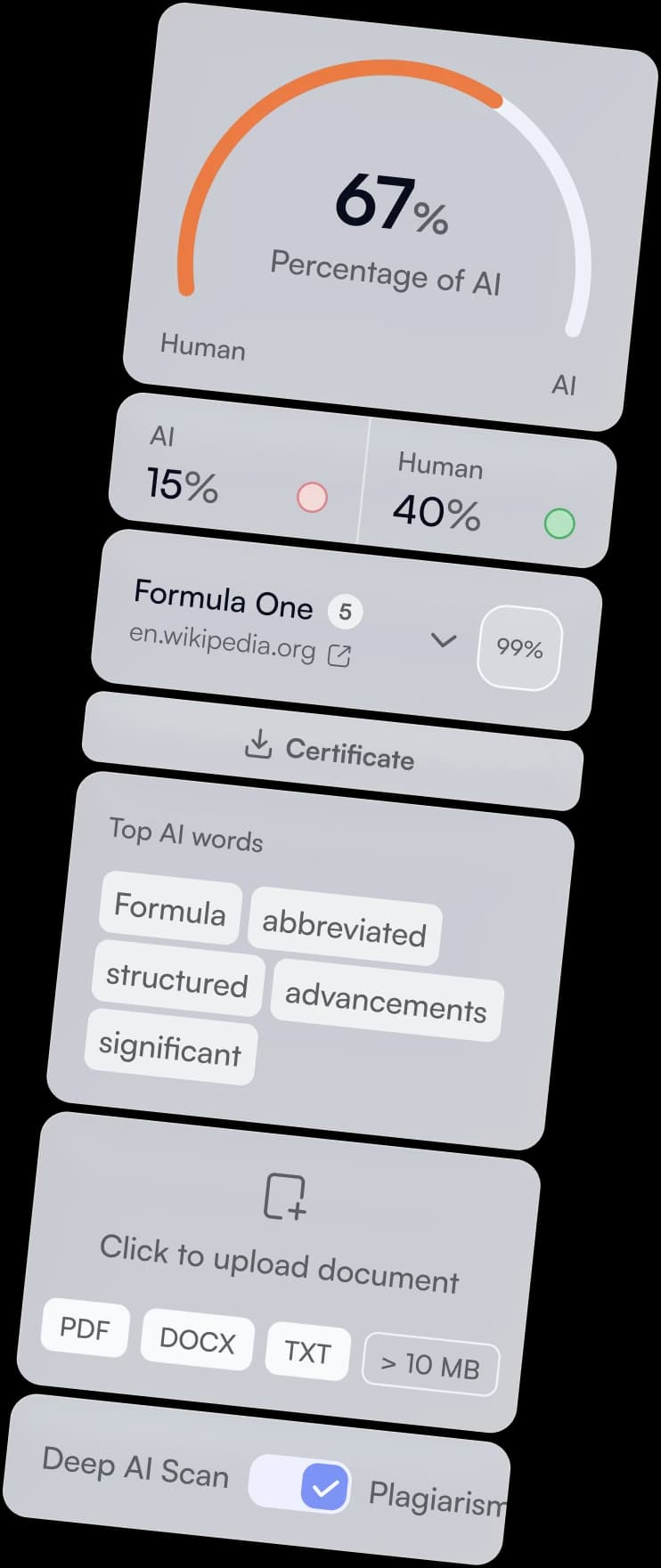
It's AI stands at the entry point of this procedure: the breakdown by fragments names the passage which is worth asking about. No detector, ours included, can carry a sanction alone. Kansas tells its faculty the same thing in plainer words: "The tool provides information, not an indictment." Its advice for what comes next is to compare the paper with the student's earlier work, talk to the student, and "focus on the problematic aspects of the writing" instead of the score.
What to Do at Your University This Week
It is worth beginning with the appeal route, because at Adelphi one administrator who decided both rounds turned out to be enough for the annulment by itself. After this, count how many cases out of the last ten of your committee stood on a single document. Six figures is what the Newbys paid to fight a zero and a workshop. Most families never pay that, so most procedures have never been tested.
FAQ: AI Detection as Evidence
Can AI detectors be used as proof of cheating?
No. An AI detector score is a probability estimate, not proof of authorship. Detectors compare a text against statistical patterns of machine writing; they cannot see who typed the words, what tools were open, or whether editing help was allowed for the assignment. That is why integrity offices treat a detector report as a reason to look closer, paired with drafts, version history, and a conversation with the student. A score alone answers "does this look machine-like," never "did this student break the rules."
How accurate are AI detectors for universities?
Accuracy depends on the text, not just the tool. Detectors perform best on long, unedited prose and worst on short answers, heavily edited drafts, and mixed human-AI writing. Research has also documented higher false-positive rates for non-native English speakers, whose sentence patterns can resemble machine output. For a university this means one number cannot carry a case: the same essay can score differently across tools and text lengths. A detector with a fragment-level breakdown narrows this problem, because reviewers see which passages raised the flag instead of judging the whole paper by one percentage.
What happens if an AI detector flags a paper falsely?
The consequences depend on what the institution does next. Where a flag starts a conversation, a false positive costs the student one meeting and an explanation. Where a flag goes straight to a misconduct report, it can mean a zero, an integrity record that follows transfer and graduate applications, and an appeal that takes months. The flag itself is recoverable; the procedure built on top of it decides how expensive the error becomes for both sides.
What should a student do if falsely accused of using AI?
Collect the evidence of process before the first meeting. Export the document's version history, gather drafts, notes, and sources, and ask to see the detector report the accusation is based on, including which passages were flagged. Check the syllabus for what the course actually allowed, and check the student handbook for the right to an advisor. Answer questions about the content of the work: explaining your own argument is the strongest reply available. Running the text through an independent detector before the hearing shows how the same paper reads across tools.
What does an AI detector report actually show?
A detector report shows how closely a text matches the statistical patterns of AI-generated writing. Document-level tools return one percentage for the whole file. Fragment-level tools break the text into passages and score each one, which is the difference between "this paper is 40% AI" and "these three paragraphs look machine-written, the rest does not." The second format is the one a reviewer can act on: it names the places worth asking about, and it leaves honestly written sections out of the question.