AI detectors for grant applications: understanding what the result means | It's AI
AI Studies
AI detectors for grant applications: understanding what the result means
See what an AI detector can tell you about a grant application, how funding rules differ, and why checking the final text helps teams prepare for submission.
Svetlana ShakhovaOct 15, 202614 min read
There is usually more at stake than the text we submit for review. We may be hoping to get a job, find a client, or win support for an idea. You can spend a long time choosing your arguments and rewriting the opening, expecting someone at the other end to read it and understand why it deserves attention. But what if the text never reaches that person because AI rejects it first?
That is what happened in a funding call run by the CRANE research network. Of 179 applications, almost half did not pass the automated screening and never received a full review by experts. In early October, the organisers announced that the rejected applications would be reviewed again. The story continued, but one question remained: how much of a decision about someone else's work are we prepared to hand over to a machine? Times Higher Education report.
AI is already involved on both sides. It helps people prepare applications, while organisations look for ways to review them faster. Some check whether the submitted text was generated by AI. Others try using a model to assess the project itself. What the result should mean for the person waiting for an answer depends on the task the tool is doing.
Curious how your own text scores? Check it right here.
characters (min 200): 0/500000
PDF, DOCX, TXT
Deep AI Scan
find out which part of text seems AI-generated with our sentence-level segmentation.
Plagiarism check
detect plagiarized content by comparing your text against online sources.
Grammar check
find grammar and spelling mistakes in your text.
4000words left
AI grant screening: a quick rejection can lead to another review
In the CRANE funding call, run by a research network based at the University of Oxford, a model helped decide which applications would go to the experts. It was not looking for signs of AI-generated writing in the applications.
The organisers said they had used human checks on a sample of applications, along with statistical cross-checks. After criticism, however, they acknowledged that the process had not been transparent enough. They decided to review the rejected applications again and suspended funding offers already issued. Details of CRANE's decision.
This does not mean that all the original rejections were wrong. But the first quick check did not finish the job: another review was needed, and even those who had already received funding offers had to wait. In our view, that extra work also needs to count when assessing the benefits of automated screening.
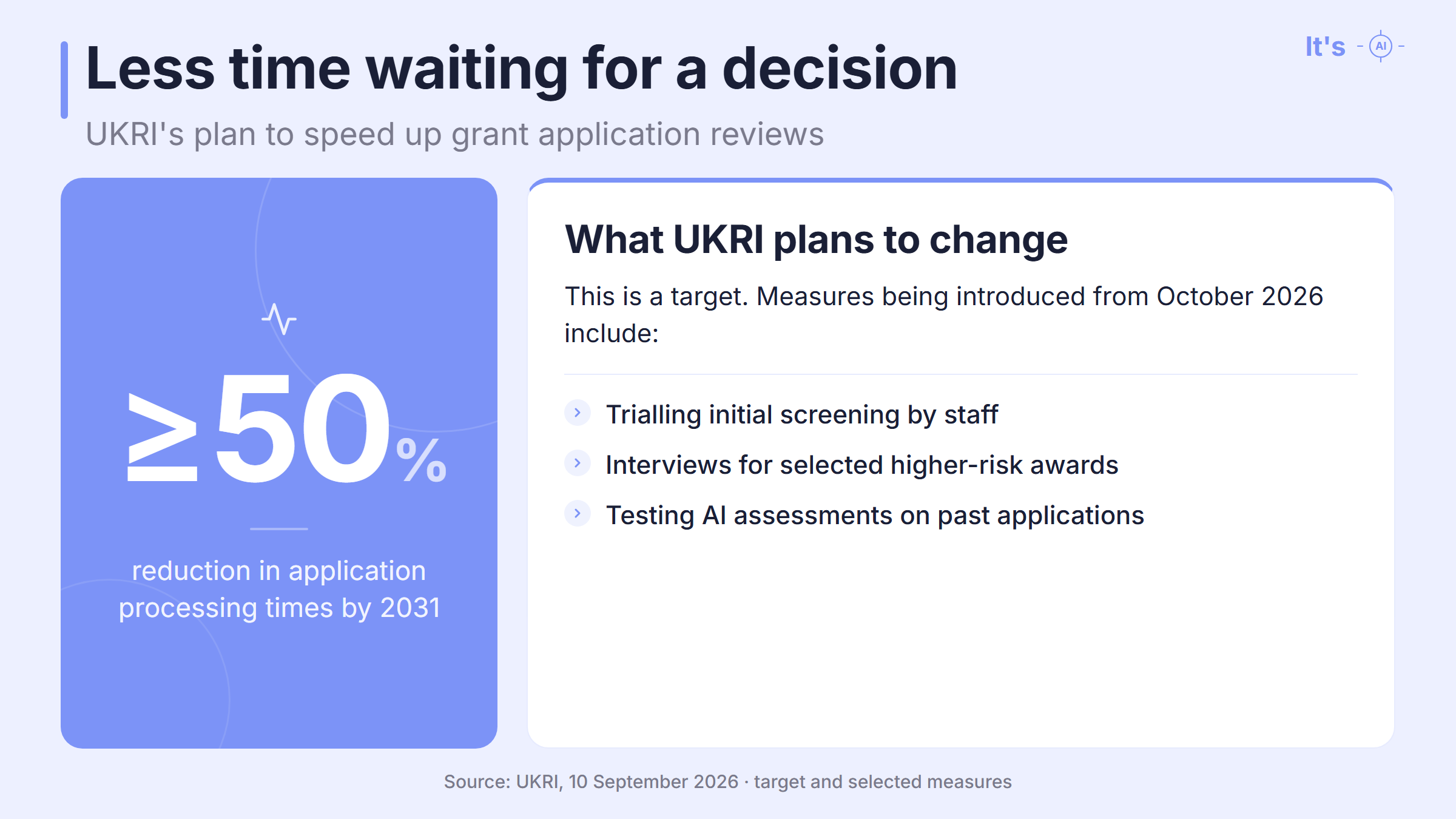
Long waits for a decision remain a problem, though. UK research funder UKRI has announced a programme to speed up application reviews. It includes several approaches, with staff reviewing applications and an experiment using AI on past submissions. UKRI's plan.
For an applicant, there is a significant difference here: a proposal may be rejected because the project is weak, or it may be excluded from assessment because it does not meet the rules. In the second case, even strong arguments for the research do not solve the problem.
A strong grant application may still break AI-use rules
The US National Institutes of Health, or NIH, allows limited AI assistance in preparing applications under certain circumstances. But it does not consider applications or sections substantially developed by AI to be the applicants' original ideas and will not consider such applications for funding. This is the position of one particular funder, set out in its guidance on AI use.
The researchers may have come up with the study themselves, then used AI to write a description of it. They may also have checked every fact in that description. There is still a question about how much of the writing came from the model and whether the funding rules allow it.
“We read and corrected everything” leaves that part unexplained. Editing helps make a text accurate and clear. Checking for signs of AI generation adds information about the finished text that the editor may not have been looking for.
For us, this is the main change: rules on AI use make the way a document was prepared a separate matter to check. A well-explained idea can still leave the team with questions about how the text was written.
AI detection and grant review answer different questions
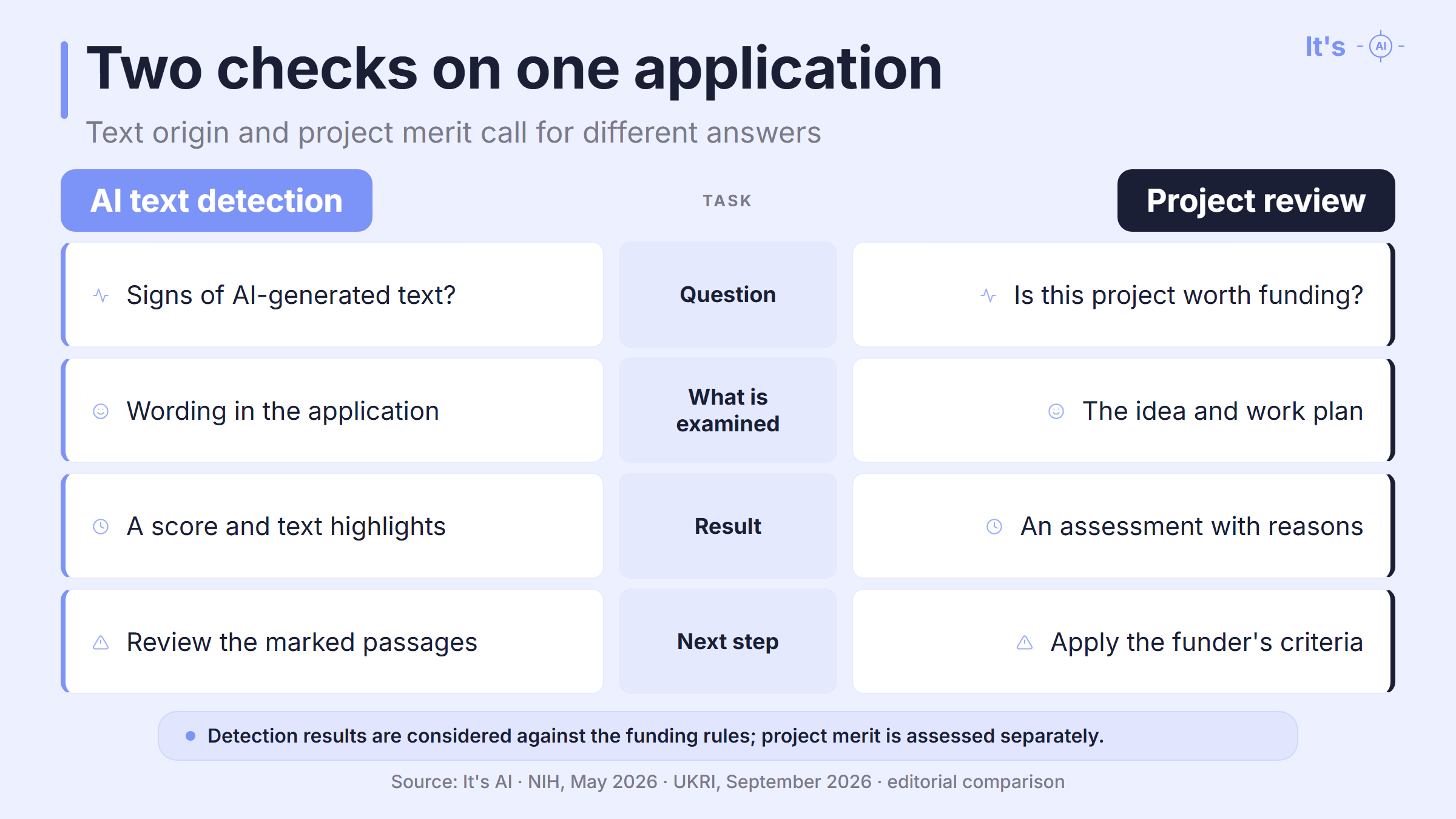
An AI detector checks the writing for signs of generation. The people reviewing the project have to consider whether the proposed work can be done and whether it is worth funding. They need more than a percentage to make that decision.
If a reviewer wants to know how a paragraph was written, the author can refer to the drafts. If the concern is about the research plan, that is the part they need to explain. Knowing which question is being asked makes it easier to respond.
We consider a check useful when it makes the remaining question about the document clearer. Otherwise, a team may end up changing perfectly good wording when the concern lies somewhere else.
Reviewing grant applications with It's AI
With a long application, we would look at the highlighted text as well as the percentage. It's AI marks the passages it classifies as AI-generated. You can read those parts with the rest of the paragraph and decide where to look more closely.
If a paragraph in the methods section is marked, we would compare it with an earlier draft. Only a few sentences may have changed. Or most of the paragraph may be new. The team can see what happened and, if AI was involved, check whether its use was allowed under the funder's rules.
The drafts provide the history of the changes. The detector report helps the team choose where to begin that comparison, without having to examine every section in the same detail.
This can be especially useful when several people prepare an application together. Whoever puts the final file together may know some sections much better than others. They can use the highlights to decide which parts to discuss with the colleagues who wrote them.
When to check a grant application for AI
We'd check the version that is ready to send, while there is still time to make changes. Someone on the team may need to find an old draft or speak to the colleague who wrote a section. Leaving the check until just before the deadline gives them little time to do either.
What happens next depends on the funding rules and what the team finds. They may need to explain their use of AI or do more work on a section. Trying different synonyms until the percentage drops would leave the original question unanswered.
We would want the team to finish the check knowing which passages it reviewed and why it is satisfied with them. Then, if a funder asks about the writing later, the authors have more to refer to than a score.
FAQ: AI detection for grant applications
These questions cover short texts, confidential applications, and reports from earlier checks.
Can I check a short grant abstract for AI?
It's AI accepts texts of at least 200 characters. A shorter abstract cannot be checked on its own. If you add other sections, the result will apply to all the text you submit. It should not be presented as a separate assessment of the abstract.
Can I use an AI detector on a confidential grant application?
First, check your organisation's rules and the service's data handling terms. An application may contain unpublished methods or information belonging to partners. Permission to read a document as a reviewer does not necessarily include permission to send it to an external service.
Do I need to send an AI detector report with my application?
That depends on the requirements of the funding call. The check can remain an internal part of preparing your application. If the organiser asks for a report, it should refer to the version you submit.
Should I check the text for AI again after editing?
Another check is useful if you have substantially rewritten a section or added new text. The previous result applies to the earlier version and does not cover later changes. Small corrections do not always call for another scan.