AI detector for surveys: why check responses before analysis | It's AI
AI Studies
AI detector for surveys: why check responses before analysis
AI-generated survey responses can affect business decisions. See how an AI detector helps teams review written answers before using them to plan product changes.
Svetlana ShakhovaSep 28, 202615 min read
A company asks customers why they decided not to buy. The team will use their answers to decide whether to change the price or the product itself. If AI invented some of those explanations, money could go toward changes that do not address the real reason.
The survey may still look successful: there are enough responses, and people have explained their preferences in detail. The substitution may only become apparent when someone checks where those explanations came from.
At It's AI, we believe checking survey responses with an AI detector is useful before drawing conclusions. It helps identify texts with signs of generation before the team uses them to support its decisions.
Curious how your own text scores? Check it right here.
characters (min 200): 0/500000
PDF, DOCX, TXT
Deep AI Scan
find out which part of text seems AI-generated with our sentence-level segmentation.
Plagiarism check
detect plagiarized content by comparing your text against online sources.
Grammar check
find grammar and spelling mistakes in your text.
4000words left
How fake responses disrupted survey data collection
In September 2026, researchers at East Carolina University described how bots disrupted data collection for a survey. They recruited participants through Facebook ads and offered entry into a cash prize draw for completing the questionnaire.
After the ads launched in early 2025, more than two thousand responses arrived within a day, far more than the researchers had received before. They checked the locations associated with IP addresses and other questionnaire data. Following those checks, they classified most responses as fraudulent and stopped collecting data.
The team tried to continue the study. First, they added CAPTCHA, then restricted participation to the required region and included a question about that area. But bots continued to submit responses. The authors ultimately considered the collected data unusable for analysis.
In this case, the large number of fake responses became apparent. But AI-generated answers can also come from real participants who have passed screening.
Why check the text if the survey participant is real?
Suzannah Gerber and Sean B. Cash encountered this situation in their own research. In a commentary published in Communications Psychology, they described responses to a question asking what carbon neutrality means.
Participants were screened using attention checks and an analysis of their behavior while completing the questionnaire. But when the researchers read the answers, they noticed detailed, nearly identical definitions. One even contained elements of the Google AI Overview interface, copied along with the text.
A person could pass screening and complete the questionnaire in good faith while using a ready-made explanation. That matters for the study: the researchers asked how the participant understood the term but received a definition from another source.
A similar situation could arise in a customer survey. Suppose a company wants to find out whether people understand the terms of a new subscription plan. A participant could not make sense of them, asked AI to explain, and pasted the resulting text into the questionnaire. From that answer, the team might conclude that no further explanation is needed. Yet the difficulty the survey was meant to uncover is still there.
So data quality cannot be assessed only by checking who completed the questionnaire.
What is checked
What the team can learn
Participant information and questionnaire completion data
Whether there are signs of duplicate or suspicious submissions, and whether the participant meets the survey requirements
The response text, using an AI detector
Whether there are signs of generation and which passages deserve a closer look
The content of the response
What the participant reported about their experience and whether their explanation answers the question
Checking the text for AI adds information that participant screening does not provide. It is particularly relevant when a company asks people to explain a decision in their own words or describe their experience with a product.
How AI-generated responses can affect company decisions
Repeated explanations can easily be taken as evidence of a shared problem. If several customers independently name the same reason for not buying, the team has grounds to investigate it. But if models composed the answers for them, the similarity may have a different cause.
Simone Zhang and her coauthors compared human responses from three studies conducted before ChatGPT with responses from language models. The findings described on the author's research page show that generated responses were more uniform and positive. This was particularly apparent in descriptions of social groups in sensitive questions.
The study does not measure business losses from customer surveys. But it gives us reason to consider what a company might interpret as agreement. Several similar texts do not necessarily mean that different people independently reached the same conclusion.
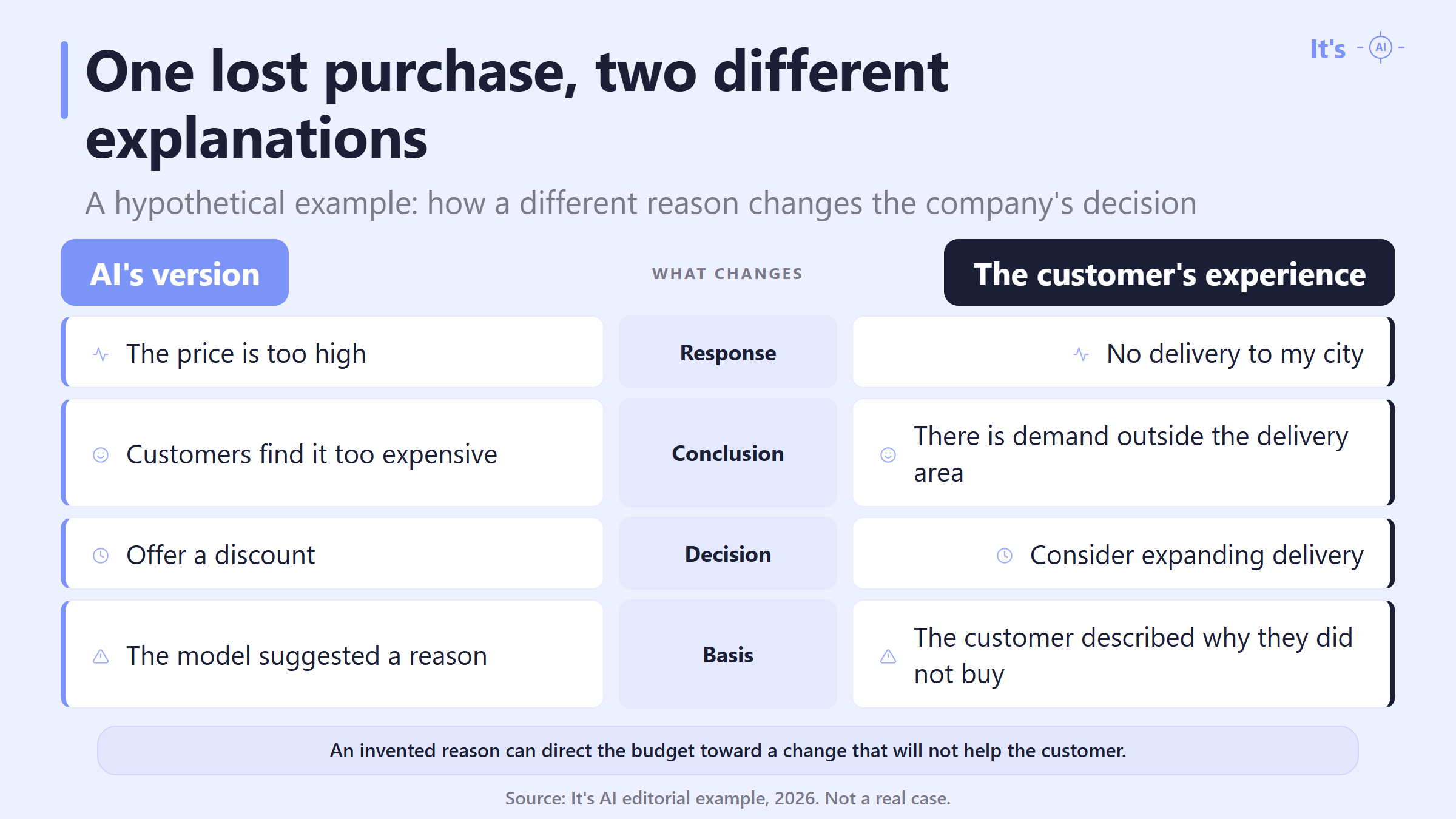
For a business, the mistake happens when such an explanation becomes a recommendation. Imagine a store investigating why people did not complete a purchase. Below is a hypothetical example of how an answer invented by AI, without reference to the customer's experience, could change the team's decision.
In this example, the store could lower the price, but the customer would still be unable to place an order. The discount would reduce revenue per purchase without addressing the reason for this particular lost purchase.
AI-generated responses do not have to make up the majority to have this effect. A single detailed answer could be included in a presentation as an explanation of the problem. If it matches an idea the team was already discussing, it may be taken as another argument in its favor.
We would therefore consider both the number of suspicious responses and how they will be used. A text that becomes the basis for an expensive product change deserves a separate check.
What checking responses with an AI detector adds
When there are many detailed responses, an analyst cannot always examine each one equally closely. An AI detector helps select texts for further review.
For example, a questionnaire contains a brief account of a specific event, followed by a long, general explanation. If the detector highlights the second part, there is reason to look separately at what information it adds. Is the person describing their own situation, or does the answer contain reasoning unrelated to it?
That is not yet grounds for automatically removing the questionnaire. The detector result concerns signs of generation in the text, not the truth of everything the participant said. But it helps direct attention to a passage that could affect the conclusion.
Checking before preparing the report can save work by addressing these questions earlier. While an analyst is examining an individual response, they can still change how it contributes to the conclusions. If a recommendation has already been built on it, its supporting argument will need to be reviewed too.
For us, the value of an AI detector in surveys is to help the team check the material before it affects the budget. A company commissions research because it needs information about its customers. A detailed AI-generated answer may look useful without adding that information.
FAQ about checking survey responses with an AI detector
When working with questionnaires, consider the length of individual answers and keep each check result linked to the original text.
Can an AI detector check a short survey response?
It's AI requires a minimum of 200 characters per check. An answer of just a few words is too short for that scan. Do not add text simply to meet the minimum: the detector would then be assessing an altered response. A short answer can be considered alongside the other information in the questionnaire.
Can you combine participants' responses for an AI check?
If you need a result for each response, check them separately. When responses are combined, the detector assesses the combined text. One person's long explanation will take up more of it than other people's short answers. The resulting percentage cannot be attributed to every participant.
Can you check a survey summary with an AI detector instead of the original responses?
Checking a summary only tells you about the summary's text. If AI wrote it, that says nothing about the origin of the responses: people may have written them. To check the survey material, you need the answers as the participants originally submitted them.
Does a plagiarism check replace an AI check for survey responses?
These checks answer different questions. A plagiarism check finds matches with other material, while an AI detector assesses signs of generation. Finding no matches does not confirm that a participant wrote the response themselves. It's AI offers AI detection and plagiarism checking separately.