What the rules say: human input matters to all of them
The Google policy is called scaled content abuse, and it describes two things: there are many pages, and they were made to move rankings. About the way the content gets made, the policy is plain: that part does not matter. In a separate guide Google adds that AI models are fine for researching a topic and for giving structure to your own material, and the violation remains piles of pages with nothing in them for the reader.
Yandex, in its Webmaster help, lists the markers of low-value text: drifting off topic or looping through the same reasoning, sentences written for length, shallow reasoning built from the page title, invented facts presented as real. While we were preparing this article, the date stopped us: that list was written in 2017, five years before ChatGPT. These are the ordinary edits an editor makes in somebody's weak article. AI models were added to the same help page later, as a separate line, as one more way to get a text that nobody edited.
Naver updated its spam guide this summer, explained the revision by the growth of AI content, and said it more directly than anyone: the use of a technology is not, by itself, grounds for a decision. Its one requirement is to add your own experience to generated material. Baidu says nothing about generation at all, its algorithms punish scraping other people's content, and the labeling of AI texts in China is required by the state, under a separate law.
| Search engine |
What counts as a violation |
Wording in force since |
| Google |
Scaled content abuse: mass-produced pages made to manipulate rankings, however they were created |
March 2024; manipulation of generative AI responses added May 2026 |
| Yandex |
Low-value text: off-topic, padded, repetitive, invented facts |
2017; AI models named in the help page later |
| Naver |
Web content spam; technology use alone is not grounds for a decision |
Guide since 2019; AI wording July 2026 |
| Baidu |
Scraping and reusing other people's content; no AI-specific search rule |
2017; state AI labeling law since September 2025 |
All four ask for the same thing: a human has to work on the text. The work itself cannot be measured, but its traces in the text can be seen, and the markers from the Yandex help page describe exactly those traces. While reading four rulebooks in a row we caught ourselves nodding: this is, almost word for word, an editor's checklist. The search companies never sat in our editorial meetings, yet they wrote down the same list we use.
A test on a live site: six articles against two thousand
Put together, the rules make a promise: edited AI text is fine, the conveyor belt is not. Nobody is eager to test that promise on their own site, which is why the SE Ranking experiment is worth reading: the company ran the test on itself and published the results in March 2026.
Six articles went out on the company blog, each made with AI and then edited by the team. A year later half of them sat in the organic top 10, and for most target queries the AI Overview named the article as a source. The other two thousand articles nobody edited at all: they went to twenty fresh sites exactly as generated. Their numbers grew for the first couple of months, then around month three the visibility dropped away and never returned before the experiment closed.
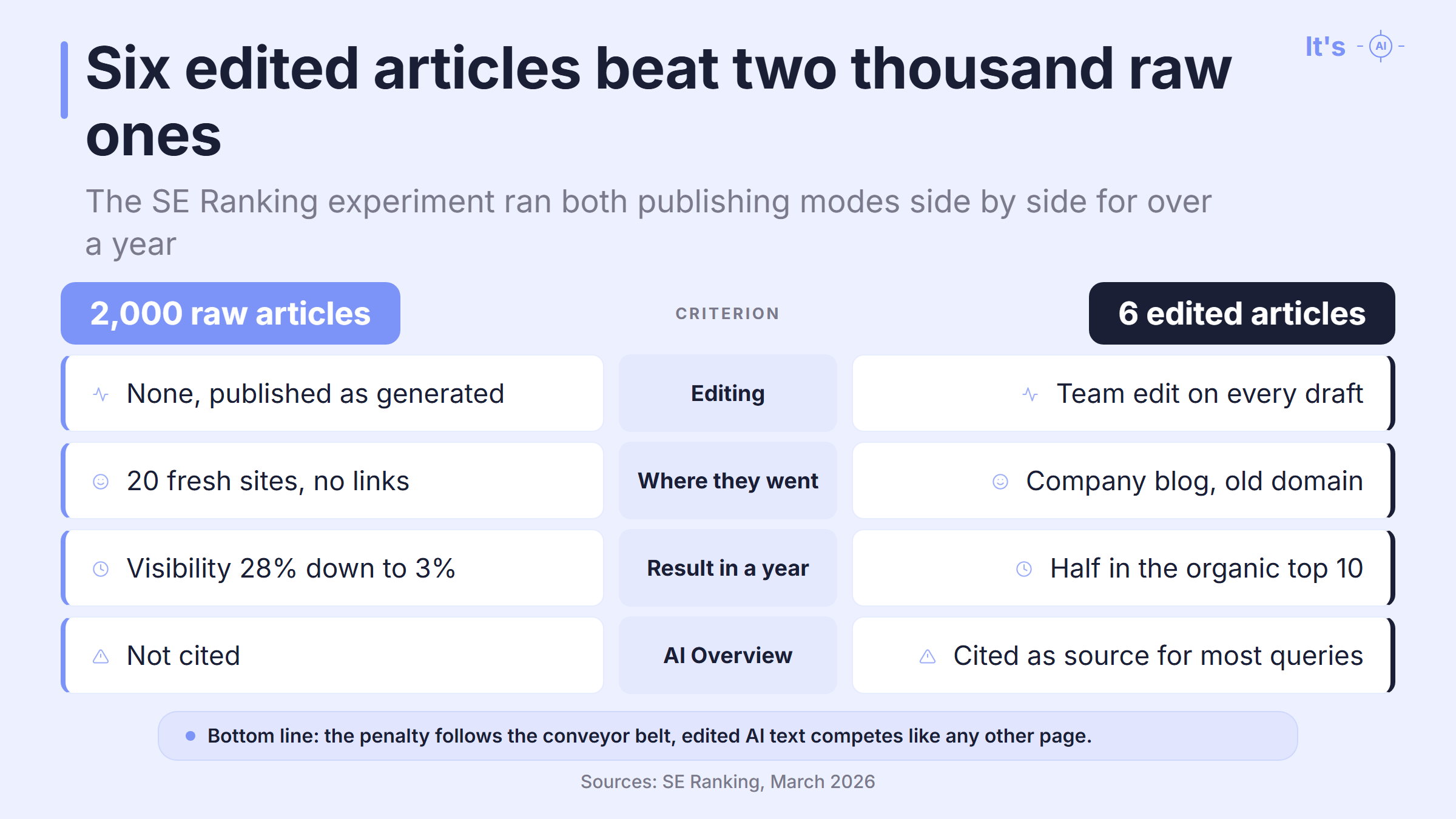
Two SE Ranking trials in one picture: the edited six on the blog, the generated two thousand on fresh sites
One honest note: editing is not the only difference between the trials. The blog stood on an old domain, the twenty sites started from zero and with no links. But at the scale of the whole web the picture is the same, and it was obtained with detectors: Graphite ran 55,400 pages from Common Crawl through three detectors and saw that mostly machine-written articles almost never appear in search results. False positives stayed under two percent, which the authors checked separately on articles written before ChatGPT. We will be honest about our seat in this game: we build a detector, so a study that needed three detectors to exist reads to us like a small compliment. Keep that bias of ours in mind, the numbers stay the same either way.
Why a detector matters when Google does not check origin
A search system has no use for the question of what wrote a text. Millions of sites pass through it, and a conveyor belt shows up there by a few signs at once: pages arrive by the thousand within weeks, most of their content repeats what the index already holds, and the pages look alike because they all came from one template. An editor is in a different spot: there is one page in front of them, the decision to publish is made today, and feedback from search arrives months later. Google's documentation says as much: after fixes, its automated systems need months of watching before they accept that a site follows the rules.
So before publishing there is one question worth answering: did the editing change the structure of the text. That is what separated the two SE Ranking trials. Blind editing may not give the result you want here. Swap a dozen words and fix the headings, and the article will feel like your own, but there is no way to see by eye whether the structure stayed machine-made. That is what the It's AI detector shows: how far the text is still built like a machine wrote it. If the score stays high after editing, the changes touched the surface and the structure stayed as it was. With that knowledge you go back to editing before the text goes out. The detector's score does not predict rankings, the spam filter has criteria of its own. There is some irony in how this works out: the tool with a reputation of a cheater catcher ends up most useful to the honest side, the writer who did edit the draft and now wants to know whether the editing actually took.
A check like this does not depend on updates: the answer is there before publishing, with no months of waiting for search to react. Even the search engines themselves keep detection and ranking in separate places: Yandex, for one, has its own public detector, and it is not connected to search results in any way.
AI answers: a second channel with a bias of its own
There is now one more path a text takes to the reader: answers written by AI. This channel is built differently. Its sources are picked by neural retrieval, and a bias has been measured in those models: of two equally fitting passages, the machine-written one is placed higher. The measurement is from research benchmarks, nobody has repeated it inside a live AI search product. An indirect confirmation is visible from outside: according to Ahrefs, the pages cited in Google's AI Overviews overlap less and less with the top of ordinary results.
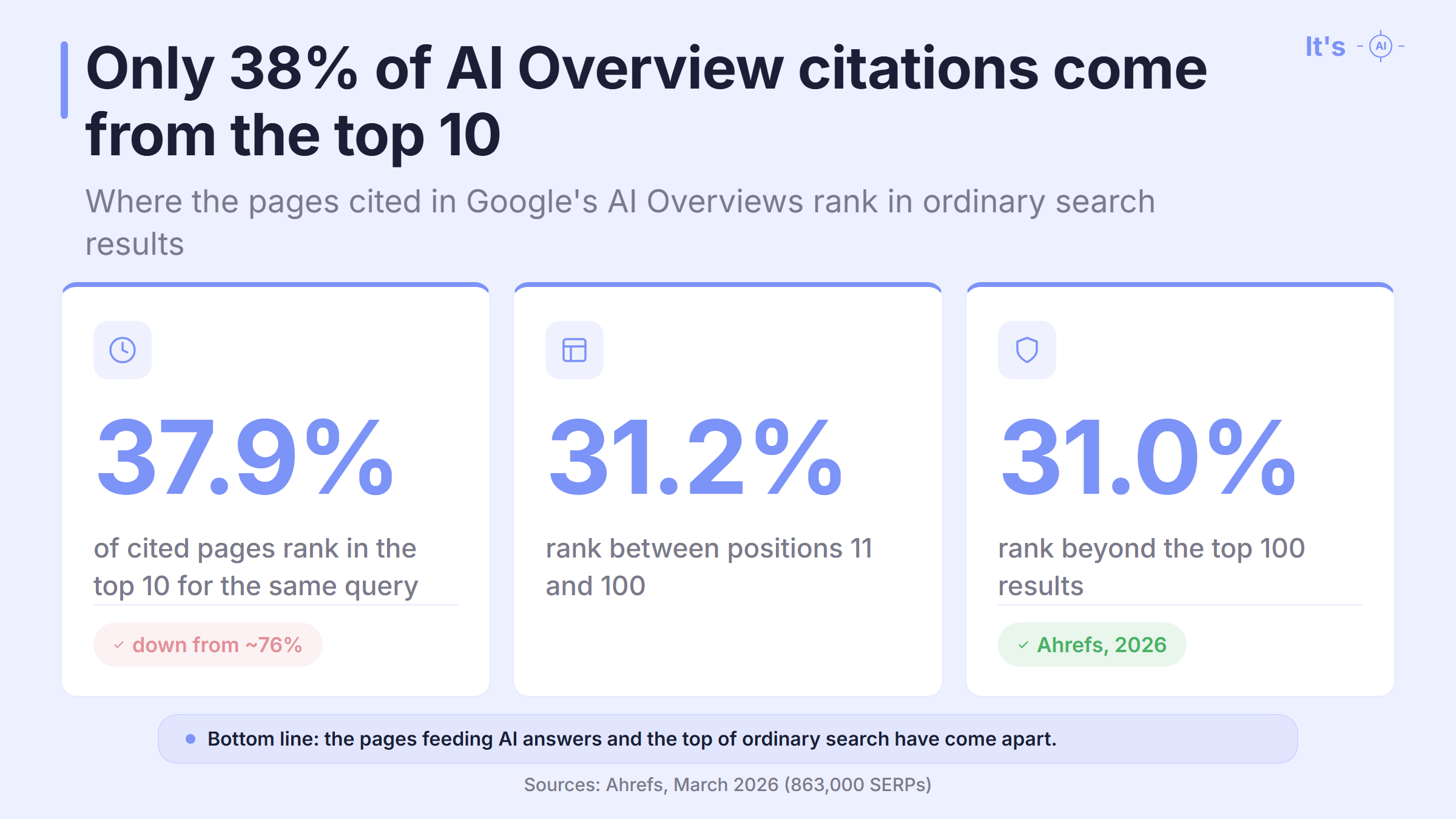
Where the pages cited in AI Overviews rank in ordinary search results
Google's rules already extend to this channel: since 15 May 2026, attempts to manipulate generative AI responses count as spam, the same as manipulating rankings. For an editorial team the conclusion is simple: there are two channels, they work differently, and it is too early to choose between them.
What is left for the editorial team to do
Clicks from search keep shrinking: according to Pew, with an AI summary on the page clicks on regular results drop roughly by half, and links inside the summary get almost none. Reading what happened to a text's rankings from its traffic no longer works.
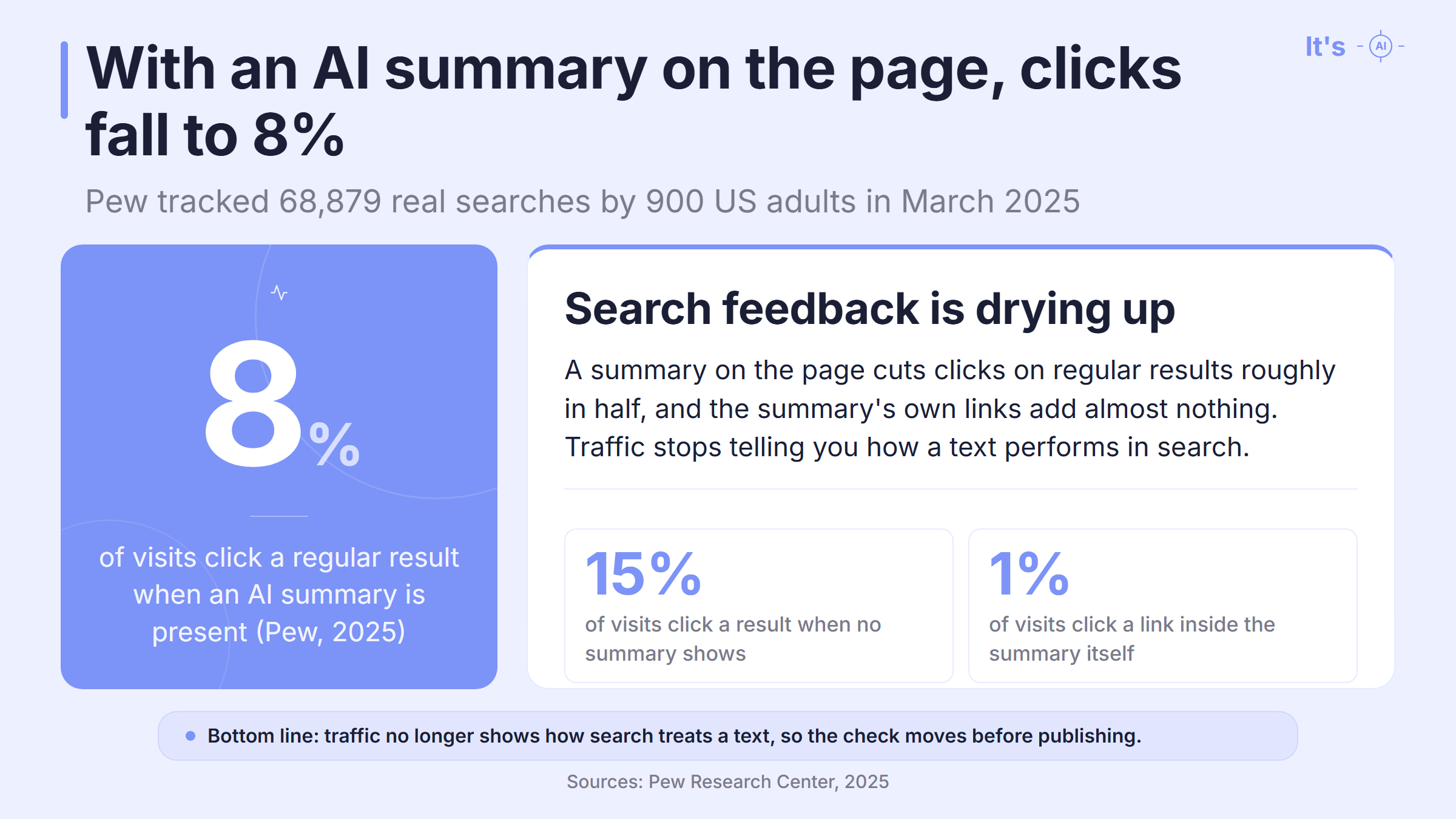
Click rates from the Pew data: with an AI summary, without one, and inside the summary
What remains is the part that does not depend on updates. Updates will keep coming, and Google ships them faster than we ship blog posts. A list of the machine-made texts in your own archive will be useful in any of them.
FAQ
Does Google penalize AI content?
No. What Google penalizes is scaled content abuse: many pages made mainly to move rankings, and how they were made does not matter. Its current form the policy took on 5 March 2024, when it replaced the older rule against automatically generated content; two more policies arrived the same day, one on expired domains, one on site reputation abuse. Google's own guidance says that appropriate use of AI or automation does not break the guidelines. So an AI-assisted article with real editing competes like any other page, and mass-produced pages risk a penalty whatever tool stands behind them.
Do AI detectors work on edited AI text?
Partly, and this is exactly why they are worth using. A detector reads the structure of a text. Light editing, a swapped word here, a rewritten sentence there, usually leaves the score high. Deep editing, the kind that rebuilds paragraphs, brings the score down. So the detector works as a gauge of editing: surface fixes and real rework give different numbers. The hardest case for any tool is hybrid text, where human and AI-generated passages mix. For such text segment-level results tell more than one score for the whole document.
How accurate is AI content detection?
It depends on the tool and on the text, so the honest measure is the false positive rate on text that is known to be human. In the Graphite study from May 2026 the detectors, used there on 55,400 web pages, returned between 1.36% and 1.84% false positives on articles written before ChatGPT existed. Long unedited machine output is the easiest case. Short fragments and heavily edited text are harder, and a score on them is a signal to review the text, not a proof by itself.
What happens to AI content after a Google spam update?
To edited AI content that reads well, nothing: updates target scaled publishing with little value. Sites built on mass generation can lose most of their visibility within weeks, and on its twenty test sites the SE Ranking experiment saw exactly this pattern. Recovery is slow by design: Google's documentation says the automated systems need months of observation before a cleaned-up site regains trust. Sitting an update out is not a strategy. This is why the origin check belongs before publishing, while the fix is still cheap.
How do you check text for AI before publishing?
Run the text through an AI detector as the last step, when all editing is finished. In the It's AI detector you paste the text or upload a file and start a deep scan: the result is marked segment by segment, not as one overall verdict. Look through the segments flagged as machine-built, rework them, scan again. A score that stays high after the second pass means the editing has not reached the structure of the text yet. The same routine fits the published archive too, starting from the most visited pages.