What do they pay attention to?
Style, linguistic construction, and narrative logic
First and foremost, essays require students to bring emotion, reasoning, and reflection into their texts. This makes the "traces" of machine intelligence easy to detect. Unlike a human, AI tends to use formal and unemotional language. These texts lack distinctive words or phrases, or distinctive syntax. And most importantly, they lack specificity. In short, they lack anything that creates an author's individual voice.
Artificial intelligence typically operates with preset structures that aren't typical of the school curriculum, but rather correspond to the language of lawyers or bureaucrats. If such formulaic expressions are ubiquitous and lack any sense of rhythm, the text is highly likely to be generated.
Structure
AI excels at summarizing information. If asked to "discuss the causes of the Cold War," it will list them clearly. However, if we ask it to "produce a thoughtful analysis of which Cold War ideology had the most profound global impact," it will struggle. Its analysis will often be superficial, condensing general points without a coherent thesis or a cohesive thread of original thought running through the text.
This happens because the models are trained to be extremely cautious to avoid generating harmful or biased content. This can manifest itself in over-caution, using phrases like "It could be argued," "One might consider," or "It is important to note," without crafting a compelling, original argument.
Sticking to One Idea
An AI essay may have a thesis, but it's often general, with subsequent sentences simply restating it. This creates the effect of a text that's full of empty words and has no substance. The other body paragraphs may only loosely relate to it. In a human-written essay, each paragraph serves the thesis, which is then proven with arguments or examples.
Factual Errors
Using AI without a detailed introduction to the context produces a large number of factual errors. ChatGPT has already learned to reduce these, but its polished, almost unnatural correctness is certainly a giveaway, making it clear that you're not dealing with a living mind. Artificial intelligence doesn't produce anything unique. Every teacher knows how a child thinks, speaks, and pays attention to things, so a purely formal text on the topic will inevitably raise questions.
Similarity to Other Works
Furthermore, if different students use the same AI tool for the same task, it produces very similar texts: structured, soulless, and irritatingly grammatically correct. The same thoughts will be expressed using different words and constructions, but they will still be formal and unemotional. Teachers don't need a perfect text; they want to see real, living thoughts and the approach to thinking.
AI detection tools
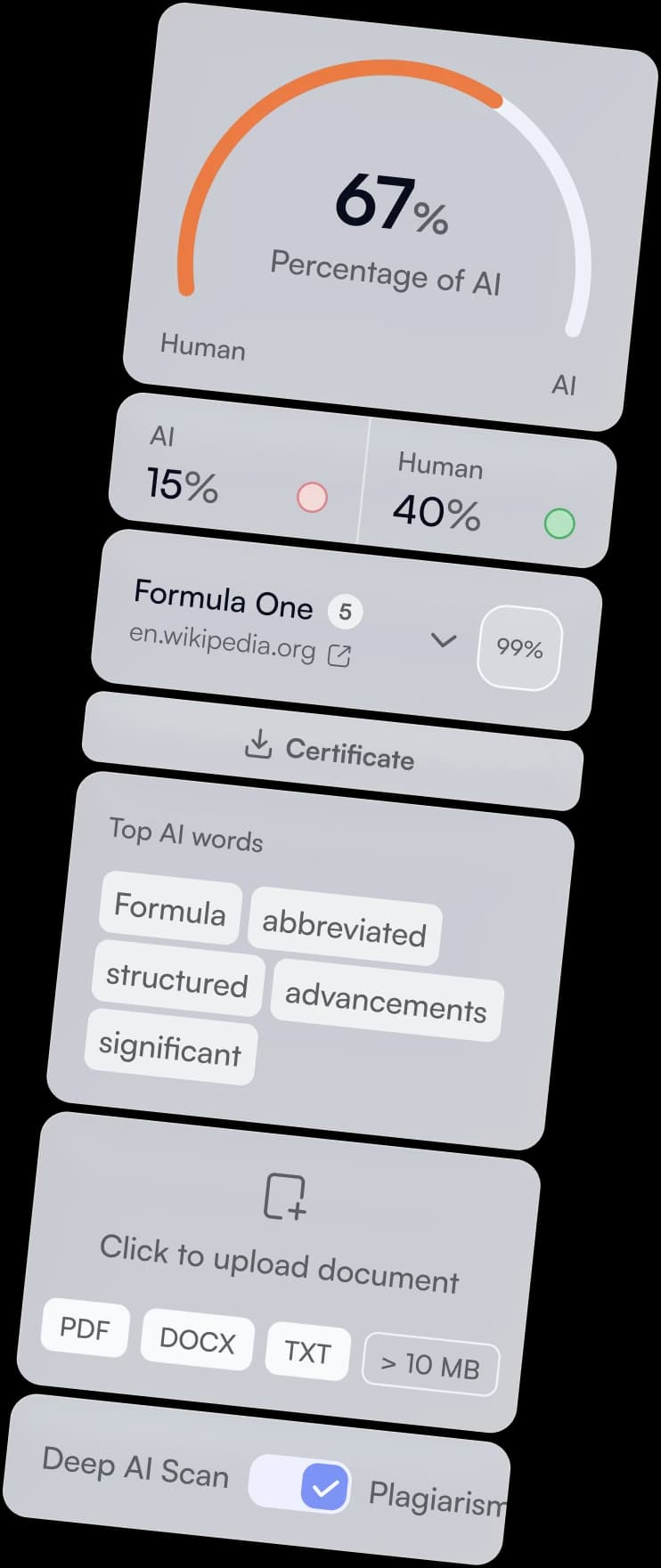
Besides their professional experience, teachers turn to specialized online services and programs for checking whether text is AI-generated:
- It's AI
- Copyleaks
- Sapling
- ZeroGPT
Some teachers also use Grammarly as a grammar assistant: it flags unusual grammar structures, wording, and punctuation.
By the way, this is an interesting experience. The results reveal a student's sense of language and desire to remain honest: for example, there are those who take a text written by GPT but rewrite it for themselves, trying to retell it in their own language. Others leave everything as is. Such an essay can reveal a lot about the student.
Lastly: how you behave
The teacher knows you when the AI doesn't. The teacher sees how you work in class, how you respond, and how you think. If your oral vocabulary or at least the style of argumentation don't match your written text, then even a beautifully written text — even if you haven't used AI — will seem suspicious. A student who struggles with grammar and syntax in class discussions suddenly submitting a flawlessly structured, error-free essay is a classic red flag.
Human vs AI essays at a glance
| What teachers read for |
Human-written essay |
AI-generated essay |
| Voice & specificity |
Distinctive voice, concrete detail, emotion and reflection |
Formal, unemotional, generic; lacks specificity |
| Thesis & structure |
Each paragraph serves and proves the thesis |
General thesis; later sentences just restate it |
| Argument |
Commits to a clear, original argument |
Hedges — "It could be argued," "One might consider" |
| Rhythm |
Varied sentence length and structure |
Uniform, formulaic, little sense of rhythm |
| Across students |
Individual, recognizably the student's own |
Very similar from one student to the next |
Conclusion
Therefore, when checking your essay, the teacher pays attention to style, linguistic construction, and narrative logic. They mentally compare what and how you write with how you respond. And if suspicions persist, AI detectors are used, which provide a more complete understanding of how the student worked on the text, although not all are highly accurate.
In fact, the easiest way to check whether your work seems to be AI-generated or not is to use the It's AI detector. It's highly accurate, and in addition to just an overall AI score it also highlights which exact parts sound like AI.