How to Avoid AI Detection: What the Research Actually Shows | It's AI
How to Avoid AI Detection: What the Research Actually Shows
Four popular methods promise to beat AI detection. The research behind each one tells a different story. What actually works and what just wastes your time.
Svetlana ShakhovaMar 04, 202619 min read
How to Avoid AI Detection: Why Bypass Methods Fail
It is 11pm on a Sunday. Your paper is due at midnight. You ran your ChatGPT draft through a free checking tool and it came back flagged. Now you are Googling how to avoid AI detection, hoping someone on Reddit has a quick fix.
We have seen this play out hundreds of times. People land on this page looking for a way to beat the system. What they find instead is why each popular method falls apart, and what it actually costs when you get caught. This is not a guide on how to beat AI detectors. It is a reality check.
Four methods get recommended over and over. We tested the research behind each one.
Curious how your own text scores? Check it right here.
characters (min 200): 0/500000
PDF, DOCX, TXT
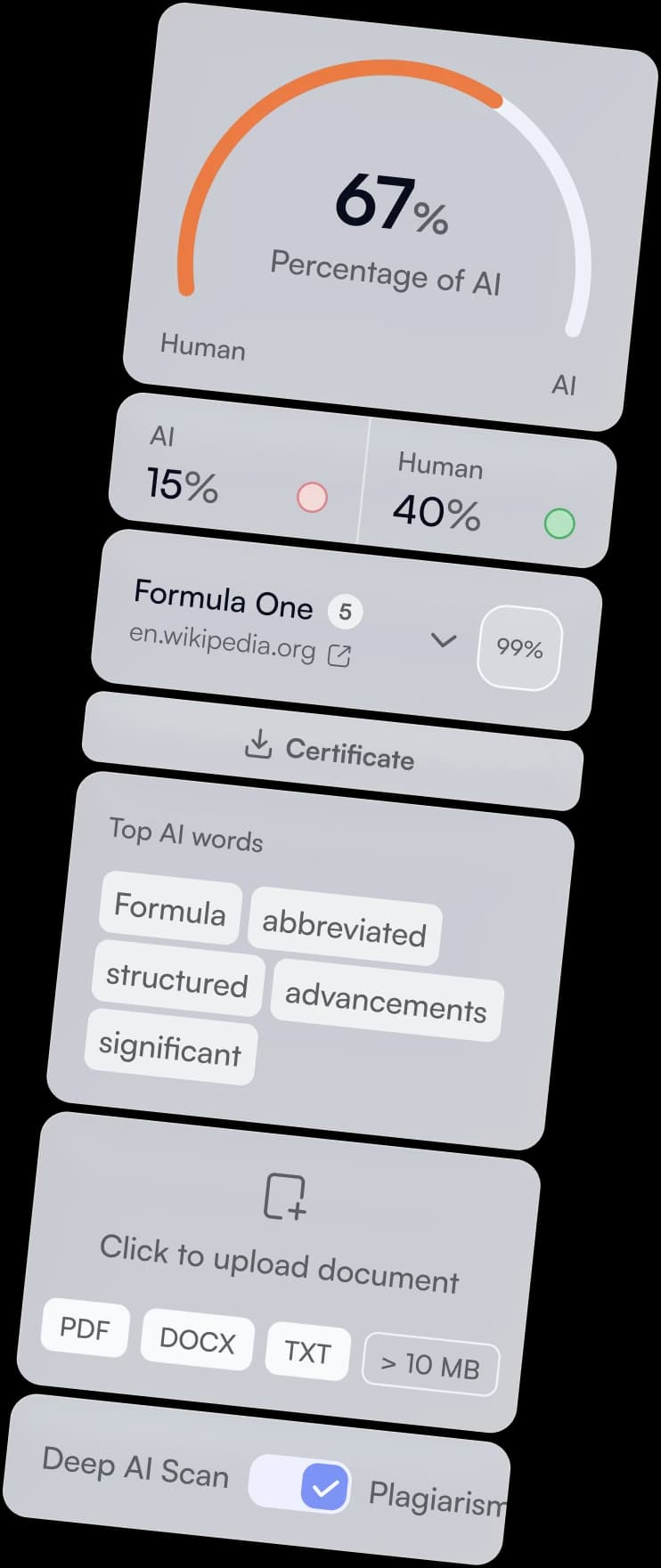
Deep AI Scan
find out which part of text seems AI-generated with our sentence-level segmentation.
Plagiarism check
detect plagiarized content by comparing your text against online sources.
Grammar check
find grammar and spelling mistakes in your text.
4000words left
How to Get Past an AI Detector by Rewording: Why It Fails
The logic makes sense at first. Take your AI text, change some words, rearrange sentences, swap a synonym here and there. If the words are different, a checking tool should not recognize it.
Here is how this actually plays out. Researchers at UMass Amherst built DIPPER, an 11-billion parameter model designed specifically to paraphrase AI text (Krishna et al., NeurIPS 2023). This thing was purpose-built for evasion. It dropped DetectGPT accuracy from 70.3% to 4.6%. Sounds devastating, right?
Except DIPPER had full control over lexical diversity and reordering. It could condition on surrounding context. It was a research weapon, not a browser extension. And it still only crushed older statistical detectors. Trained neural classifiers held up much better.
Now think about what you are actually doing when you reword a paragraph at 11pm. You are swapping "important" for "significant" and hoping for the best. You do not have an 11-billion parameter model. You do not have control knobs for lexical diversity. You have caffeine and a deadline.
Modern tools do not just look at which words you used. They read sentence structure, how ideas connect, how predictable each word is given the ones before it. Swapping synonyms does not prevent AI detection in writing. It does not touch the patterns that actually matter.
And here is the part that matters most: DIPPER knew which detector it was up against. You do not know which tool your professor uses. You are guessing blind. A 2025 study (David et al.) proved exactly why that is a problem. The researchers trained a reinforcement learning model to beat specific detectors. It worked great against the detector it was trained on. Against others? The evasion barely transferred.
That difference between knowing the system and guessing? It is everything.
How to Beat AI Detectors With Character Tricks
This one is more technical. You replace standard characters with visually identical Unicode characters. The letter "a" becomes a Cyrillic "а." Looks the same to you. Completely different encoding underneath.
The RAID benchmark from ACL 2024 tested this across five detection systems. Average accuracy drop: 40.6%. Sounds like it works, right?
One system in the same study lost only 0.3%. The difference: one line of preprocessing that normalizes Unicode before analysis. It's AI does this. Every serious platform that has seen this trick (and by 2024, all of them have) just filters it out.
"A black-box adversary, without prior knowledge of the detector's type, would face difficulty consistently fooling detectors."
— RAID Benchmark, ACL 2024
With character tricks, you either hit an unprotected tool and it works perfectly, or you hit a protected one and it fails completely. No way to know in advance which one your professor runs. Not exactly a reliable way to get past AI detectors.
Undetectable AI Tools: What You Are Actually Paying For
Dozens of "undetectable AI" tools have appeared in the past two years. Monthly subscriptions. Confident landing pages. I have looked at many of them. Most run on the same principle: automated rewording with a few extra steps.
They hit the same ceiling as manual rewording. Here is why.
Remember DIPPER? Purpose-built, 11 billion parameters, full context awareness. Even that needed to know which detector it was targeting. Commercial humanizers do not have any of that. They are running basic paraphrasing without feedback from the detection side.
The 2025 reinforcement learning study (David et al.) took a different approach. The researchers trained their model against live detector APIs. The model got direct reward signals when it fooled a specific detector. After training, evasion on that specific platform was strong.
Why Undetectable AI Is Not Working as Advertised
But here is the catch:
Scenario
Evasion Result
Tested against the same detector it trained on
Strong evasion
Tested against a different detector
Weak, inconsistent evasion
No detector access during training (what humanizers do)
Weakest results
Cross-detector transfer was inconsistent. A model trained to beat one system did not reliably beat others. And this study had something no commercial humanizer offers: direct API access to the detector's scoring during training.
So what are you paying for with a humanizer subscription? A tool that does basic rewording without any feedback from the system that will actually check your text. Does undetectable AI work? It is DIPPER minus the research engineering, minus the detector access, minus the context conditioning. The weakest version of a method that only works when everything lines up perfectly.
Chris Callison-Burch, the Penn Engineering professor behind RAID, put it bluntly:
"It's an arms race, and while the goal to develop robust detectors is one we should strive to achieve, there are many limitations."
— Penn Engineering, Aug 2024
An arms race where the defense side keeps absorbing the offense's playbook. It's AI scored 98.3% on RAID, including texts that had been through various attacks.
How to Avoid AI Detection in ChatGPT With "Human" Prompts
You skip external tools entirely. Instead you tell ChatGPT: "Write as a college student." "Add grammatical errors." "Be less formal." These prompts circulate on forums and TikTok.
Does telling ChatGPT to write like a human actually do anything?
In our experience, no. And the DIPPER study helps explain why. Even a purpose-built 11B parameter paraphraser could not consistently fool trained neural classifiers. A prompt telling ChatGPT to "sound human" is orders of magnitude less sophisticated than that.
The problem is fundamental. When you tell an AI to "sound human," it generates its best statistical guess at human writing. That guess still carries the same fingerprint: predictable word choices, systematic sentence variation, uniform structure. Asking for messiness produces... organized messiness. Checking models pick up on it.
Here is what this looks like in practice. You paste output into a free AI generated text detector. It says "AI." You tweak the prompt, try again. Maybe version two passes that tool. But your professor uses a completely different platform with different models and training. You optimized for the wrong target.
What Getting Caught Actually Costs
Let us step away from the technical side. Say you tried one of these methods and it did not work. What then?
Stanford updated its Honor Code in 2024. Undisclosed AI use now counts as academic dishonesty. Same bucket as plagiarism. They also started a proctoring pilot across 50+ courses for 2025-2026.
Harvard rolled out a three-tier policy: "AI-permitted," "some AI," "no AI." Using AI in a "no AI" course is a violation. And 92% of students now use AI in some form (HEPI 2025 survey, up from 66% in 2024). That spike means universities are investing in better enforcement, not less.
It goes beyond campus. Schneier and Sanders at Harvard warned about wider damage:
"Society suffers if the courts are clogged with frivolous, AI-manufactured cases."
— Schneier & Sanders, The Conversation, Feb 2026
They also mentioned Clarkesworld, the sci-fi magazine that shut its submission portal in 2023 after being flooded with AI stories. A respected publication locked out new writers entirely.
Getting caught means more than a failed assignment. Academic probation. Expulsion. A transcript mark that follows you. A professional reputation that does not recover.
How to Get Around AI Detectors: The Smarter Move
Here is the bottom line on how to get past AI detectors with bypass methods: you probably will not. Manual rewording does not change sentence structure. Character tricks fail against any properly built system. Humanizer tools are basic paraphrasers without detector feedback. Prompt tricks do not change the statistical fingerprint.
The only approach that shows real results in research, targeted optimization against a known system, requires resources no student or professional has access to. That is a lab scenario, not a Tuesday night before a deadline.
With Stanford and Harvard enforcing policies and detection tools above 98% accuracy, the math does not favor bypass methods. Use AI as a brainstorming partner, but write the final draft yourself. And if you want to check your own writing before submitting, try It's AI to see what these systems see.
Frequently Asked Questions
Not reliably. The DIPPER study showed that even an 11B parameter model purpose-built for evasion could not consistently beat trained neural classifiers. And DIPPER had advantages no student has: full context conditioning and lexical control. Blind guessing, which is what you are actually doing, performs far worse. It's AI scores 98.3% on RAID, including texts designed to dodge detection.
The tools exist and they do modify your text. But is undetectable AI accurate enough to actually bypass modern detectors? The research says no. These services run basic paraphrasing without any feedback from the detection side. A 2025 RL study showed that even trained evasion with live detector access transfers poorly across platforms. Commercial humanizers have less sophistication and zero detector access.
The only method that showed real results in research was targeted optimization against a known system. That requires resources no student has: 11 billion parameters, detector API access, reinforcement learning infrastructure. For everyone else, the answer is simpler. Use AI for the draft, then rewrite the final version yourself. Your own writing style is the one thing detectors cannot flag.
There is no trick that targets a specific ChatGPT detector because you do not know which system your professor or client uses. Even DIPPER, which was built to target specific detectors, only crushed older statistical tools. Trained neural classifiers held up. The detection side updates faster than the evasion side.
No. If an 11B parameter paraphraser with full control knobs could not consistently beat trained detectors, a prompt instruction has no chance. AI picks words based on probability patterns that trained systems recognize, regardless of persona instructions.
Stanford classifies undisclosed AI use as academic dishonesty. Harvard uses a three-tier system with course-level restrictions. Penalties go from failing grades to expulsion.