The March 2026 ban: a rule by itself finds nothing
The ban itself turned out to be the simple part of this story. The vote ran from March 15 to March 20, ended early because the outcome was obvious, and produced a short wording: creating or rewriting articles with language models is forbidden. There are two exceptions, fixing the editor's own text and a rough translation from another language edition, and in both cases a person reads the result before publication.
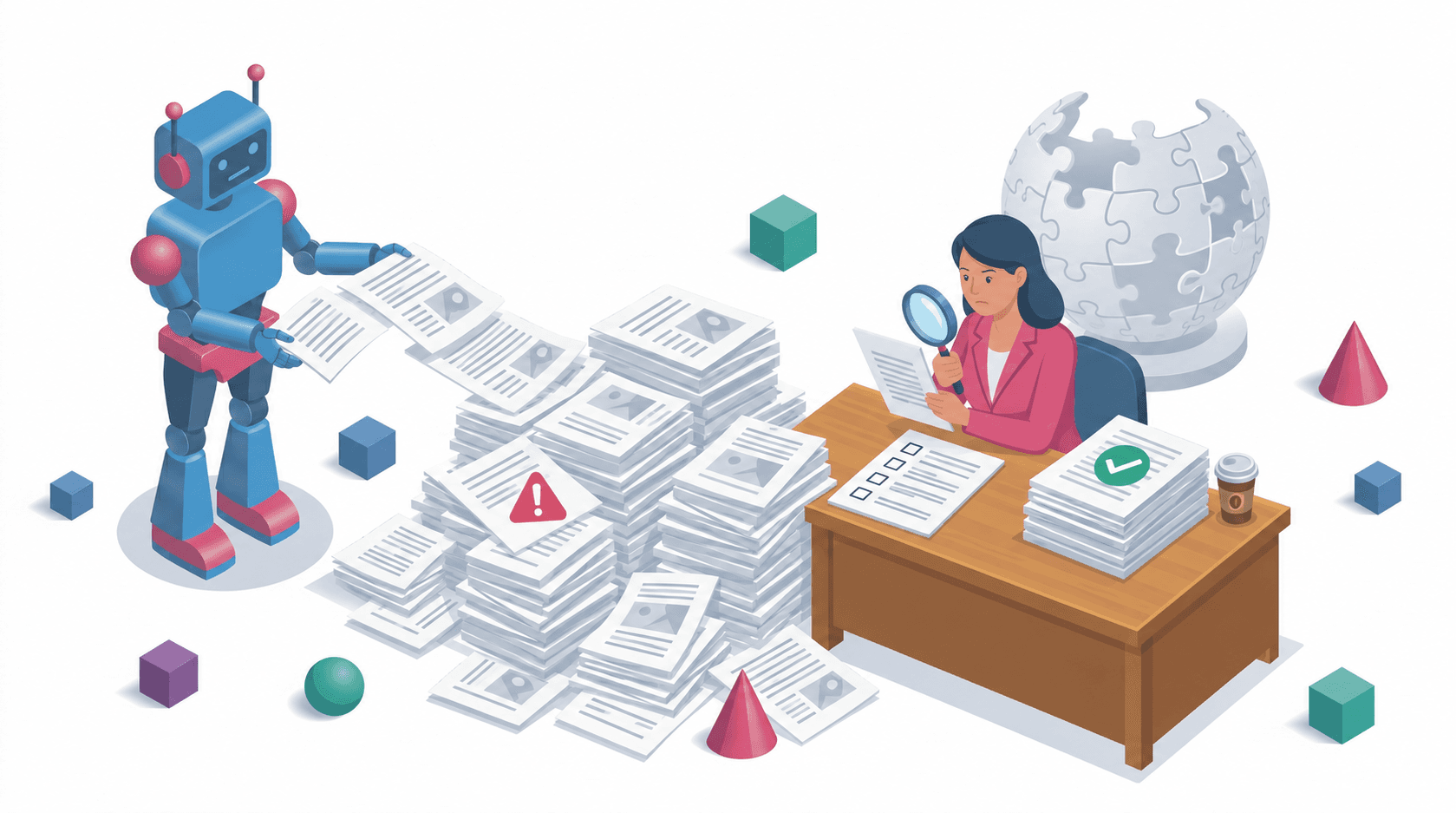
The hard part began after the vote. The main argument in the discussion was about time: an article is generated in seconds, checking the facts and references in it takes a volunteer hours, and the ban does not remove that asymmetry. The rule declares machine text illegal, and people still have to do the searching. For the search they have the catalog of signs and a detector in the role of a hint.
The catalog of signs: the traces Wikipedia uses to find machine text
The easiest thing to take from Wikipedia's experience is the catalog of signs: any editorial team can use it today. The AI Cleanup project has been collecting it since December 2023 and keeps it open to everyone, seven groups of traces. We put the compressed version into the infographic below.
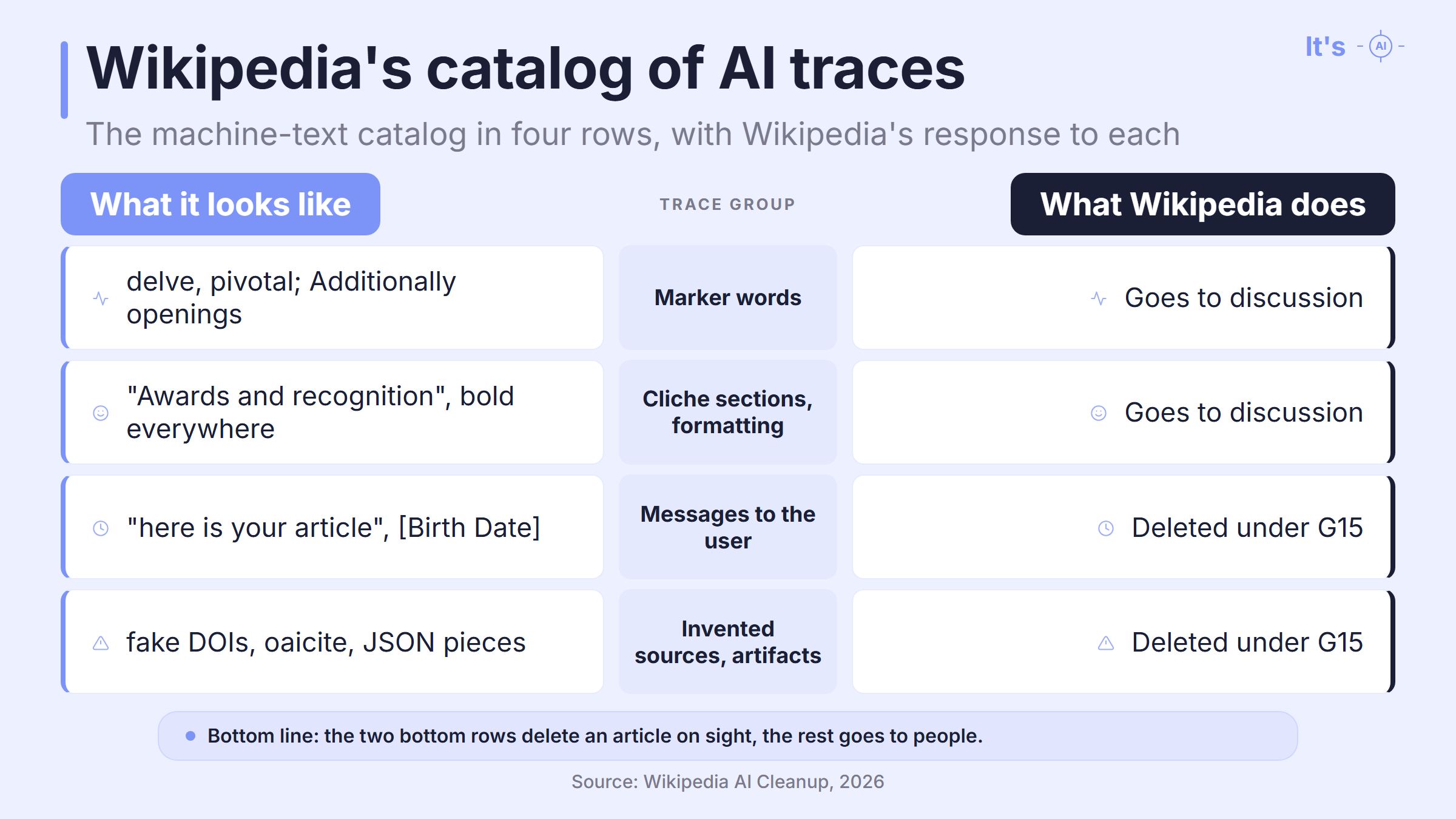
Wikipedia's catalog of machine-text signs, compressed.
The two bottom rows of the infographic Wikipedia treats as unambiguous. An article with such traces gets deleted under the fast-track criterion G15, without discussion. A text that talks to the chat user could not come from anywhere except a model. The other rows give only a reason to discuss the article on a separate board.
The word Additionally is innocent by itself, living authors use it too. A sign grows out of frequency: GPT-4 opens sentences with it noticeably more often than a person. One case means nothing, a streak of such openings is already statistics. A volunteer counts that streak with their eyes, on one page. A detector counts it across the whole text at once. And next to it the detector counts hundreds of other frequencies, the kind that eyes do not see. The difference between the catalog and the detector sits exactly here, in how many signs fit into one look.
Invented sources take the most work. The model attaches a plausible DOI to a plausible title. One reference takes a minute to check, and there are dozens of them in an article. On this check the volunteers lose the hours the vote was talking about.
August 2026: an open catalog ages from two sides
Any list of signs has a short life, and Wikipedia was the first to see it: in August 2026 a note appeared in the AI Cleanup working guide that a significant part of the catalog is outdated for the newest models and the work has become harder. The first reason is obvious: the catalog was collected on texts of past generations, and the new models dropped the old habits.
The second reason sits in the catalog itself, and the guide does not write about it. The catalog is published. Honest editors read it, and so does everyone who wants to push a machine article through: it is enough to remove the marker words and rewrite the cliché sections. We took this effect apart in the article about academic humanizers: cleaning the outer signs makes the text smoother and does not touch the statistical structure. An open detection checklist ages from two sides. The models stop leaving the old traces, and people wipe away the ones that remain.
Wikipedia's answer is honest, though forced. Since July 22, 2026, edits by an editor with a proven history of machine publications may be rolled back without reviewing each one, for example after a block for AI use or after the editor's own confession. The check moved from the text to the author's reputation. Inside a community with years of edit history this works. In a newsroom with freelancers, or on a stream of student essays, there is no reputation history, and this move cannot be repeated there.
The detector in Wikipedia's rules: a hint, and why this role is not enough
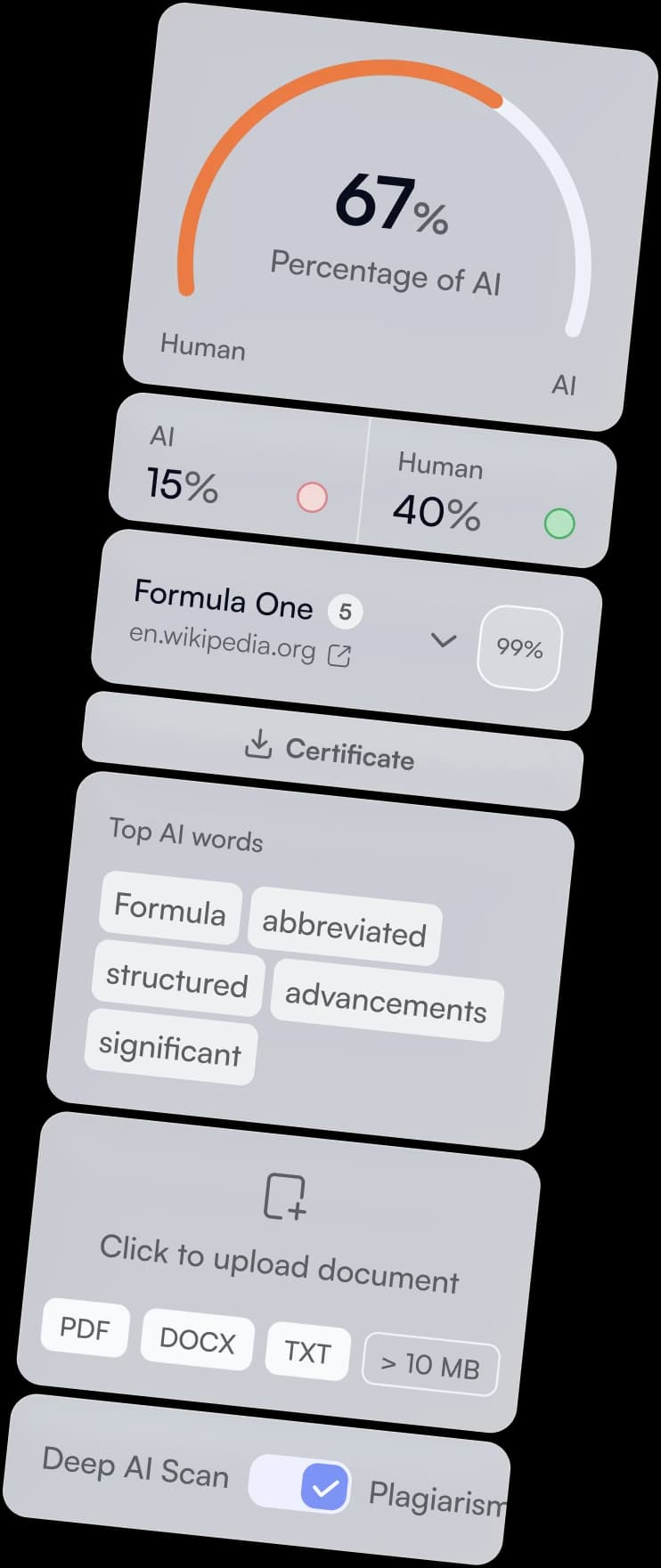
The speedy deletion rules say it directly: readings of automatic detectors are not grounds for deletion. The internal guide rates third-party tools soberly: even the most reliable one has many misses, and the advice is to apply it for checking your own suspicions. With the rule "a score is not grounds" we agree completely. The It's AI detector returns a probability for exactly this reason: a person makes the verdict out of it, through their own procedure.
One distinction is missing from these rules. The catalog of signs and the detector age differently. The signs page is updated by hand, by volunteers, and by August it had fallen behind. A detector is retrained on texts of fresh models, and its signs cannot be wiped away by a checklist, because they are not published and are not visible in the text one by one. Wikipedia can afford to patch the catalog with hundreds of people. An organization without those hundreds gets the same layer of checking ready-made, in the form of a detector.
A first stage made of a detector straightens out the same arithmetic from the vote. The machine does the continuous checking of the stream, and people spend their hours only on the texts it highlighted.
Scale: who else has two hundred ninety volunteers
How well manual checking copes with the stream is unknown, and that by itself is a result of the experiment. Since 2024, volunteers have flagged more than 4,800 suspicious articles: Wikimedia gave the number to Rest of World in February 2026. The only independent measurement was made at Princeton on data from August 2024: traces of AI turned up in more than 5% of new English-language articles, and the flagged articles were on average worse in quality, with self-promotion and slants in contested topics. Nobody has measured the share since, so how much machine text passes through the filters now, Wikipedia itself does not know.
The English edition is protected best of all: more than 284 thousand editors make at least one edit a month. The editions in Telugu and Tamil count their active editors in hundreds, and the stream of machine text through them is the same. Rest of World describes people who write their own articles and clean out other people's machine ones at the same time. Manual checking needs a lot of people, and only a big language edition of a big encyclopedia has that many. Where there are not enough of them, the choice stands between a detector and no checking.
What to take from Wikipedia's experience today
The checking rules are worth writing before the first conflict. An editor whose article was deleted under G15 opens the criterion and sees which sign fired. Most newsrooms and universities have no such page, and every dispute is settled from zero.
The unambiguous is worth separating from the debatable. Wikipedia drew this line in its own rules, and for any checking regulation it is the right bar.
The rest is covered by a detector. It gives the statistical layer, and it leaves the decision to people. Wikipedia assembled this pair out of hundreds of volunteers and a page of rules. An editorial team needs one page of rules and the It's AI detector as the first stage. The conclusions from two years of someone else's experiment come free.
FAQ — Wikipedia and AI text
Does Wikipedia allow AI-generated content?
No. Since March 2026, English Wikipedia bans the use of large language models for creating or rewriting articles. A model may still fix an editor's own text or help with a rough translation from another language edition. The rules go further than the ban itself: under the presumptive-removal guideline, edits by an editor with a proven history of AI generation can be removed without individual review, and a new article written by a single such author can be deleted through its own procedure. The argument recorded in the vote reads: high-speed, low-effort generation calls for high-speed, low-effort removal.
How does Wikipedia detect AI-generated text?
Wikipedia detects AI-generated text with a public page of signs, deletion criteria, and a set of working tools rather than any single detector. The Signs of AI writing page lists the traces, the G15 criterion handles unambiguous cases, and everything debatable goes to a dedicated AI noticeboard. The WikiProject AI Cleanup also uses tagging templates for suspicious articles, the Cite Unseen tool for checking references, and a bot log that tracks AI-generated images. The project's own pages note that automatic detectors have nontrivial error rates, so a high score alone is never enough to delete an article.
How much of Wikipedia is AI-generated?
More than 5% of new English-language articles showed traces of AI in the only independent measurement, and the share was lower in the German, French, and Italian editions. The Princeton team behind that study set the detection threshold to keep false positives near 1%, which makes the estimate conservative. The count of flagged articles is a separate number: the 4,800+ suspicious articles marked by volunteers is a figure Wikimedia gave to the press, and there is no public counter behind it. For older articles and for other language editions, no comparable measurement exists at all.
Can AI companies train models on Wikipedia?
Yes, and the largest ones pay for structured access. Wikimedia Enterprise announced AI partnerships with Amazon, Meta, Microsoft, Mistral AI, Perplexity, and Ecosia in January 2026, while Google has been a paying client since 2022. The product gives model builders clean access to about 65 million articles in more than 300 languages, a corpus that draws around 15 billion pageviews a month. Scraping Wikipedia stays legal under its open license; the paid tier sells reliability and freshness of the data feed. Selling training data and banning AI text in articles are, for Wikimedia, two separate decisions.
Is AI reducing Wikipedia's traffic?
Yes. The Wikimedia Foundation reported human pageviews down about 8% year over year in 2025. The foundation names direct answers from AI chatbots and search engines as one cause, along with social video: readers get a summary without opening the source page. The figure surfaced after a data cleanup, when months of traffic had to be reclassified because a wave of bots in Brazil was being counted as human visits. Fewer readers is a risk for the volunteer pipeline, and volunteers are exactly who does the checking of AI text on Wikipedia.