How AI detection works
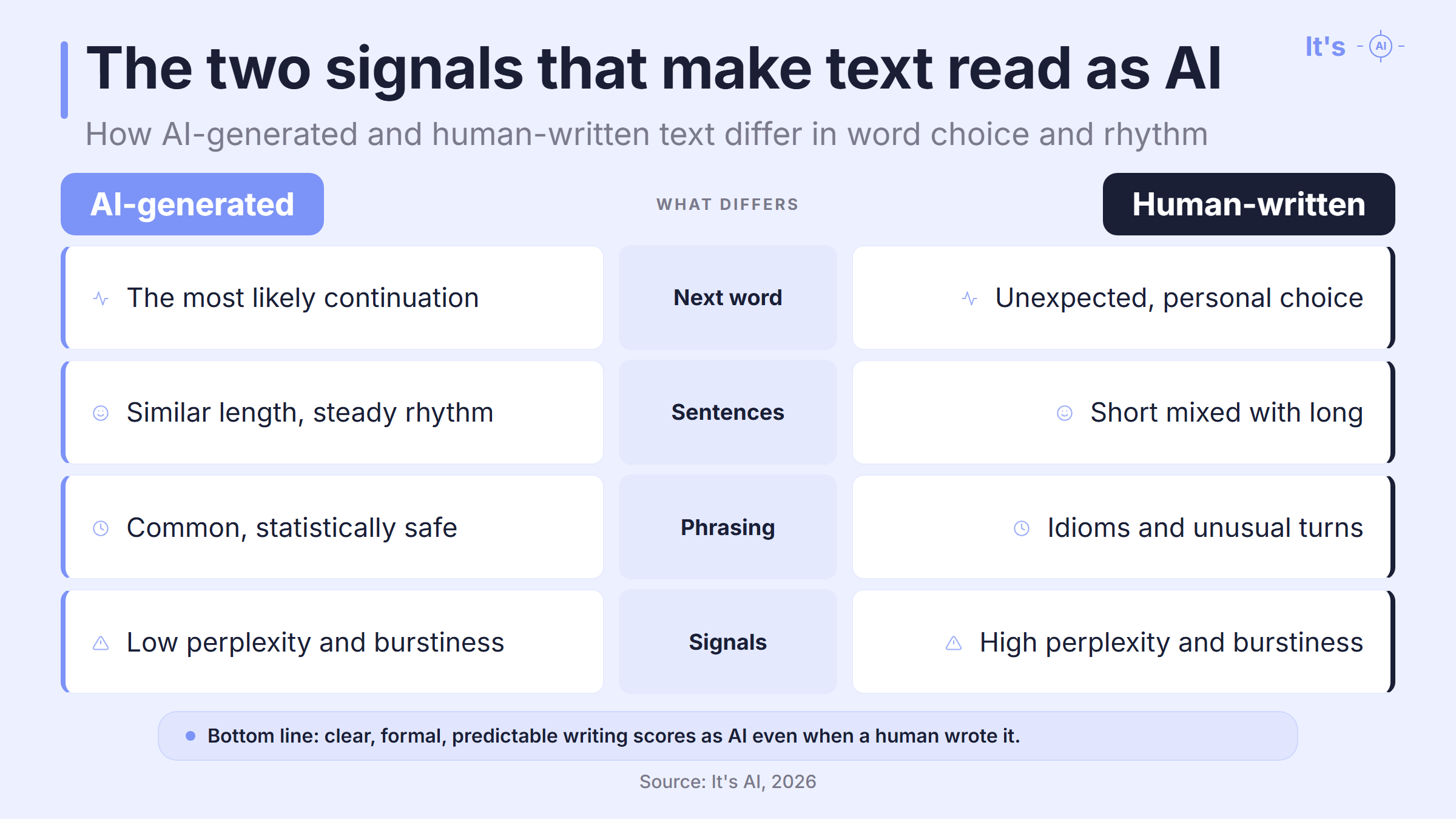
Since AI language models tend to predict the next word when writing, AI detectors are used to seek a lack of human creativity and pattern disorder with the help of Machine Learning and Natural Language Processing.
Through Machine Learning, AI detectors learn the subtle patterns that distinguish human-written from AI-generated text. The more data they have, the more accurate they get at spotting these patterns.
Natural Language Processing helps with understanding language nuances. It analyzes grammar, context, sentence structure: the whole way of delivering the idea, not just its form or essence separately.
Most detectors focus on two main signals that measure the level of “human-ness” of the text. These are the concepts of Perplexity and Burstiness.
Perplexity
Perplexity measures how surprised or confused you are by the chosen word.
For example, you are reading the sentence “The sky is…” and thinking of the next possible word. The most predictable and logical continuation is “blue” or “full of stars”, and that is what AI would choose, getting low perplexity. But if we go with something like “The sky is covered with dark heavy clouds, as if foreshadowing distressing news”, the text will be too unusual to guess easily. You just don't expect it to be like this.
AI is designed to be clear and coherent, so it often chooses the most common and statistically likely wording to sound accurate as well as to be understood. Humans are erratic. They use personal idioms, poetic expressions, unusual phrases, making sentences more creatively complex.
The more unexpected words you choose, the higher the perplexity.
Burstiness
Burstiness is about the rhythm of the entire text. It measures the variation in sentence structure and length, words' complexity and their connections.
AI often produces monotonous texts with low burstiness. Sentences tend to be of similar length and structure, creating a steady rhythm. There will be no interesting phrasing, no advanced grammar constructions, nothing that makes the language rich, as the text leans towards more uniform and repetitive structures.
People mix short sentences with longer and more complex ones. Fragments are used for emphasis, long ones describe the situation or emotions more thoroughly, punchy sentences grab attention. The writing develops smoothly and naturally, avoiding familiar patterns.
The more attractive and grammatically rich your text is, the higher the burstiness.
In a nutshell
The main reasons for your work being flagged as AI are low perplexity and burstiness, or simply perfect wording and common knowledge.
What a detector compares when it scores your text
If you are writing on a topic that includes standard phrasing like “the importance of sustainability” or “possible consequences of natural disasters”, both you and AI will have similar output simply because different wording will often distort the meaning or just not be used.
The same thing happens when you need to write an essay or a business report that follows a strict format. Perfectly editing it means sticking to a well-known pattern that is predictable and uniform and might seem to be made by AI.
Conclusion
Being flagged doesn't always mean that you write like a robot or generated your work on purpose. It means you write clearly, coherently and formally, the way we typically associate with good writing. The current technology is simply struggling with the most challenging task of all: understanding the subtle, beautiful, and often unpredictable nuances of human creativity.
Keep writing with your unique voice.
FAQ
How do you avoid getting flagged as AI when you write?
Writing that keeps its natural variation gets flagged less often. Mix short sentences with long ones and keep the personal details that only you could add: a specific example from your own work, an opinion a template would never contain. Avoid polishing every sentence into the same even rhythm; that uniformity is what AI detectors read as machine-like. It also helps to save your drafts and version history as you go. If a checker ever flags your text, the visible history of your edits shows how the work actually came together.
What should you do if your work is falsely flagged as AI?
A false AI flag is easier to contest with evidence of your writing process. Version history in Google Docs or Word shows when the text grew and how it changed, which a generated file cannot imitate. Outlines and early drafts work the same way. Ask for a human review; one detector's score does not overrule another, and a reviewer can compare the flagged text with your earlier writing. Before you send anything, ask what evidence the reviewer accepts, so your appeal answers the actual question they will be deciding.
Does using a grammar checker make text look AI-generated?
Light grammar fixes do not usually make text look AI-generated, but heavy rewriting can. A tool that corrects an ending or a comma leaves your word choice in place, and word choice is what AI detectors measure. A tool that rewrites whole sentences replaces your phrasing with the most statistically common version, which is exactly the pattern detectors flag. If you rely on a rewriting assistant, check the result before submitting it and compare the rewritten sections with the ones you left alone; the difference in score shows what the tool did to your voice.
How can you check if your text will be flagged as AI before submitting it?
Run the text through an AI detector before submitting and look at which sections it highlights, along with the overall score. The It's AI detector marks the sentences that read as machine-written, so you can see whether the flag comes from one formulaic paragraph or from the whole text. A standard introduction that follows a required format often scores higher than the personal sections around it. Checking early also gives you a record: a saved report from before submission shows you reviewed your own work.