The text reads well. What can an AI detector still find? | It's AI
The text reads well. What can an AI detector still find?
A text can read well and still need review. See what an AI detector adds before publication, with publishing cases and answers about scores and false positives.
Svetlana ShakhovaNov 01, 202617 min read
An engaging text does not always hold up on closer reading. A convincing account may contain inaccuracies, and a well-structured argument may lead to a conclusion the author has not supported. AI-generated text can also contain familiar stock phrases: the writing is easy to follow, but the author's own point is harder to find.
If you liked the material on first reading, these weaknesses are easier to miss. Readers may notice them after publication, though. They may also wonder how carefully the author or publisher read the text before sharing it.
For a business, there is more at stake than a paragraph that needs work. A company may promise to share its experience, then offer only general observations. Readers get less than they expected. An unsupported claim presented as an expert conclusion may influence their decisions. In both cases, convincing writing makes it harder to notice what is missing.
October's events in book publishing raise a further question about how a text was produced. They show why approving a text and understanding how it was written deserve separate attention. That distinction also helps explain what an AI text detector can add to a review.
Curious how your own text scores? Check it right here.
characters (min 200): 0/500000
PDF, DOCX, TXT
Deep AI Scan
find out which part of text seems AI-generated with our sentence-level segmentation.
Plagiarism check
detect plagiarized content by comparing your text against online sources.
Grammar check
find grammar and spelling mistakes in your text.
4000words left
AI-generated content: why editorial approval is not enough
Canadian publisher Boréal chose Thélyson Orélien's novel C'était ça ou mourir because it had deeply moved its editors. Yet on October 21, 2026, the publisher announced that it was ending its relationship with the author.
After allegations of AI use, Boréal worked with Orélien to document how the novel had been written, then commissioned an external review of working files. According to Boréal, some files contained AI-related metadata. The publisher considered this evidence inconsistent with the author's earlier assurances and said it had lost trust in him.
Boréal also acknowledged that the extent of AI involvement remained unknown. Its statement does not establish which passages were generated. It describes the publisher's findings from a review of documents, rather than proving that AI wrote the entire book. Boréal's statement.
This case does not establish that the novel contained factual errors. The publisher had liked the book, but still had questions about how it was written. What it later learned was enough for it to end the relationship.
An editor buying an article faces two questions too: does the text meet the brief, and did the writer follow the agreed rules on AI? Reading for meaning may answer the first without settling the second. This is especially relevant when you expected the writer's own analysis and allowed AI only to help with wording.
AI-assisted writing still needs an author's contribution
The French literary prize Prix Pascal began accepting submissions in October for works created with AI assistance. Entrants must submit a manuscript and a technical account of their writing process. Its rules call for judges to assess literary quality and originality, as well as how the author worked with the model. Prix Pascal's rules.
AI involvement is known from the outset. The organizers still have to decide whether the result deserves attention. A description of the tools used cannot take the place of the work itself.
What interests us in these stories is that knowing about AI use only answers part of the question. An author can be open about using a model and still submit an article with weak arguments. Nothing has been hidden, but the reader still needs an explanation or evidence that the text does not give them.
A client may have hired a writer for their experience and allowed them to use AI for the wording. We would want to see that experience in the finished article: what the writer observed and how they reached their conclusions. Permission to use AI tells us little about whether those details made it into the text.
What an AI content detector adds to editorial review
An editor reads for meaning and checks whether the facts support the argument. An AI writing detector examines the writing for signs of generation. A team can use both when reviewing the same article.
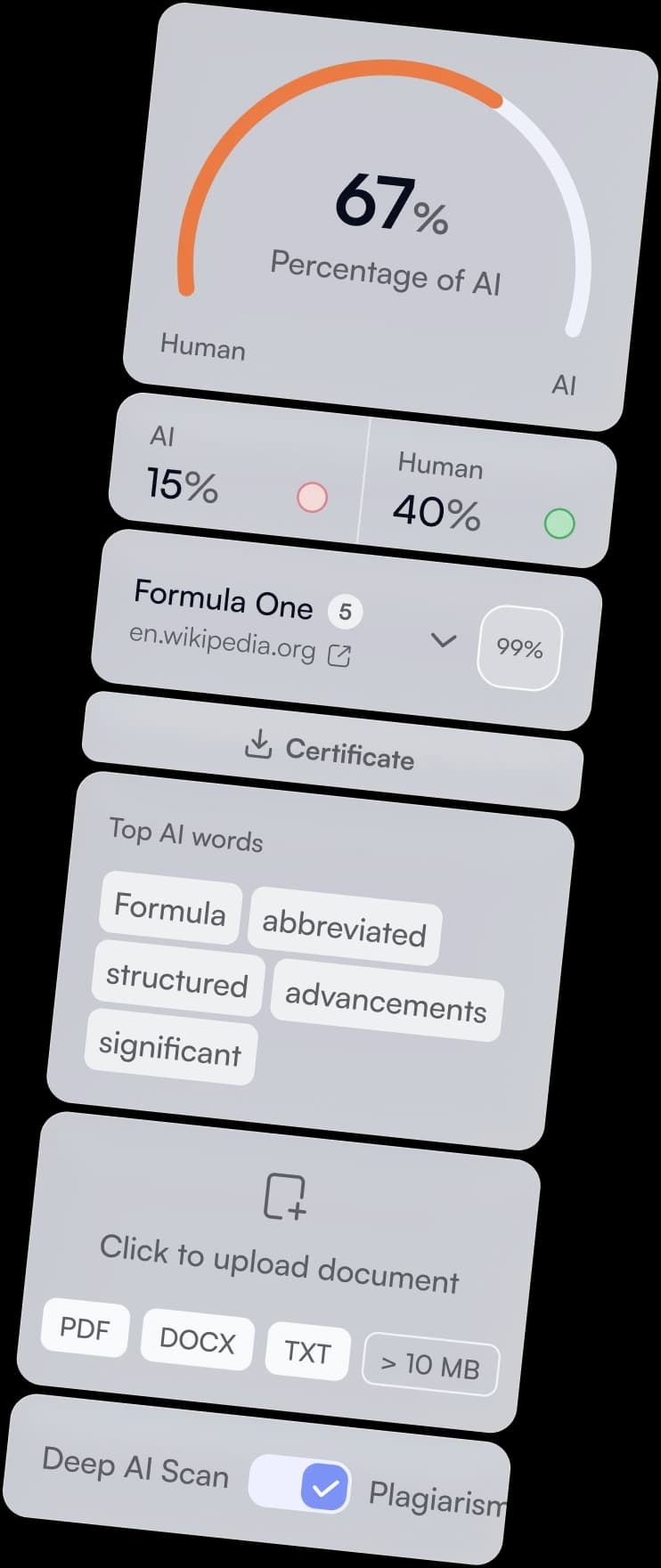
With It's AI, you can see the result for the whole text and look at sentences marked as AI-generated. You can also see which words and phrases contributed most to the score. An editor working on a long document can open a marked passage and read it with the paragraphs around it.
Take an article about falling sales as an example. The detector marks a paragraph, so the editor reads it again. The author has promised to explain the decline, but the paragraph only says that businesses need to "adapt to changing conditions." It reads like a complete thought until you ask what actually caused sales to fall. The writer's observations or data could supply the missing explanation.
Here, the editor found a gap in the argument after looking at a marked paragraph. The detector had identified signs of generation, not the missing explanation. Another passage might need no changes after the editor reads it again.
What you notice
What to look into
The AI checker has marked part of the text
How that part was written
A paragraph says little about the subject
What the writer meant to explain
A claim has no evidence behind it
Whether a source or the writer's data supports it
The conclusion does not follow from the facts
Where the reasoning went wrong
AI content detection shows signs of generation. The other issues in this table require an editor's judgment.
Using different words will not answer the question the paragraph left open. The score may change while readers still fail to get what the article promised. In that case, the check becomes useful when it leads to a more informative paragraph.
AI detection for publishers with different rules on AI
Reviewing highlighted passages is one way to use a scan. We see value in an AI detector for publishers who permit AI assistance and for teams that accept only texts with no detected signs of generation. For the first group, the highlighting helps focus editorial attention. For the second, the result becomes one of the criteria for accepting material.
Different requirements explain why one team may revise a flagged text while another will not accept it in its current form. A team can decide whether to accept an article under its rules. Making an accusation about its author raises a further question: what evidence supports it?
The US Authors Guild addresses that distinction in its October 13 recommendations. It opposes accusations and contract termination based solely on detector results. Where undisclosed generation is suspected, it allows for the use of a suitable tool followed by a discussion with the author. This is a professional association's position, rather than a rule followed by every editorial team. Authors Guild recommendations.
We see no conflict between that position and the value of a check. A detector adds information about the text, and the team's purpose determines how to use it. The score tells us about signs of generation in the writing. We still need to read the article to judge its quality, and the number alone cannot explain the author's intentions.
Checking for AI before publication: what can change
The review gives the team a chance to change the text. A writer can put back a point that was lost in an earlier edit or remove a paragraph that says nothing useful. The team may also ask for more work if the article does not meet its rules on AI use.
That takes time, so we would run the check before publication. Once the main edits are done, there is a finished version to check and still a chance to change it before readers see it.
You can check text for AI with It's AI at that point. The scan can help you detect AI writing in a passage you might otherwise have passed over. You can read it again with the result in front of you and decide whether it needs more work. Your team's rules on AI use will also be part of that decision.
The reader may never know why a paragraph was changed. They will still benefit from an explanation that was missing before, or from a claim being removed because there was no evidence for it.
FAQ: AI detection before publication
Can an AI detector produce false positives on human-written text?
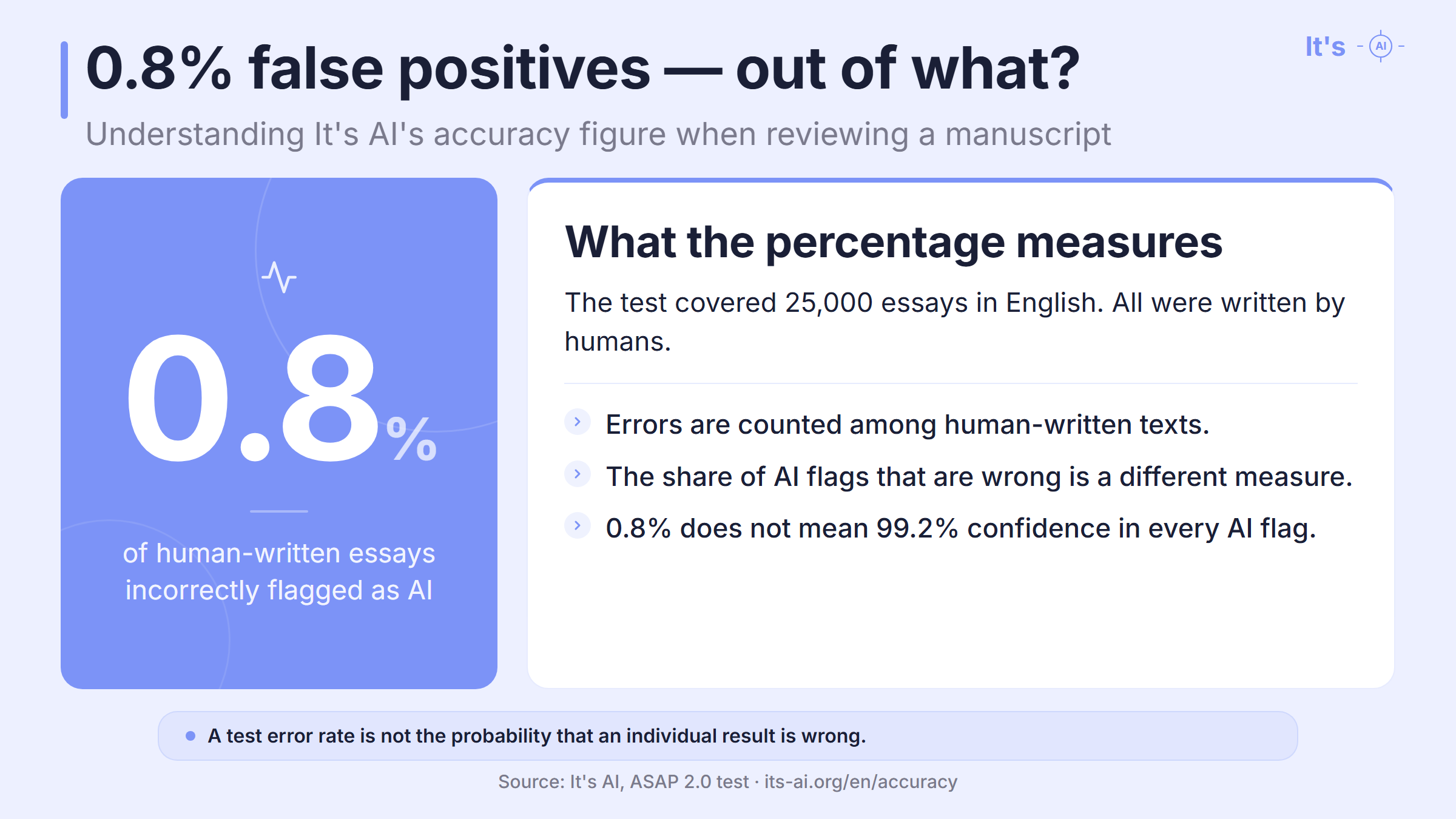
Yes. It's AI recorded a false positive rate of 0.8% on human-written essays in the English-language ASAP 2.0 dataset. The results and evaluation conditions are published on the It's AI accuracy page.
What do the AI Score and Text composition percentages mean?
AI Score is an overall assessment on a scale from human-written to AI-generated. A higher score places the text closer to the AI-generated end of that scale. It does not tell you how many words came from AI.
Text composition shows the percentage of sentences in each group. AI and Human are the more confident classifications. Probably AI and Probably Human are less certain, while Uncertain covers sentences without a clear classification. This breakdown describes the sentences in the text. AI Score assesses the text as a whole, so the two results can differ. Both are explained in the It's AI documentation.
Can an AI detector tell whether AI was used only for editing?
The detector reads the version you submit. It does not see what you asked the model to do. The result alone does not show whether a model wrote a passage or helped edit it. If you have an earlier draft, you can compare that passage in both versions to see what changed.
How can I see which passages affected an AI detection result?
In Deep Scan mode, It's AI highlights sentences with signs of generation. Additional word and phrase highlighting shows their influence on the assessment: a deeper red means a greater contribution to the AI Score. This sentence-level AI detection lets you move from an overall result to a specific part of the manuscript and read it in context. Explore the scan features.