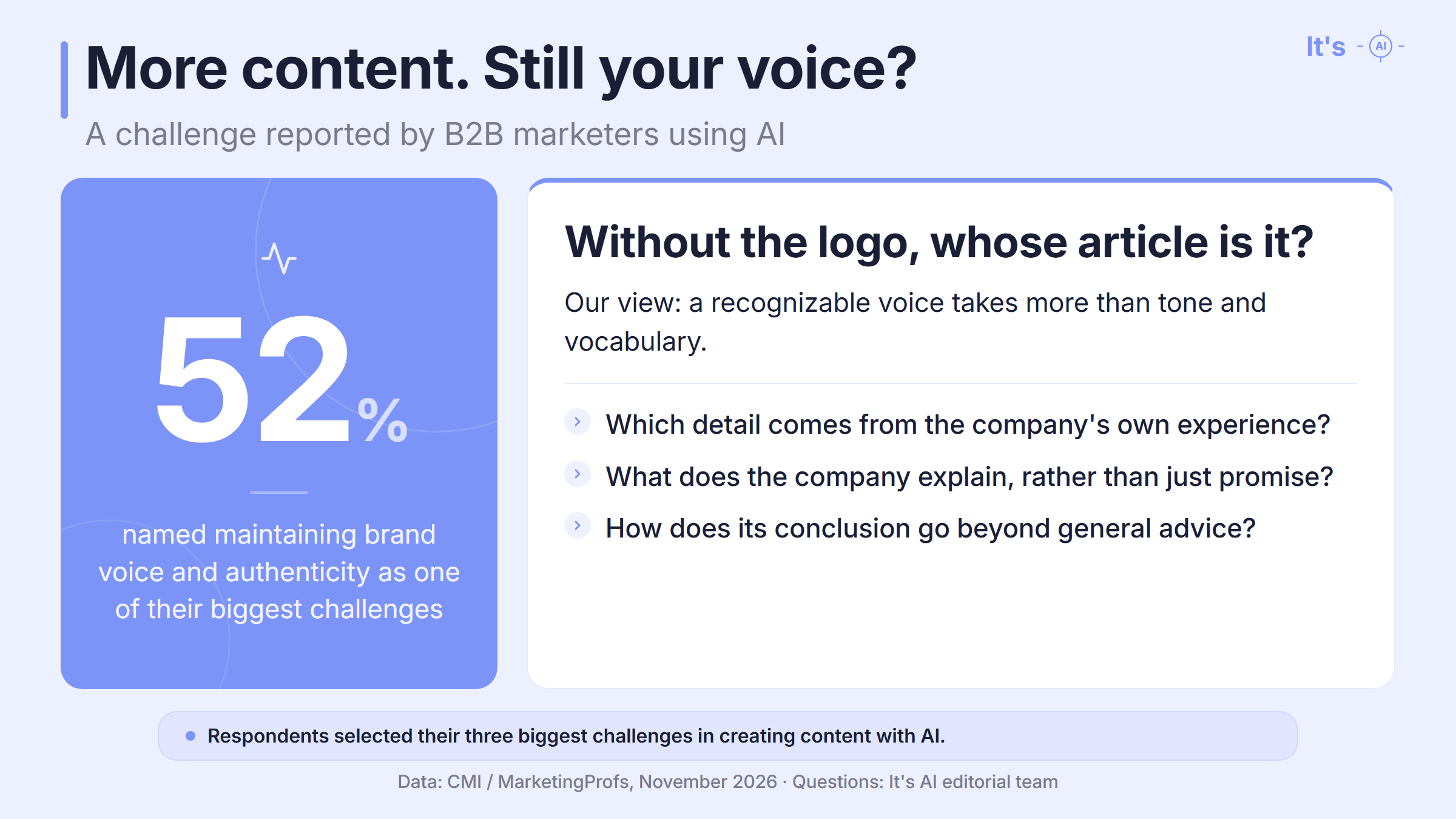
Why AI-generated content can make companies sound alike
Imagine a logistics company's article about urgent deliveries. Its specialists know which promises a carrier can keep and which it should avoid making. But after several rounds of rewriting, the text offers “flexible solutions,” a “personal approach” and a “reliable partner.”
There is nothing necessarily false in those phrases. Almost any competitor could use them, though. The reader still does not know when an urgent delivery is possible or what might prevent it.
That loss of detail can be easy to miss when reviewing a single article. Every sentence makes sense, and the writing stays on topic. But as similar wording appears across the blog, it tells readers less about the company itself. The volume of AI content grows without helping readers see what sets the business apart from its competitors.
A study presented at EMAC 2026 gives businesses a reason to take this concern seriously. The researchers examined restaurant posts during Italy's temporary ChatGPT ban, comparing Milan with other European cities. While access was restricted, Milanese restaurants' posts became less similar to one another. The restaurants posted less often, while their average like counts, measured by business and week, increased by about 3.5%. The restaurant-post study.
The researchers studied a change in access to the tool, not how each writer used it. Their findings cannot tell us which phrase affected the audience's response. But they raise a useful question for a business: if you publish more often, do people have more reasons to pay attention?
AI writing: what survives of the author's original idea?
General statements can appear even when a specialist gives the model detailed notes or a dictated explanation. During rewriting, the AI draft may lose the conditions and exceptions that made the account useful. The author explained when an approach works; the finished article says only that it works. The company contributed its experience, but the reader received much less of it.
That outcome is not inevitable. In a preliminary study by Jo and Raghavan, participants created texts with AI assistance. When rewards depended on originality, the writing became more varied, with the clearest effect in the advertising task. Participants continued using the model but copied its wording unchanged less often. The study of incentives in human–AI writing.
We see this as a reason to use AI thoughtfully. What the team wants to preserve in an article matters, as does what it values in the writer's work. If submitting a text on the assigned topic is enough, missing details may go unnoticed. The company can discover the problem later, when it evaluates what the published articles actually achieved.
AI content and SEO: faster publishing, uncertain returns
Companies contact us after noticing a drop in search rankings as employees or contractors start using AI more heavily to write content. They want to add an AI detector to their review before publication so they have more oversight of AI use. We do not share client stories publicly, so we looked for comparable cases in published agency reports.
SOZO describes a hospitality business that rewrote its website copy with AI. According to the agency, rankings and bookings began to fall; the case study reports a 32% traffic decline. A copywriter worked with the SEO team to audit and rewrite the content. SOZO then reported better search performance and more enquiries from key pages. The agency does not disclose every detail, so we cannot independently establish what caused the decline. SOZO itself links the deterioration to the AI rewrite. SOZO's case study.
The copy was updated, and the work was finished. There were just fewer visitors and bookings, which was hardly the reason for updating the website. That is the problem with judging savings too early: the cost of producing the text is already known, but the business has yet to see what happens after publication. A job marked complete can come back later with a question: “Why are bookings down?”
Another case shows what can remain unresolved in published AI-generated content. Outsourcing company Hugo approached Redefine to improve its visibility for relevant searches. Most of its previous blog articles had been generated with AI. In the agency's assessment, they spent too much time promoting Hugo's services instead of answering questions about outsourcing. Headings were generic or wordy, long paragraphs made reading difficult, and internal and external links were missing. Redefine's review of Hugo's content.
The company wanted visitors who were looking for information but offered them articles that read like advertising. The posts contained information, yet it did not match what people had come to find. Adding more articles can repeat that mistake, even when each covers a different topic.
Redefine refreshed about 30 articles, aligning them with readers' questions and improving readability. The agency also added keywords and links. Over six months, it reported a 42% increase in blog traffic.
What contributed most to that growth: more useful answers, clearer headings or better links? We cannot separate their effects from the published account. What stands out to us is the direction of the edits. The articles spent less time insisting on the value of the company's services and did more to answer potential customers' questions.
That is easy to overlook in the rush to publish more. A company commissions an expert blog and brings in AI to increase output, but gradually ends up with a collection of similar articles. There are fewer observations from its own work and more general advice that could come from any competitor. The publishing target has been met. The reader, unfortunately, did not ask for a publishing target. They wanted an answer.
We see a risk in how easily this process can expand: the model produces another draft, and the team accepts it through the usual review. If useful detail keeps getting lost, the business repeatedly misses the chance to show that it knows its work and understands its customers. As output grows, editors need to notice where the company's explanations give way to generated generalities. An AI content detector can help them choose passages to examine during that review.
What an AI detector adds to editorial review
An editor cannot know an article's future search ranking before publication. But they do not have to wait for traffic data to notice that an explanation has been replaced by general wording or that the author's point has disappeared.
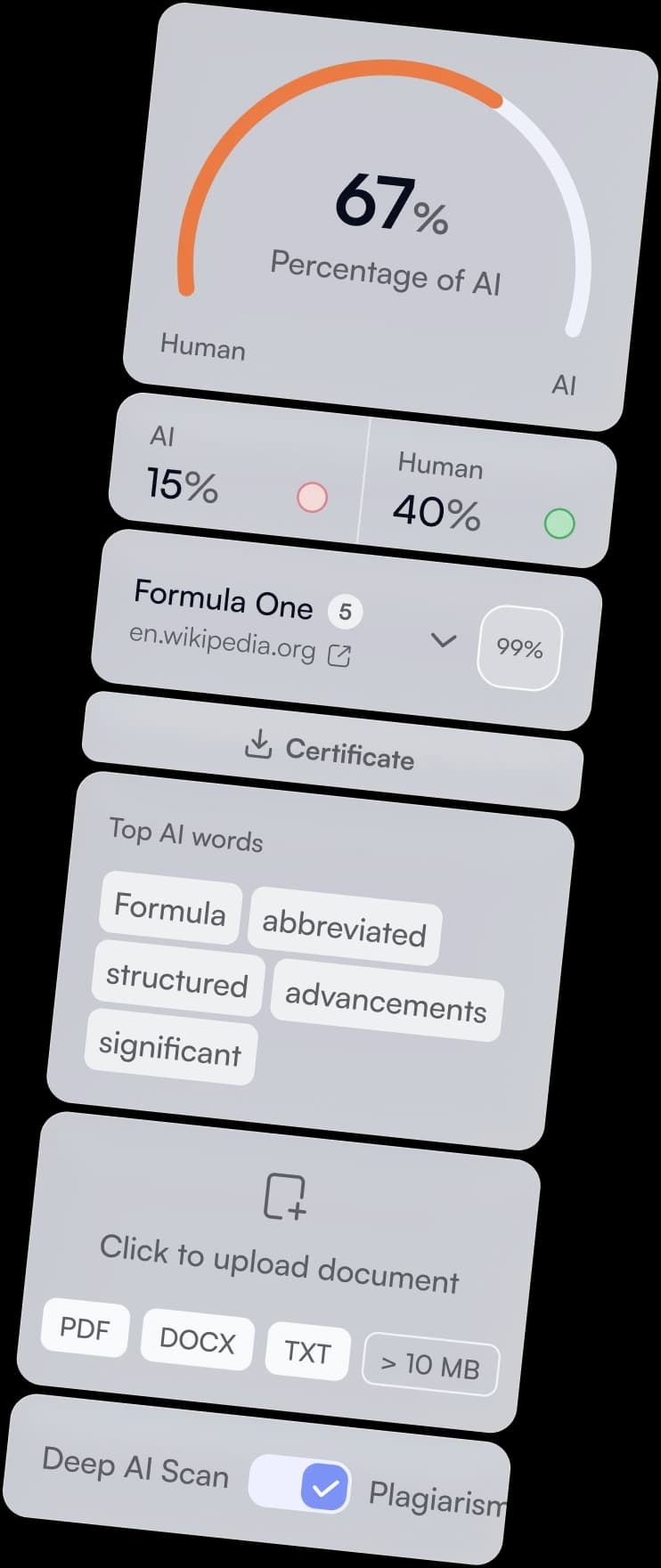
An AI text detector gives the editor another reason to revisit particular passages. With the It's AI detector, you can view the overall result and sentences the service classifies as AI-generated. Word and phrase highlighting shows which expressions influenced the assessment most. In a long article, this helps you choose where to read more closely.
A highlight does not by itself mean a passage is poorly written. The editor reads it with the surrounding paragraphs and decides whether anything needs attention. Some wording can stay. Elsewhere, the review may reveal a missing part of the explanation that needs to go back into the text. Our article on using an AI detector before publication looks more closely at this part of the review.
In the logistics example, the missing information might be the conditions for an urgent delivery. Replacing “a personal approach” with “solutions for your needs” is easy. The reader still does not know whether the shipment will arrive on time. That takes the company's knowledge, not another synonym.
We support using AI to help a company explain its work. An AI check of the finished text can be part of preparing it for readers. The editor's question afterwards is practical: what will the reader get from this article, and why does it matter to them?
FAQ: AI detectors for business content
Does Google penalize AI-generated content?
Using AI does not by itself violate Google's content policies. Google's guidance permits generative AI, but producing many pages to manipulate search rankings without adding value for users can violate its scaled content abuse policy. That policy also applies to content produced by other methods. Google's guidance on generative AI content.
What AI detector score is acceptable for SEO content?
Google's published guidance does not set an acceptable score from a third-party AI detector. A company can set its own threshold for submitted articles, but that is an internal acceptance rule. A low AI score does not establish that a page answers the search query or deserves a high ranking.
How can I check a contractor's articles with an AI checker?
Check each article separately if you need a result for each one. When several articles are combined into one submission, the AI check assesses the combined text. Separate reports are easier to match to individual articles and discuss with their writers.
Can an AI text detector check short product descriptions?
It's AI requires at least 200 characters for a text check. A shorter product description cannot be checked on its own. Adding other descriptions to reach the minimum changes what is being assessed: the result applies to the combined text, not to each product description individually.