Fake citations in court filings: what they cost lawyers
Looking at just the first quarter of 2026, U.S. courts had already imposed sanctions totaling more than $145,000 in cases like these. And the stories behind them vary widely: some got off with a verbal reprimand, while others were fined a six-figure sum.
| Court |
Case |
What happened |
Sanction |
Source |
| U.S. Court of Appeals for the Third Circuit |
McCarthy v. U.S. DEA |
A lawyer filed an appellate brief with hallucinated citations and didn't check them |
Reprimand, no monetary fine — the court noted it was the first such case in the circuit and warned that the next one wouldn't be so lucky |
Stevens & Lee |
| U.S. District Court for the Southern District of Ohio (Senior Judge Walter H. Rice) |
— |
Two attorneys filed documents with AI hallucinations — the judge called it the worst Rule 11 violation of his career |
$7,500 combined across the two attorneys + a contempt finding + referral to the disciplinary arm of the Ohio Supreme Court |
ABA Journal |
| U.S. Court of Appeals for the Sixth Circuit (Cincinnati) |
Whiting v. City of Athens |
Two Tennessee attorneys cited more than 24 fake references, misrepresented a lower court's ruling, and gave quotes with no quoted text behind them |
$30,000 combined across the two attorneys + dismissal of the case as "almost entirely without merit" |
ABA Journal |
| U.S. District Court for the District of Oregon (Medford) |
Couvrette v. Wisnovsky (Magistrate Judge Mark D. Clarke) |
15 nonexistent citations and 8 fabricated quotes across three briefs over five months |
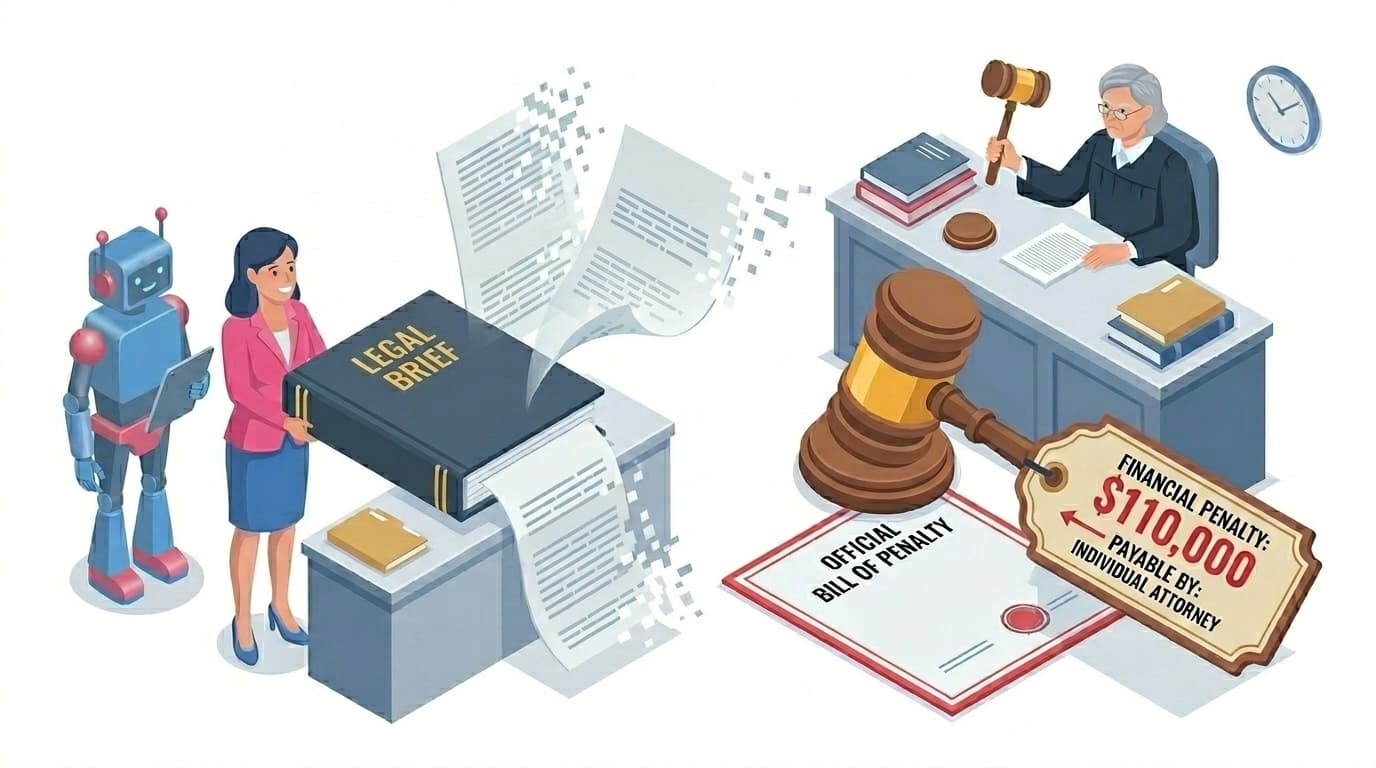
$110,000 combined (two lawyers + the client), including $14,000 in fees charged separately to attorney Murphy; the briefs were struck and the case dismissed with prejudice |
ABA Journal |
Let's break down the standout case.
A winery, $110,000, and a lawsuit that backfired on the plaintiff
The record penalty grew out of a family drama around Valley View winery, which the Wisnovsky brothers had run for most of their lives. Their sister, Joan Couvrette, filed a $12 million suit, claiming the business should have gone to her under the will. Yahoo!
Her lawyers (one of whom, by the way, took the case pro bono) leaned on AI to prepare the documents, and three briefs turned out to contain 15 nonexistent cases and 8 made-up quotes. When it came to light, Judge Clarke struck the briefs and dismissed the suit. NWSidebar
Where did the $110,000 figure come from? The court shifted the brothers' legal costs onto the offending side: someone, after all, had to read through all those fakes and prove to the court they weren't real. Dozens of hours of actual lawyer time at real rates. Justia
In the end the suit was thrown out entirely, and the court awarded the winery to the brothers. Couvrette went in for $12 million and came out with no winery and a bill for the other side's lawyers. And all it would have taken was opening the citations and checking them. Sources: ABA Journal; Justia
Judges seem to be getting more serious about it: the American Bar Association's journal notes that penalties are tightening, and what a year ago ended with a simple warning can now turn into a fine.
AI isn't the problem. The chase for it is.
You might think we're building toward the idea that AI is evil and best banned from legal practice. We're not. We think AI is a good, useful tool, but it has to be used properly — like any other tool, right?
These days we keep seeing situations where people try to get more done, especially with anything text-related. And as the workload grows, each individual document gets less and less time and attention. Social media only adds fuel to the fire: the feed is full of stories about someone who optimized their work with AI, started earning more, built a company staffed by AI, became an expert in programming despite being a philologist by training. A lot of people, pressed for time, trust AI more than they should.
Back to our topic. Small law firms that really do lean into technology tend to grow revenue much faster than everyone else, and a single lawyer ends up handling far more cases than before. You hear the same from individuals: one doubled their website traffic and inbound inquiries in about six months, while another cut contract prep from 45 minutes to 10, then used the freed-up time to bring in more clients.
The upside is obvious, and it's easy to see why people want to push AI as far as it'll go. On top of that, according to the Sedona Conference Journal (a survey of 502 federal judges, Northwestern Pritzker, 2025), the judges themselves use AI in their work: 61.6% of them. Which means no one is forbidding lawyers from using it. It all comes down to balance. AI should genuinely speed up the work and help you earn more, without turning into a nasty surprise — a fine and a lost case, with your reputation gone along with them.
Why AI hallucinations happen
To understand where a citation to a case that never existed comes from, it helps to remember that by default AI doesn't search for anything. It doesn't go digging through legal databases or check facts. On top of that, many of those databases sit behind paywalls and logins: Westlaw, LexisNexis, Bloomberg Law. A standard model simply can't get in there.
And if search is turned on, the model looks wherever it can reach, which is often blogs and social media. For a court filing, those sources obviously won't do, but the model may well use them as a starting point and fill in whatever's missing. The thing is, every model is tuned to help, and admitting it doesn't have the information feels, to the model, like refusing to help. So assembling a plausible fragment out of scraps and neatly inventing the missing parts reads, to the AI, as a service rendered.
And that's how we end up with fakes. And because they're backed by real scraps, they stand out even less than something invented from scratch.
It's exactly that ordinariness that makes such citations dangerous. At first glance everything's fine. Catching a fake isn't hard — you just open the source and check. But that's the last thing you want to do with a smooth, confident draft where nothing raises a flag. In the Raja Rajan case, which the Philadelphia Inquirer covered in April 2026, they went a step further: one AI was asked to check another's work. Both approved it, and the opposing side was the one who spotted six fake citations.
Two checks before filing: citations by hand, and a detector
The Rajan case drives home the key point: checking AI with AI is pointless. Two models share the same blind spot, and a nice-looking nonexistent citation will be accepted as real just as readily by both. So the checking has to go back to a human, and it's done in two passes.
The first and most important pass is to open every citation by hand. No verification service will confirm that a specific case actually exists, so you open the source and see what it really says. Does the quote match, is it the right year, does the case even exist. Sometimes you'll have to search Google separately or ask the AI to find the original source in a new chat, without trusting what it already gave you. It sounds tedious, but it's exactly this boring step that cost the lawyers in the examples above tens of thousands of dollars.
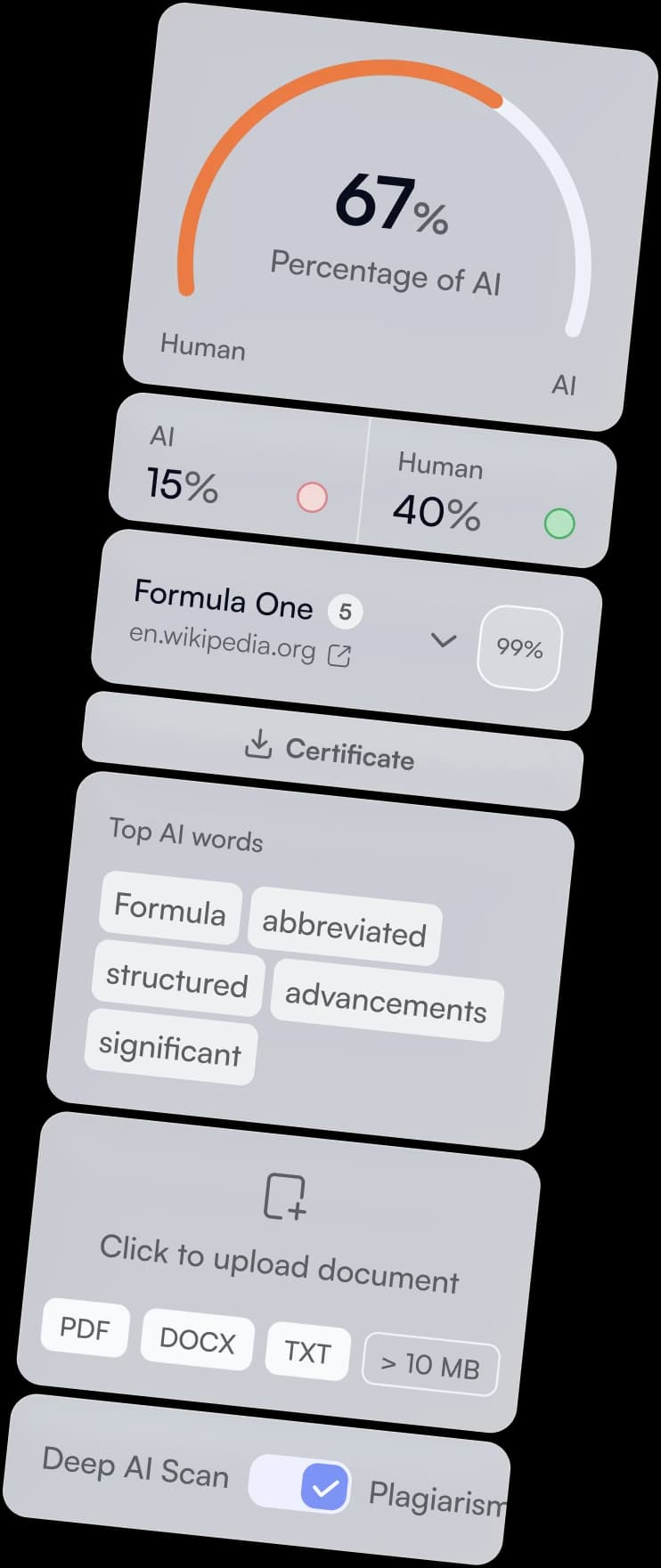
The second pass saves time on the rest of the text. It's a check through an AI detector. The detector won't tell you whether a quote is real or made up, but it will show you which chunks of text were machine-generated. And that's almost always exactly where the hallucinations hide. So instead of going over the whole document under a magnifying glass, you run it through It's AI, look at the highlighted fragments, and check only those by hand. A twenty-page document turns into three paragraphs that are actually worth rereading.
Where to draw the line — how much to trust AI and how thoroughly to re-check it — every lawyer decides for themselves. The tools for it already exist. The only question is whether you're willing to send a judge a draft just because it reads smoothly. In practice, the smoothness of a draft says nothing about its honesty.
FAQ: AI hallucinations in legal filings
Can AI hallucinations in a legal filing get a lawyer sanctioned?
Yes. In the first quarter of 2026 alone, US courts imposed more than $145,000 in sanctions over filings that cited cases that did not exist. Penalties ranged from a verbal reprimand to a $110,000 fine, and they landed on the individual lawyer who signed, not the firm.
What is an AI hallucination in a legal citation?
It is a citation an AI model invents. The model produces a real-looking case name, volume, page, and year, yet no such case exists in any legal database. Because the format looks correct, the fake is hard to spot on a quick read.
How many AI hallucination cases in court have been recorded?
An open database run by Damien Charlotin (Smart Law Hub, HEC Paris) tracks more than 1,350 filings worldwide that contained citations to nonexistent cases, and the count keeps growing.
Do judges allow lawyers to use AI?
Courts are not against AI itself. A Sedona Conference Journal survey of 502 federal judges found that 61.6% use AI in their own work. Sanctions come from unverified output, not from using the tool.
Can an AI detector catch fake legal citations?
An AI detector will not confirm whether a cited case is real, which still needs a manual check. It does flag which parts of a document were written by a machine, and that is usually where invented citations sit, so you only recheck those sections by hand.