Amazon's KDP rules: why they don't detect AI generated text
About two and a half years ago, in September 2023, Amazon introduced mandatory disclosure for everyone publishing through Kindle Direct Publishing. This came after months of negotiations between the Authors Guild and the KDP team. Three weeks later, KDP added a cap of three new books per day from a single account.
For an editor or agent trying to use these rules as a screening tool, two things matter. The author classifies their own use: a book that went through KDP without a flag could have been written with AI at almost any level of involvement and still pass as "assisted." The three-books-a-day cap hits farms using AI novel generators to push out dozens of titles under names mimicking known authors, not a single contracted manuscript with a real editorial pipeline. Neither rule helps you tell whether the book on your desk was written by a human.
For the reader at the moment of purchase, the disclosure flag on a product page isn't visually highlighted and doesn't affect the recommendation algorithm. The signal is almost invisible.
Human Authored Certification: marking human written text without proof
The Authors Guild gave authors a positioning tool. The Human Authored Certification program launched for Guild members in January 2025 and expanded in early 2026 to all authors, members and non-members alike, in partnership with the UK Society of Authors. It's a registered certification mark that an author can place on a book as a statement that the text was written by a human.
What's worth knowing about the terms before you apply:
| Parameter |
What it is |
| Who can apply |
Any author, including non-members of the Authors Guild |
| Cost |
$10 per book for non-members, free for members |
| What's allowed |
Minimal AI use for grammar and spell-check |
| What it doesn't block |
AI for research and brainstorming, as long as the text itself was written by a human |
| How it's verified |
Honor system: the author signs a statement that the book is human-authored |
| Where it appears |
Public database of certified titles |
What the certification gives an author: a public statement to point to in disputes with readers or in conversations with an agent or editor. USPTO registration of the mark is in process, and the UK partnership extends coverage into the British market.
What it doesn't give: actual manuscript verification. The Authors Guild itself acknowledges that even the most accurate AI detector isn't currently accurate enough for this task, and once one exists, it will be used. Right now the certification rests on the author's word. As proof in a contractual dispute, the certification works as your written commitment, not as independent verification.
Where it helps in practice. The certification is a public counter-argument for self-published authors worried about reader accusations — especially when reader conversations on Goodreads or in genre subreddits start with "AI or human written?" suspicions. It also gives agents and editors a registered mark to point to when they want confirmation of human authorship, and it states your position under the criteria of any awards or communities that exclude AI-assisted work.
Where it doesn't cover the risk. If you're signing with a traditional publisher and the contract has a morality clause or AI-related warranty, the certification doesn't replace your direct contractual obligation to the publisher. If someone raises a dispute about specific paragraphs in your manuscript, the mark says nothing about the text itself, since the text was never checked.
Pre-acquisition verification: AI detector tools editors and agents use
Two hard truths. First, in April 2026, none of the Big Five and no major commercial publisher publicly uses AI detection systematically at the submissions or editorial stage. Per Jane Friedman, some editors at non-fiction houses use AI detection selectively, as an entry point for a conversation with an author whose draft seems suspiciously polished. Second, there's no industry standard for proof-of-authorship either. No author can yet hand you a documentation package that lets you say "yes, this was a human," and no acquisition has been refused over the lack of one.
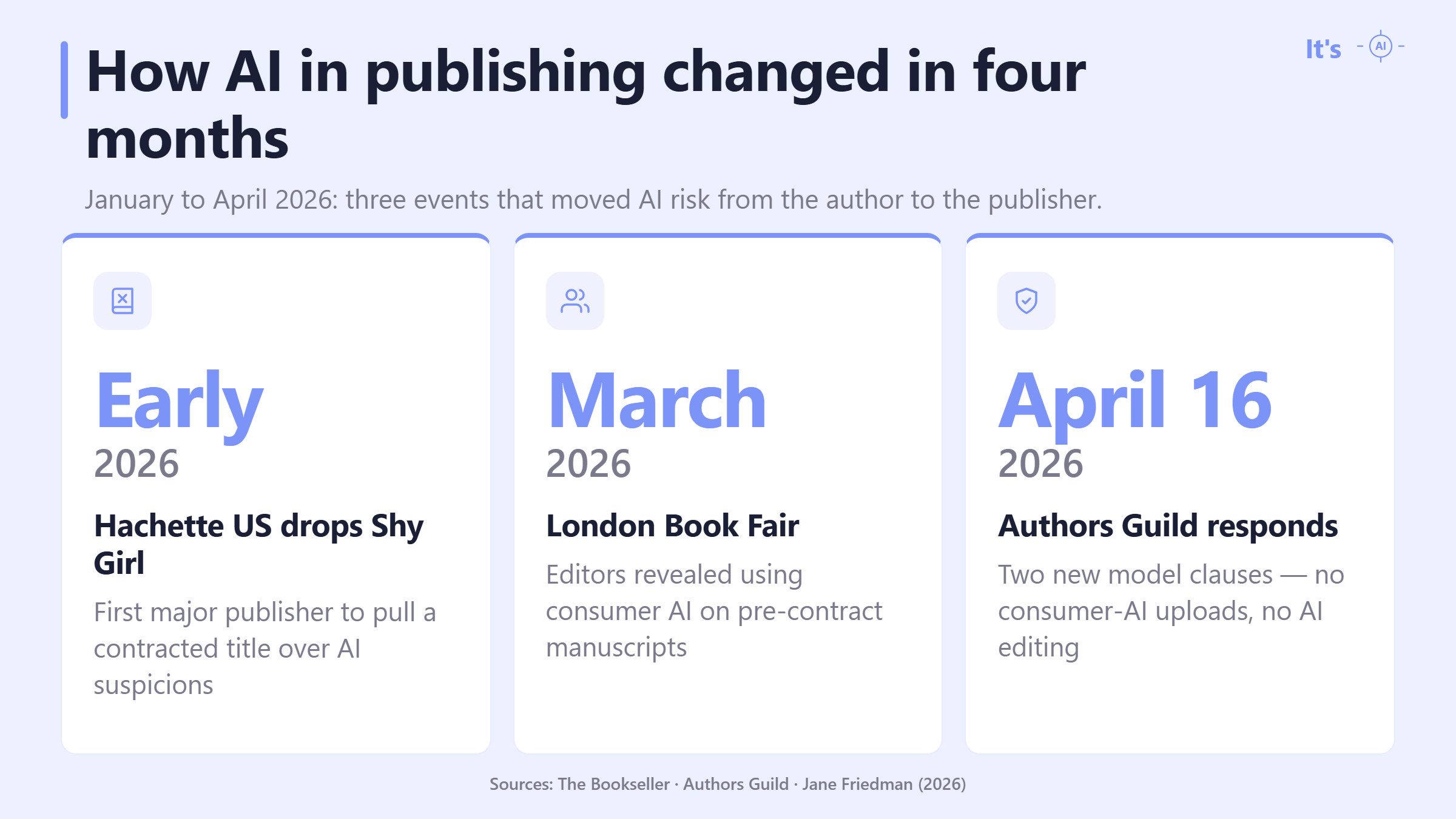
Hachette/Shy Girl shows how this works in practice. The book was self-published in early 2025, then picked up by Hachette UK and released in November 2025 before Hachette US pulled the title in early 2026. The conversation about its style was online for months before Hachette US even looked at the rights — the publisher acquired anyway.
Pre-acquisition verification is something you have to put together yourself. A few things make sense at this stage.
Read the reader communities. Reddit and Goodreads start to detect AI writing well before any official release, often including specific paragraphs and quotes. If the book was already published before you're considering rights, the search takes thirty minutes. Reader communities now effectively work as a free pre-screen: thousands of people read suspicious passages more carefully than a submission editor will manage in a working day.
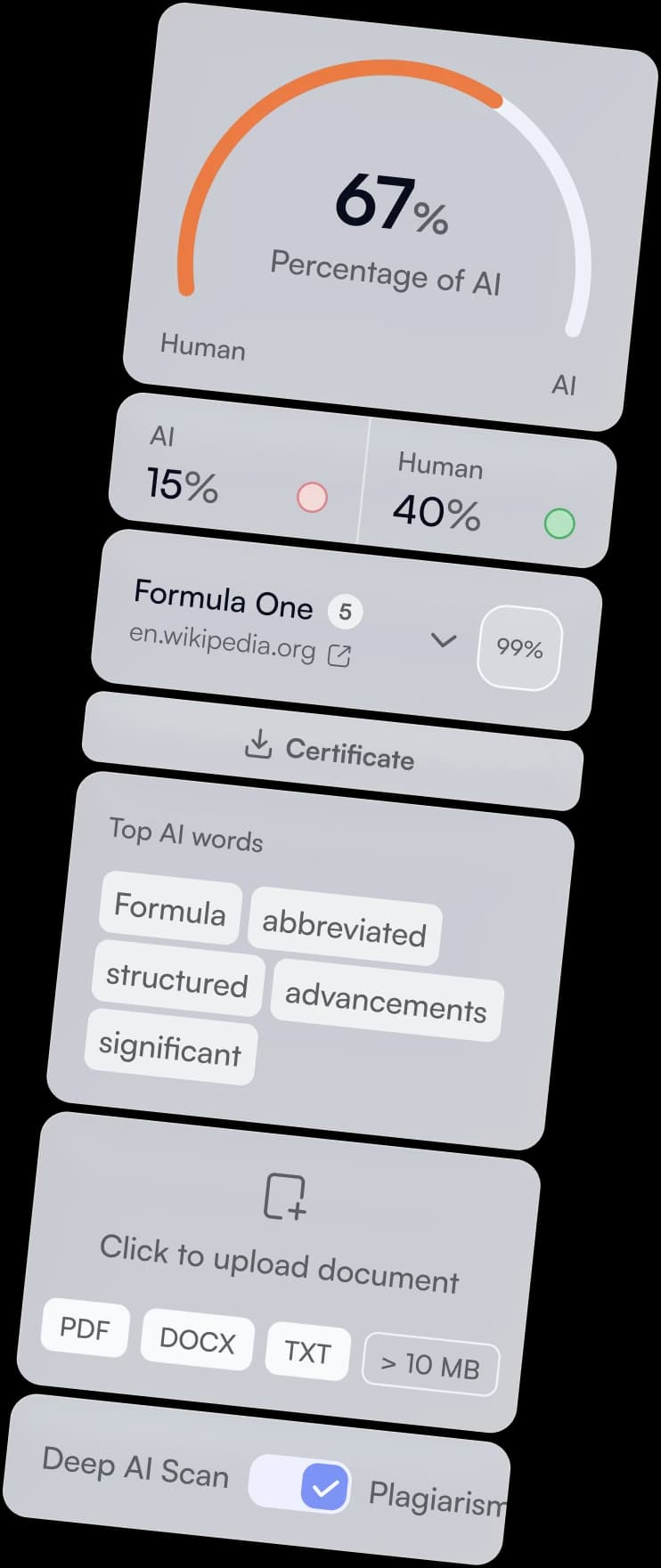
Run the manuscript through an AI content detector as a conversation starter, not as a verdict. Even the best AI detector works on probabilities, not certificates. Reputable services flag this in their own results: "likely AI-generated" doesn't equal "AI-generated." Use detection the way the editors who actually run it do — to raise a substantive conversation with the author about specific sections, not as grounds for an immediate rejection. The It's AI detector fits this exactly: long text, section-by-section markup that shows the editor which parts to discuss with the author, instead of a single overall verdict on the manuscript.
Request process documentation in submission. This is a growing practice among agents: ask the author directly what they used. Per Jane Friedman, agents who ask this question are usually concerned either about copyright protection (which wholly AI-generated text doesn't get) or simply don't want to work with authors who use AI in any form. The direct question works as the cheapest filter. Authors with something to hide tend to stumble over this question more often.
Plan for the legal "what if." Per Jane Friedman, the legal route publishers are using now isn't "our detector said this is AI" but "the manuscript fails to meet contractual quality standards." This is a more defensible position than an AI-use accusation that you can't prove. The evidence that actually holds up in court: concrete artifacts, like an AI prompt accidentally left in the manuscript, or AI chat records that are potentially discoverable in litigation.
The new risk: your publisher uses AI on your manuscript
Until March 2026, the main risk of AI contamination came from the author side and was assumed in standard contract templates. At the London Book Fair in March, The Bookseller reported that some editors and other publishing-house staff are using consumer AI to generate manuscript summaries, primarily at the pre-contract evaluation stage. The main concern here isn't summary automation itself but the fact that manuscripts get uploaded into consumer-facing chatbots without the author's consent and without guardrails to make sure the text doesn't end up in AI model training.
In this whole setup, the reader is the endpoint. Whatever AI tools introduce into the finished book — synthetic narration in audio, an AI-generated cover, or any other AI touch — eventually surfaces in reader conversations exactly as the reader encounters it.
In parallel, direct partnerships between publishers and AI firms have appeared. In spring 2026, HarperCollins announced partnerships with companies such as Toonstar to adapt specific works into short-form videos and animations. This is no longer shadow use but an officially structured channel. Whether that channel is open for your book depends on whether the contract had an explicit prohibition.
On April 16, 2026, the Authors Guild responded to the situation with a full statement and two new model clauses for publishing agreements. The logic of the statement is straightforward: uploading a copyrighted work or an author's personal information into consumer AI without permission can be a copyright or privacy violation. Editors and agents shouldn't upload manuscripts into consumer-facing chatbots without the author's written consent, and the same applies to anyone else inside the publishing house. If internal AI systems are used, they should be sandboxed and have guardrails preventing the manuscript from being used for training.
A separate risk runs alongside this: an editor using AI in revisions without the author's consent. Professional editorial norms hold that an editor's role is to improve, not to generate. But the author still reviews and approves all changes. If the editor used AI in their revisions and you approved them without knowing, the copyright and disclosure implications fall on you as the author. If a dispute about AI breaks out around your book, "I didn't know my editor used AI" doesn't release you from your responsibility to the publisher.
What to do about this in practice. Before working with any editor, in-house or freelance, settle the AI policy in writing. Don't assume the editor's policy matches yours by default. Put it in an email: AI is permitted in my edits for X, not permitted for Y. Keep that email. For larger publishers, ask the same question directly: which AI systems the publisher allows staff to use internally on a manuscript, and for what tasks.
What to put in the contract: six clauses from the Authors Guild
The Authors Guild now recommends six clauses for an author contract. Four older ones cover the long-running risk channels — AI training, audiobook narration, translation, cover design. Two new ones, added on April 16, 2026, cover what the publisher does with the manuscript directly: uploads into consumer AI and AI-editing of the text itself.
| Clause |
What it establishes |
| No AI training use |
Prohibits the publisher from using or sublicensing the book for generative AI training without the author's written consent |
| Audiobook narration |
Prohibits AI narration for audiobooks without the author's written consent |
| Translation |
Requires the author's consent before any AI translation of the work |
| Cover design |
Prohibits a fully AI-generated cover without the author's written approval |
| No uploading to consumer AI (April 16, 2026) |
Prohibits the publisher from uploading the manuscript or the author's personal information into consumer AI for summaries, assessments, or marketing purposes without written consent |
| No AI editing (April 16, 2026) |
Prohibits the publisher from using AI to edit the manuscript except for basic spell-check; requires a guarantee that proposed text or art revisions weren't AI-generated |
The principle uniting all six clauses: each one controls a single channel through which AI can reach the reader without the author's permission. Without the clause, every channel stays open by default.
By default, AI-training rights stay with the author under most standard publishing agreements, and major publishers, including the Big Five, behave as if they accept this. Today, your publisher cannot sell your book for AI training without your consent. But in new contracts, this increasingly needs to be spelled out, since AI licensing is becoming its own revenue stream. The Authors Guild recommends 75–85% of revenue from an AI license going to the author; in practice, publishers are currently offering 50-50.
Audiobook narration is a particular pain point. Without an AI-narration prohibition in the contract, the publisher can release your audiobook with a synthetic voice, and you'll find out after release. Translation works the same way: Amazon has already launched Kindle Translate in beta, and an AI translation of your book released without your consent won't be copyrightable in the US, but it will still be associated with you as the author. Cover design follows a similar pattern: without an explicit prohibition, the publisher can use an AI-generated cover, which closes the door on awards that exclude AI art.
The two new clauses are the most interesting part of the April update because they close exactly the zones where the publisher previously had freedom to act without the author's knowledge. The first prohibits consumer AI as a channel for summaries and assessments, closing the exact process The Bookseller surfaced at LBF. The second prohibits the publisher itself from AI-editing the manuscript, with an exception only for spell-check, and requires a guarantee that proposed text or art revisions weren't AI-generated.
What the next contract signing looks like now
Two threads converged over four months: the first public case of a major publisher dropping a contracted title over AI suspicions, and confirmation that AI contamination now flows from the publisher side as much as the author side. The Authors Guild's April 16 response — two new model clauses — gave the contract template the most current baseline it has had.
For the author at signing: six Authors Guild clauses in the contract and an AI policy with the editor in writing; Human Authored Certification gets handled separately if you need it for positioning. For the editor or agent at signing, the minimum looks like this: thirty minutes searching reader communities and a direct AI question to the author in submission; AI detection used as a conversation starter, not as a filter. If the AI question surfaces after signing, the defensible ground in the dispute is quality standards, not AI accusation; courtroom evidence comes from artifacts in files, not probability scores.
Together these checks and clauses for the next signing add up to about four hours. The alternative looks different: a print run pulled after Goodreads recognized the style; for the author, either an accusation with no answer or an audiobook in a synthetic voice you discover at the same time as your readers.
If you're a reader yourself and suspect AI in a book you just finished, running a sample chapter through a free AI detector shows you which parts of the book the suspicion actually points to. The It's AI detector works section by section on long texts, which for a book means you get a distribution across chapters instead of a single overall score. That's a usable basis for a substantive conversation with other readers before writing a review or raising the topic in a community.
FAQ
How do you detect AI writing inside an editor's revisions?
To detect AI writing in editorial revisions, run the changed sections through an AI content checker separately from the original draft. Editors who use AI for revisions usually paraphrase or expand passages, and those operations leave statistical patterns even when the editor is good. If your editor agreed to a written AI policy, you can ask for AI-detection markup on the revised version, which lets you spot AI-generated text introduced during the edit. Without that agreement, the practical signal is rhythm — when an editor's revisions read as a different writer than the rest of the book, that's worth a check. An AI written checker run on the revised paragraphs will tell you whether the rhythm shift is human style or model output.
Why does an AI detector flag some chapters of a book and not others?
An AI detector flags chapters based on statistical patterns in that specific text, and those patterns vary across a book. A novel written entirely by one human still shows variance from chapter to chapter — different scenes have different rhythms and vocabulary. A book that mixes human and AI authorship will show large swings, with AI-generated chapters scoring high and hand-written chapters scoring low. For a reader running a free AI detector on a finished book, the answer to "is this written by AI" depends heavily on which chapter you sample. For a book with a single author and a stable voice, an AI detector that flags only one or two chapters is more reliable than one that flags every chapter or none.
What is the difference between an AI content checker and a plagiarism checker?
An AI content checker flags text that statistical models classify as machine-generated; a plagiarism checker matches text against an existing corpus of published material. They answer different questions. A plagiarism checker asks "was this copied from somewhere"; an AI content checker asks "was this written by AI". A passage written entirely by GPT will pass plagiarism check and fail an AI generated checker. A passage paraphrased from a published book will pass AI content detection (no AI involved) and fail plagiarism check. For pre-acquisition review of a book manuscript, an AI written checker covers risks the older plagiarism tools miss, and the plagiarism tools cover risks the AI checker doesn't see.
How do you check whether a chapter was written by a human or AI?
The most reliable human written check pairs a direct question to the author about their process with a section-level AI detector pass on the text. Reader-community discussion on Goodreads or in genre subreddits adds a third layer when available — the conversation often surfaces "AI or human written" suspicion before the author or editor catches it. No single signal is conclusive on its own. A human written checker will give you a probability per paragraph, but probability isn't proof — any human AI detector currently available will misclassify edited AI text as human-authored at meaningful rates. The combined picture is harder to fake than any one signal.
Can a human AI detector tell the difference between AI brainstorming and AI drafting?
No — a human AI detector evaluates the final text, not the process behind it. If an author used AI for brainstorming and then wrote the book themselves, the detector should mark the text as human-authored. If the author used AI to generate paragraphs and lightly edited them, the detector will probably flag those paragraphs as AI-generated. The distinction is statistical, not procedural. This matters for KDP disclosure rules: Amazon doesn't require disclosure for AI used in brainstorming, only for AI-generated text in the final book. The gap between what the rule asks about (process) and what the detector measures (output) is real, and editors making policy decisions need to know which one they're actually checking.