Are AI checkers accurate? How to choose a reliable AI detector with a low false positive rate | It's AI
AI Studies
Are AI checkers accurate? How to choose a reliable AI detector with a low false positive rate
How often do AI detectors flag human writing? Compare false positive rates, see what student essay tests measure, and learn how to read a flagged passage.
Svetlana ShakhovaNov 24, 202618 min read
An AI checker can be 99% accurate and still leave a teacher with a fairly basic question. When a student writes an essay without AI, how likely is that essay to get flagged? An editor might want to know the same thing before asking a longtime contributor to account for a passage in an article.
It helps to look at what goes into the 99%. Say a developer tests a checker on 1,000 pieces of writing and it gets 990 right. The ten mistakes could all be AI texts that slipped through. They could just as easily be ten pieces of human writing that the checker flagged. Both results would give the developer the same accuracy figure. Only the second would leave ten writers with something to explain.
Curious how your own text scores? Check it right here.
characters (min 200): 0/500000
PDF, DOCX, TXT
Deep AI Scan
find out which part of text seems AI-generated with our sentence-level segmentation.
Plagiarism check
detect plagiarized content by comparing your text against online sources.
Grammar check
find grammar and spelling mistakes in your text.
4000words left
What does the false positive rate tell you?
To calculate the false positive rate, or FPR, start with the human writing in the test. Count how many of those pieces the checker marked as AI and divide by the total number of human pieces. An FPR of 1% works out to one false positive per hundred human texts in that sample.
Notice which hundred you started with. They were all written by people. A folder of papers that a detector has flagged is a different group. Some may contain AI writing, and some may be false alarms. How many fall into each group depends partly on how much AI writing there was among the submissions in the first place. Knowing the FPR alone won’t settle a question about one student’s paper.
Vanderbilt University had a good reason to ask about that rate. In 2022, its students submitted about 75,000 papers through the university’s checking system. The following year, Vanderbilt explained to faculty why it was turning off a built-in AI detector. The university estimated that, at that submission volume, the advertised false positive rate of 1% could have meant around 750 papers flagged incorrectly. Those 750 papers were a projection. What the university knew from experience was how many assignments came through its system.
Whose writing did the AI detector get wrong?
A teacher looking at a test of English essays might reasonably ask who wrote them. Were the students writing in their first language? Had they all been given the same assignment? An editor who commissions product reviews has a different reason to look at the sample. A test on school essays can tell the editor something about the tool, but it leaves open how it performs on reviews.
In a 2023 study published in Patterns, researchers tested seven detectors on TOEFL essays written by people for whom English was a second language. On average, the detectors incorrectly flagged about 61% of the essays. All seven agreed on the wrong answer for nearly one in five. A teacher who checked one of those essays with a second or third service would have had more reason to feel confident in a mistaken judgment.
Those figures apply to the detectors and essays in that study. When choosing a tool today, look for enough detail about its evaluation to tell whether the people whose work you’ll be checking were represented in the test.
How It’s AI measures detection accuracy and false positives
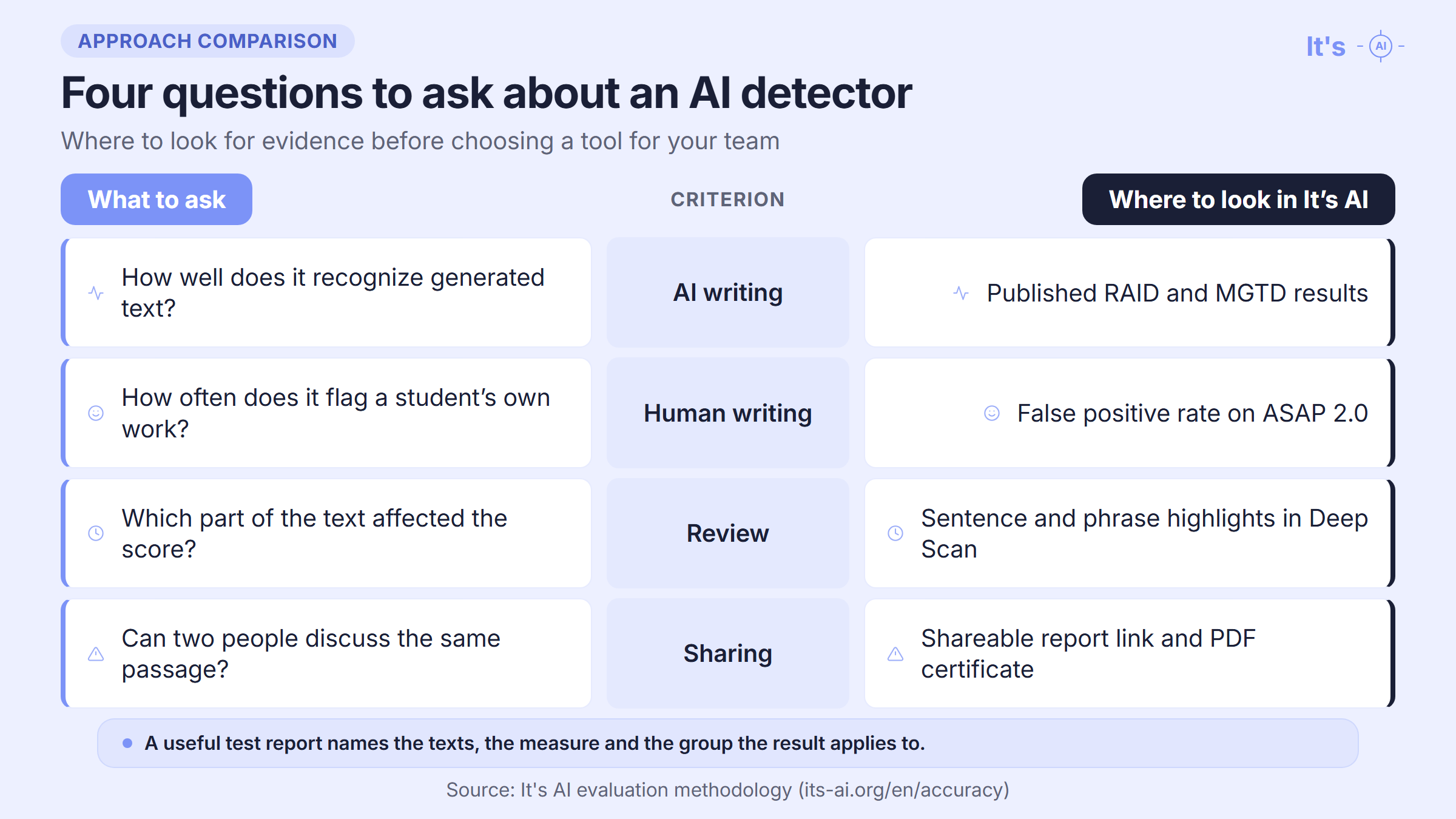
We publish separate results for AI detection and false positives. If you need to check drafts produced by different models, you can look at tests that cover a range of AI writing. If you teach writing, you can go straight to the evaluation on authentic student essays and see how often our detector flagged them.
How well does the detector recognize AI writing?
The researchers who built RAID collected writing from multiple language models across different subjects and varied how the models generated their responses. That variety matters because a detector may recognize the output of one model more readily than another. Our detector achieved 98.3% detection accuracy on RAID’s clean texts, before the deliberate modifications used in other parts of the benchmark.
A second evaluation, MGTD, brought together 15 datasets with about two million samples. It’s AI ranked first in that comparison. The researchers used a measure called ROC-AUC to assess how well each tool could tell human and AI writing apart over a range of detection thresholds. Our article on the MGTD results explains how the tools were compared.
For a closer look at what happens in a classroom, consider the assignment itself. Students writing about the same reading have good reason to use some of the same vocabulary. They may even choose the same evidence for their arguments. A collection of essays written under those conditions lets us measure how often a detector raises a flag when we already know the students did the writing.
How often does It’s AI flag a student’s own writing?
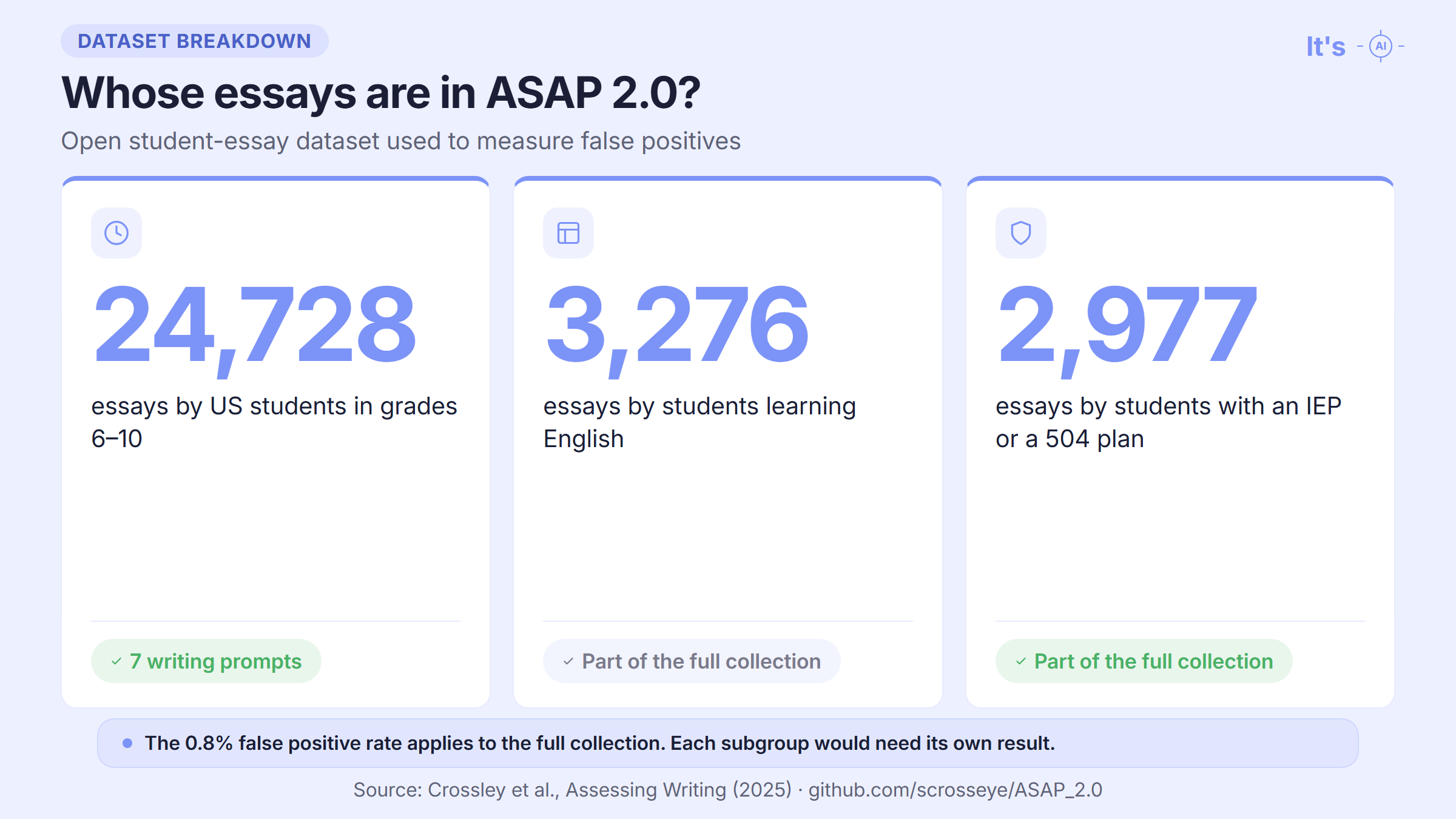
The ASAP 2.0 dataset contains essays that middle and high school students wrote in English in response to source-based assignments. It includes work by English language learners and students with individualized education programs. The researchers who assembled the dataset describe how the essays were collected and what information is available about their authors.
On ASAP 2.0, It’s AI recorded a false positive rate of 0.8%. That amounts to fewer than one false positive per hundred student essays on average. A teacher can see what that number covers, right down to the kind of assignment the students received.
We use separate collections of human writing to evaluate the other languages It’s AI supports. The published false positive rates are 0.48% for German, 0.56% for French, 0.72% for Spanish, and 0.89% for Arabic. An editor working in Spanish, for example, can consult a test on Spanish writing instead of relying on a figure from English essays.
What can you learn from a flagged passage?
Benchmarks help you choose a detector. Once an editor has an article in front of them, it helps to see which passage contributed to the result. In Deep Scan, the editor can see which sentences It’s AI marked and which words or phrases had the most influence on the assessment. Those show up in a deeper shade of red.
A familiar phrase might be exactly how the author would describe a familiar process. Elsewhere, the writer may have promised to explain a drop in sales and offered only a general comment about market conditions. In the second case, the editor has a useful question for the writer: what actually caused sales to fall? The highlight helped the editor choose where to look. Reading the argument revealed what was missing. We explore that distinction in our article on using an AI detector before publication.
In a classroom, it can help to read the marked passage alongside the original assignment. Is the student using terms from the assigned reading? Are some of the highlighted words part of a quotation? When a teacher sends a student the report link, they can both refer to the same passage. The teacher can also save a PDF certificate with the assignment.
What you can learn by checking your own work
For a quick trial, an editor could pull two pieces from their own files: a column they wrote for a magazine and the instructions they wrote for its contributors. Both have a known author. The column gives the editor room to write in their own voice, while the instructions call for fairly standard language. Check each one separately in Deep Scan. If a passage catches your eye, you have an advantage you rarely have with somebody else’s draft: you know why you wrote it that way. Even when both pieces come back clear, seeing what the report contains can help you decide whether it belongs in your review process.
You can try this with the free It’s AI plan. It includes three Deep Scans and a total allowance of 4,000 words, with room for up to 10,000 characters in any one scan. Two pieces give you a chance to read the results closely. For a figure you can use when choosing a detector for a whole department, refer back to the larger tests.
The next consideration is where the work arrives. It’s AI offers checks in Canvas for course submissions and a Chrome extension for text on a web page. A team receiving documents can upload files in batches. The API is an option for teams that already have their own system for handling drafts.
Questions about AI detector accuracy
Can an AI detector show me what changed between drafts?
A highlight tells you something about the sentence as it reads now. It might have appeared word for word in the first draft. To find out, open the earlier copy. This is especially useful when an author says they used AI for editing and you want to see how much of the wording changed.
How do I choose an AI essay checker for students learning English?
Look for a test that includes students learning English, then check which students the reported error rate covers. ASAP 2.0 includes essays by English language learners. Our figure of 0.8% applies to the full collection. To find out how often the checker flagged essays by English language learners in particular, you’d need the results for those essays alone.
What is a good false positive rate?
Below 1% is a useful target. When two tools meet it, the closest comparison comes from testing both on the same writing. A small difference between their published rates is hard to interpret if one was tested on college essays and the other on newspaper articles.
What if three AI detectors flag the same essay?
All seven tools in the TOEFL study flagged some of the same essays by mistake. For a teacher reviewing a disputed paper, that’s a reason to look beyond the scores. An outline can show where an argument began. An earlier draft can show how the student developed it. Either can add something you didn’t know after the first check.
Can I check one answer from a PDF or Word file?
Yes. Copy the student’s answer into It’s AI if that’s the passage you want to review. The minimum is 200 characters. It’s AI also accepts complete PDF, DOCX, and TXT files. With a worksheet, uploading the file means the checker will read the questions along with the answers.
Can Grammarly or a translation tool affect an AI detection result?
Yes. Correcting a spelling mistake changes very little of the original wording. A translation can change every sentence while preserving the author’s argument. The checker has only the version you give it, so its score can’t tell you what kind of help the writer used. Our article on Grammarly and AI detection in student work looks more closely at those differences.