How AI-Generated Applications Slow HR Teams: The Numbers
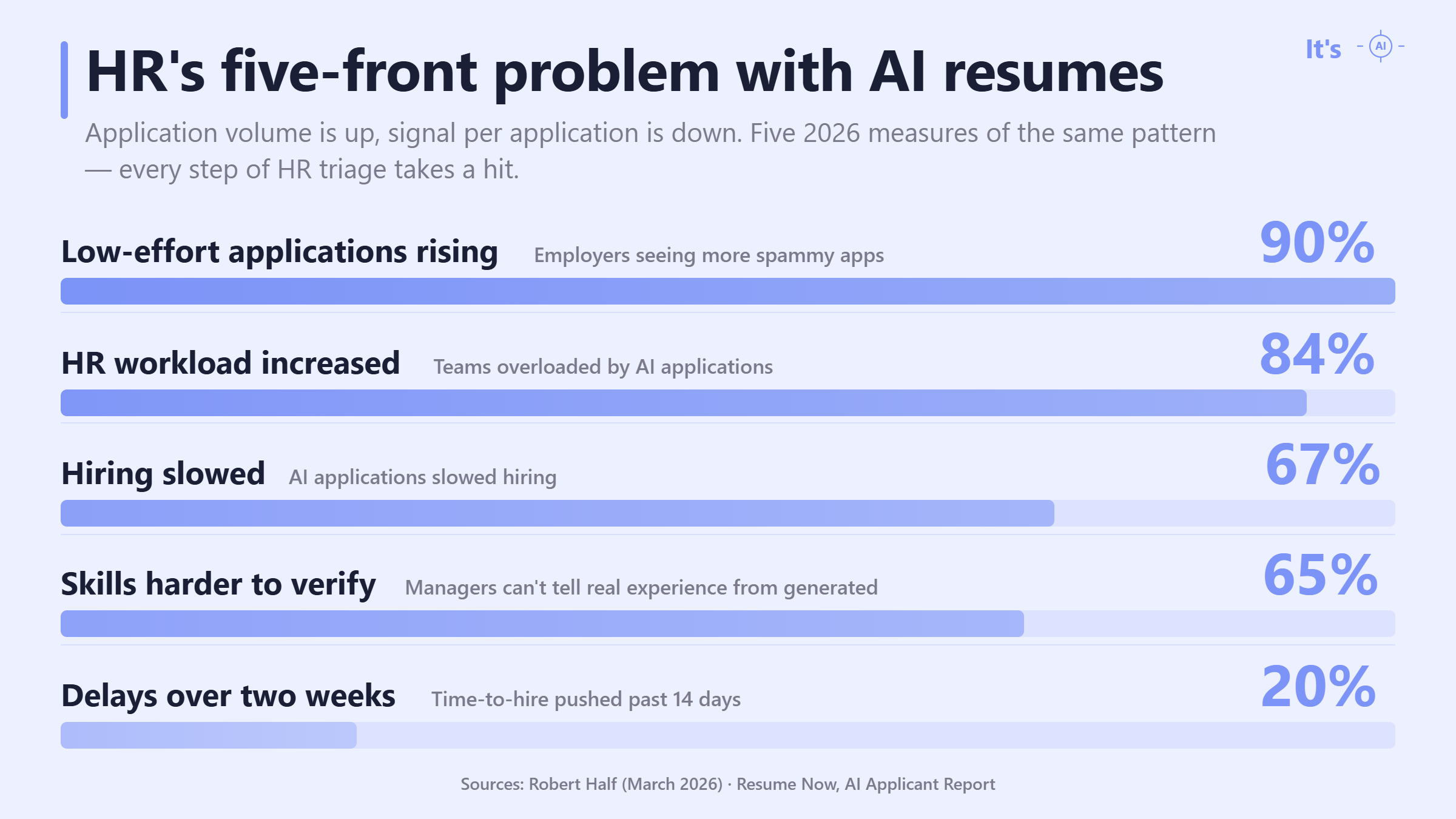
All of these numbers tell the same story. Application volume goes up, but useful information per application goes down. HR teams spend more hours reviewing and come away with less confidence in their candidates.
SHRM estimates that somewhere between 40 and 80 percent of job seekers now use AI for resumes, cover letters, or interview prep. That's a wide range, but even the low end means at least one in three applications has been through a generative model. At that scale, manual review becomes the bottleneck. A checker for AI-generated applications is no longer a nice-to-have. It's basic triage.
Was This Written by AI? Why Resumes Fall Apart in Interviews
An AI-written resume is optimized for the keywords in the job posting. It picks the right phrasing and slots in the right skills, all tuned to pass through an ATS filter. On paper, it checks out. But there's often no real experience behind it.
Robert Half specifically notes that generative tools in some cases fabricate or inflate work history and skills. This isn't cosmetic editing like fixing grammar. It's made-up projects, inflated titles, achievements that never happened. A hiring manager reads about leading a cross-functional team and saving two million in budget, then the candidate can't explain any of it in the interview.
There's another side to this. In the San Francisco Bay Area, 72% of recruiters said the main reason hiring has slowed is that AI-generated resumes look nearly identical to each other. When dozens of candidates send what is essentially the same document with minor variations, the resume stops doing its job. It no longer tells one person apart from another. Asking "is this AI-written?" of any single resume gives the same useless answer: probably.
Jamie Kohn at Gartner put it well: if every applicant uses ChatGPT to tailor their resume to the job description, employers end up with a pile of identical documents. And Ben Eubanks from Lighthouse Research added at SHRM: there is no future where candidates using AI to beat AI produces a better outcome for hiring.
AI Content Checker: Where Today's HR Tools Fall Short
According to Resume Now, 78% of companies started actively checking applications for AI-generated content in 2025. Over half of employers (62%) reject resumes that show no sign of personalization. Nearly as many (53%) are frustrated by templated messages with no connection to the specific role.
Recruiters have learned to spot signs of AI text. Unnatural phrasing and repetitive structure are the easiest. Vague descriptions of experience and buzzword overload come next. The Resume Genius 2026 Hiring Insights Report found that 80% of managers believe they can recognize an AI-written resume. But those "how to tell if something is written by AI" instincts get smoothed over by better prompts.
| What companies do now |
Where it falls short |
| Manual review for AI signs |
Subjective, relies on the individual recruiter's judgment. Doesn't scale. |
| Extra interview rounds to verify skills |
Increases time-to-hire and team workload. |
| Rejecting resumes without personalization |
Filters out lazy applicants but misses high-quality AI fabrications. |
| ATS filters with AI screening |
Screen by keywords but can't distinguish AI-generated text from human-written. |
Sources: Resume Now, Resume Genius 2026 Hiring Insights Report.
Most companies are responding, but each of these methods only covers part of the problem. Manual checks depend on one person's eye. Additional interviews stretch the process even further. ATS systems handle volume but can't tell human-written text from machine-generated text. There's no off-the-shelf "written by AI" checker built into the recruiting stack today, and a resume plagiarism checker won't help either — copy-pasted experience is rarely the problem. Fabricated experience is.
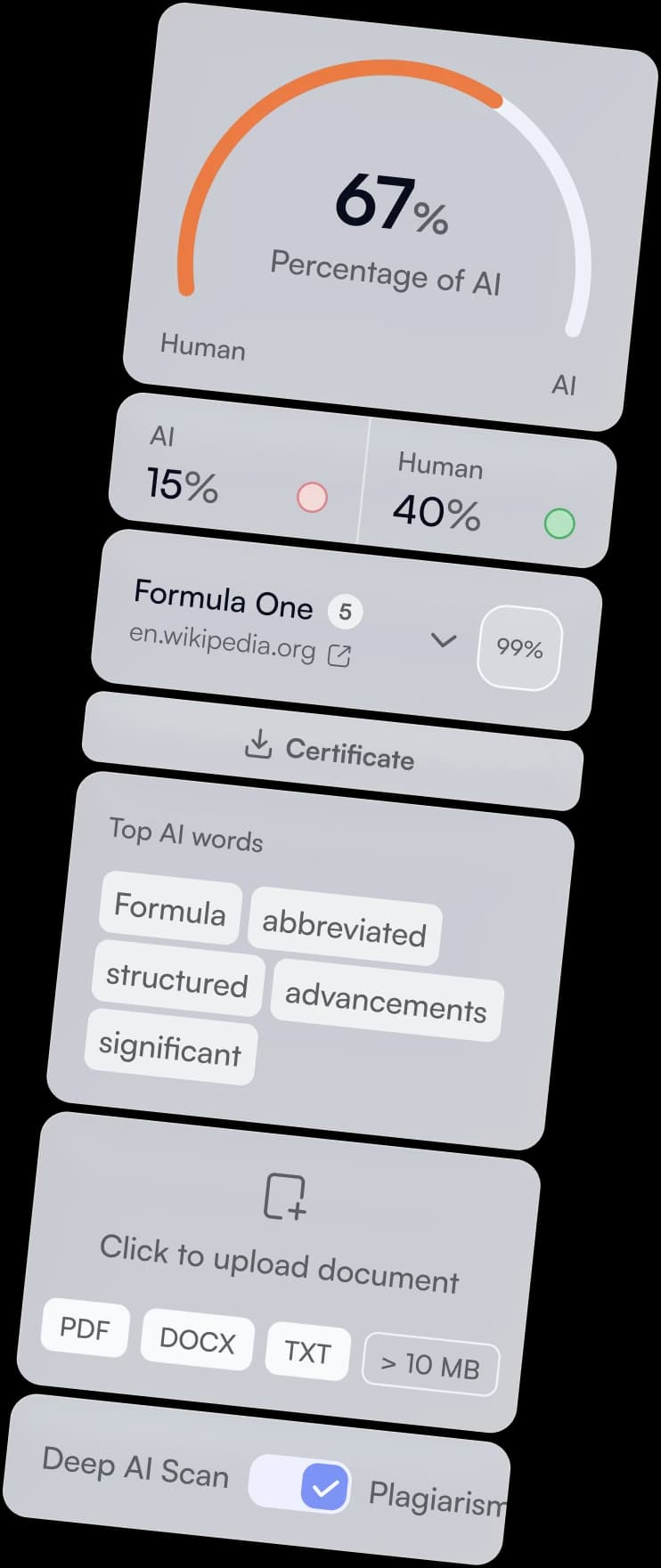
That's the gap an AI content detector fills. The It's AI detector checks a document before the recruiter starts spending time on it. Not instead of an interview. Not instead of a skills assessment. As a first-pass filter: separate human-written applications from generated templates. If a detector keeps a recruiter from burning three interview rounds on a candidate whose experience was invented by a neural network, that's a direct saving of time and budget.
The Resume Format Is Failing as a Hiring Signal
Historian Stephen Mihm, writing for Bloomberg, pointed out that the resume was never designed as a self-promotion tool. In the 1920s it was invented as a "data sheet," a dry list of facts about the candidate meant to counterbalance flowery cover letters. Almost immediately, candidates started using it for the opposite purpose: embellishing, tailoring, padding. By the 1960s, padding was normal. By the 1990s, there was an entire industry of professional resume writers.
AI didn't break the format. It pushed a hundred-year-old trend to its logical end. When anyone can get a perfectly structured document in three minutes, the resume's ability to differentiate candidates drops to near zero.
The market is already responding. According to the Willo Hiring Trends Report for 2026, fewer than 40% of employers consider resumes a reliable indicator of candidate competence. Over 40% are actively moving away from resume-first hiring toward skills tests and behavioral interviews. Gartner predicts that by 2028, one in four candidate profiles worldwide will be fake.
But while that transition plays out, companies still accept resumes. And as long as that's the case, the question stays the same: how do you check if something was written by AI before the calendar fills up with interviews?
Resume AI Detector: How It Fits Into the Hiring Process
79% of employers in the Resume Now survey believe companies need formal guidelines around AI use in applications. Guidelines require enforcement tools. An AI text detector is one of those tools.
A recruiter gets a stack of applications. Instead of reading through each one by hand to detect AI-generated text by eye, they run the batch through the It's AI detector. The output is one thing: an AI-written check at intake — high likelihood, or low. Applications flagged high go into a separate pool for further review or a request to verify skills. Applications flagged low move down the funnel.
This doesn't replace human judgment. It removes the most routine step: detecting AI writing across dozens of resumes by hand. According to Robert Half, 84% of HR teams are overloaded specifically because of the increased volume of review. A detector takes some of that load off at the front door, not at the third round of interviews when the time has already been spent.
FAQ
Q1: Should you opt out of AI resume screening?
You can't really opt out — companies decide whether they screen for AI use, not candidates. The honest move is to read each company's policy before applying. Some roles allow AI-assisted polish (grammar, formatting, phrasing) but reject AI-fabricated experience. Others ban AI use in applications outright. If you're not sure, write the resume yourself and use AI only for editing finished text, not generating it. The detectors HR teams run flag statistical patterns regardless of intent. A clean human-written resume passes those checks even if you used a spell-checker that has AI under the hood.
Q2: What's the most accurate AI detector for screening resumes?
Accuracy depends on the text type and which model produced the resume. Detectors trained on long-form essays often miss short formal documents like resumes. Hybrid cases — human structure with AI-written bullet points — are the hardest. For HR use, recall matters more than precision: catching fabricated experience is worth a few false positives that get cleared at interview. Paragraph-level scoring beats single-document scoring because it tells the recruiter which section looks generated, not just "this document is 60% AI." The It's AI detector reports per-paragraph confidence, which is what most HR workflows actually need.
Q3: Is there a free AI detector for resume screening?
Yes, most major detectors offer free tiers, usually capped by monthly word count or document count. The trade-off sits in feature access: batch upload, API connection, paragraph-level reporting, and integration with applicant tracking systems typically require a paid plan. For an HR team running 50-100 resumes a month, free tiers cover the volume. Once detection becomes a standard intake step, the constraint shifts from cost to throughput and reporting. Test a free version on your actual pipeline before paying — that's the only way to know if accuracy holds on your specific candidate pool.
Q4: How do you detect AI-written text in a resume?
Two signals are most reliable: pasted-in templates and generic accomplishments with no verifiable numbers. Manual review catches both at low scale; detector tools catch them faster and add a probability score. For resumes specifically, watch identical bullet structure across unrelated jobs — AI tends to repeat phrasing patterns. Also watch for cover letters in a different voice than the resume, which often means one was AI-generated and the other wasn't. A detector flags the statistical patterns at intake. The recruiter applies judgment to the flags. Neither replaces the interview — they just decide which interviews are worth scheduling.