What the EU AI Act requires for AI content labeling
The requirements themselves come from Article 50 of the AI Act and are mandatory from 2 August 2026. The Code published on 10 June is voluntary: companies that sign it can use it as proof of compliance with the law, and those that go their own way will have to prove the adequacy of their measures to regulators separately.
Inside, the Code is split into two parts by type of participant:
| Who |
What the Code requires |
| Model providers |
Mark output (text, image, audio, video) with a machine-readable tag and make it detectable as AI-generated |
| Deployers — publishers and platforms |
Label deepfakes and AI text on matters of public interest |
For the visible label the EU even released an official set of icons, so the label looks the same across different platforms. Put together, labeling has two layers: a machine one, for platforms and systems, and a visible one, for people. And there are two details that usually get lost in the news headlines.
Where AI labeling rules stop: the editorial exception
The first detail concerns providers. The machine mark is required not unconditionally but "as far as is technically feasible." That is, even the authors of the rules assume machine marking has a technical limit to its reliability, and they write that right into the wording.
The second detail is more important, and it's directly about editorial teams. AI text on matters of public interest doesn't have to be labeled if it has gone through human review and is published under editorial responsibility. Read that again: the regulator itself takes editorially reviewed material out from under the mandatory label. In essence it says the same thing any editor-in-chief would say: the person who reviewed and published the text is responsible for it.
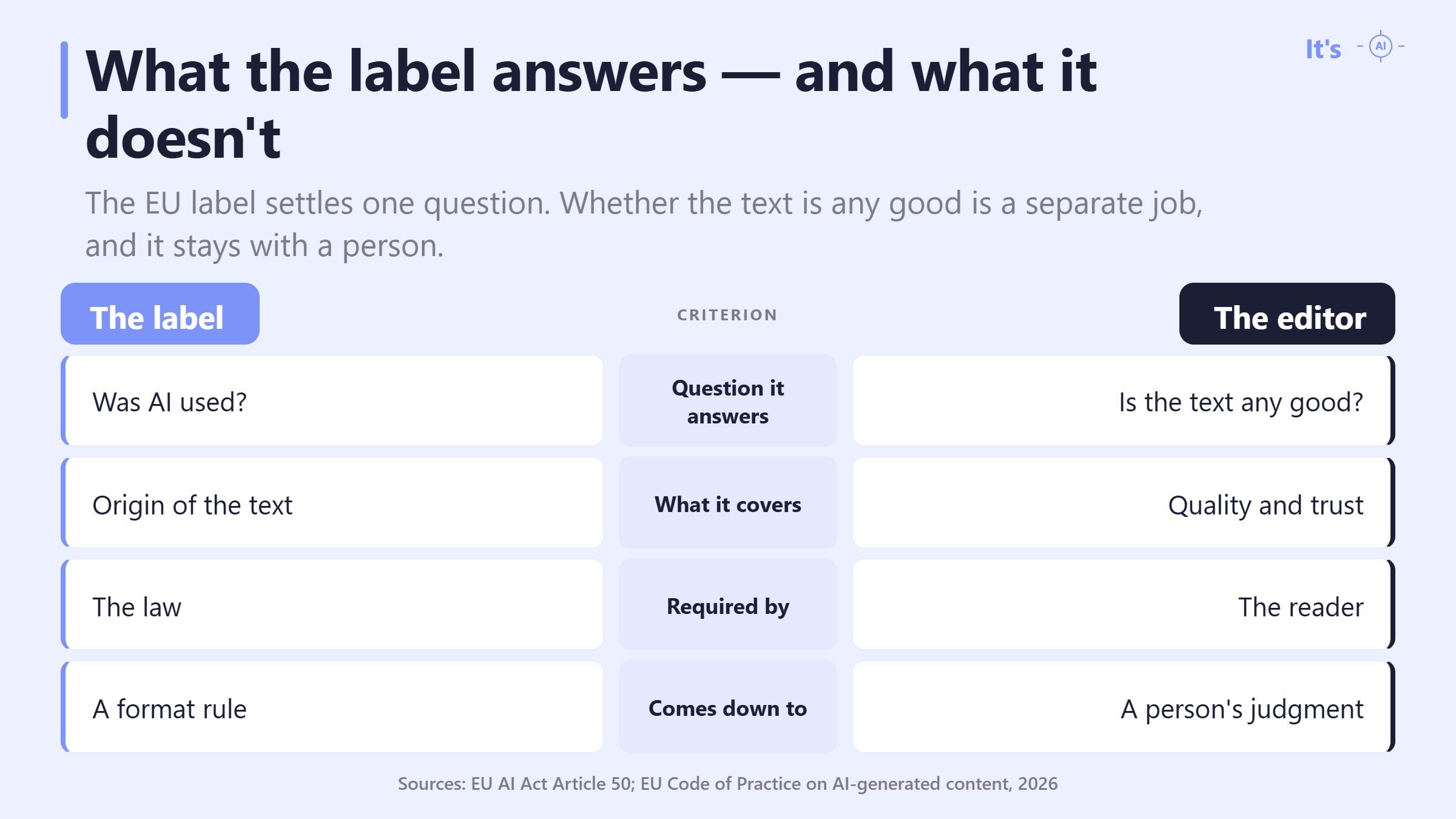
So the label answers one thing — who wrote it. Whether you should trust it is a separate question.
Why an AI label doesn't make a text more trustworthy
The question is simple: if you honestly warn the reader that AI wrote the text, does the text become less convincing? Intuition says yes — a person should grow more cautious and trust it less. That is what was tested.
Gallegos and colleagues (PNAS Nexus, 2026) took convincing argument texts on contested public issues and showed them to 1,601 Americans. The same text was shown with a different authorship label:
- "written by AI,"
- "written by a human expert,"
- no label at all.
Only the label changed; the text itself was the same. After reading, they measured how much the person's view on the topic moved.
The arguments did persuade: on average they moved opinion by about 9.74 points on a 100-point scale. But the label had no effect on this — the "written by AI" version worked exactly the same as "human expert" and as no label. And people believed the label: 92% took it as true, so it wasn't that they skipped past it. They believed AI wrote the text and were persuaded just the same. What also didn't change was how accurate people found the text and how willing they were to share it.
It comes down to one thing: the "AI" label honestly reports origin, but it doesn't make the reader more cautious and doesn't reduce the text's effect. There's transparency, but no protection from persuasion.
What to do before the AI labeling rules hit in August
You'll have to apply the label either way — that's what the law requires. Joining the Code (its full name is the Code of Practice on transparency of AI-generated content) is voluntary, so the first thing to decide is whether you'll sign up. If you do, read the terms and submit the form — the form and instructions are on the European Commission's site. For signatories it makes proving compliance easier.
But the main thing to remember is something else. Labels don't make a text special. An article or a post won't work any better or any worse just because it carries a label or doesn't. Content gets results when it's made by a professional. And an AI detector like It's AI is one more tool worth keeping in the pocket of anyone who wants to publish quality text and get results.
FAQ: AI text labeling under the EU AI Act
When do the EU AI Act labeling rules take effect?
The EU AI Act's transparency rules for AI content take effect on 2 August 2026, under Article 50. From that date, deployers must label AI text on matters of public interest, and providers must mark AI-generated output in a machine-readable format so it stays detectable as AI. The EU's Code of Practice, published on 10 June 2026, explains how to meet these obligations in practice. The rules reach any provider or deployer serving EU users, whatever the modality — text, image, audio, or video.
Is the EU Code of Practice on AI-generated content mandatory or voluntary?
The Code of Practice on AI-generated content is voluntary; the Article 50 obligations it supports are mandatory. Signing the Code lets a provider or deployer use it as evidence that they comply with the law. A company that opts out still has to meet Article 50, but it must prove the adequacy of its own measures to regulators separately. So the question is not whether to label AI content, but whether to follow the Code's route to proving compliance or document your own.
Who has to label AI-generated content under the EU AI Act?
Under the EU AI Act, two parties must act: model providers and deployers (publishers and platforms). Providers mark AI-generated output in a machine-readable format, so the content stays detectable as AI. Deployers add the visible AI disclosure people actually see: they label deepfakes and AI text on matters of public interest, using the EU's official icon set so the label looks the same across platforms. In short, marking is the provider's machine-readable tag inside the file; labeling is the deployer's human-visible signal on the page.
What counts as "synthetic content" under the EU AI Act?
"Synthetic content" is any text, image, audio, or video generated or manipulated by AI. Under Article 50, providers must mark such output in a machine-readable format so it stays detectable as AI-generated, applied as far as is technically feasible. The visible-label duty is narrower: deployers label deepfakes and AI text published on matters of public interest, not every AI-assisted file. So the marking obligation covers synthetic content broadly, while the human-visible AI label is reserved for content that could mislead the public.
What does "AI text on matters of public interest" mean?
"AI text on matters of public interest" is AI-generated text published to inform the public on issues of public concern. Under Article 50, this is the category the EU AI Act singles out for a visible AI disclosure, and the duty falls on deployers: the publishers and platforms that put the text in front of readers. It does not cover private or internal AI-assisted writing, only public-interest publications. The wording matters, because it draws the boundary of where the visible AI label is actually required.